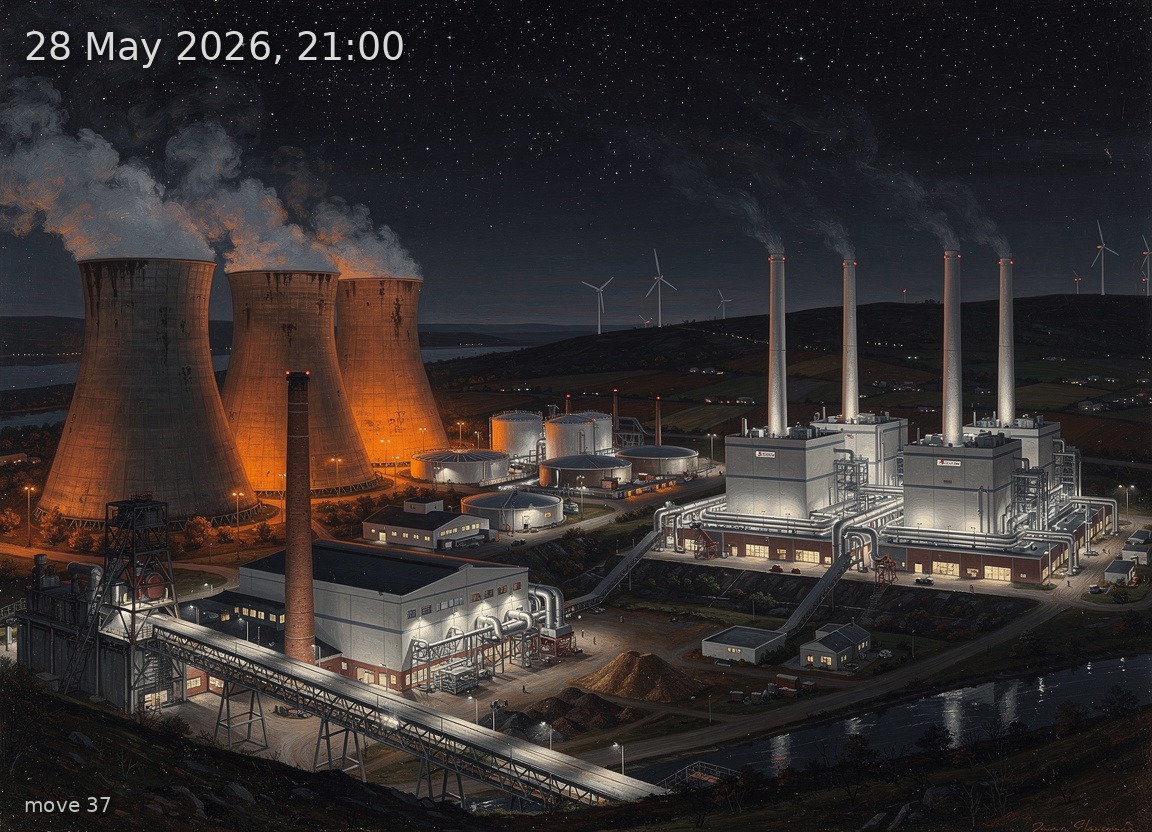
Gas and brown coal dominate scarce domestic generation as Germany imports 26.5 GW to meet strong evening demand.
Back
Generation mix
Wind onshore 8%
Wind offshore 2%
Solar 0%
Biomass 17%
Hydro 7%
Natural gas 28%
Hard coal 11%
Brown coal 27%
34%
Renewable share
2.6 GW
Wind (on + offshore)
0.1 GW
Solar
25.5 GW
Total generation
-26.5 GW
Net import
368.0 €/MWh
Day-ahead price
18.8°C / 8 km/h
Temp / Wind speed
Open-Meteo, Kassel (51.3°N 9.5°E)
0.0% / 24.0 W/m²
Cloud cover / Radiation
438
gCO₂/kWh
Records
#2
The Spike
Image prompt
Natural gas 7.2 GW dominates the centre-right as a cluster of compact CCGT power stations with tall single exhaust stacks venting pale heat shimmer into the night; brown coal 6.8 GW fills the centre-left as massive hyperbolic cooling towers with thick white-grey steam plumes rising into darkness, lit from below by orange sodium floodlights; biomass 4.2 GW appears in the middle distance as a collection of industrial biogas and wood-chip combustion facilities with squat chimneys and warm amber-lit buildings; hard coal 2.7 GW sits further left as a smaller conventional power station with a single tall brick chimney and coal conveyors illuminated by work lights; wind onshore 2.0 GW is represented by a few three-blade turbines on a distant ridge, their red aviation warning lights blinking faintly; wind offshore 0.6 GW is suggested by tiny red lights on the far horizon line over a dark sea; hydro 1.8 GW appears as a concrete dam structure in a valley at far right, with water cascading under spotlights; solar 0.1 GW is absent from the scene — no panels visible. The sky is completely dark, deep navy-black, with a perfectly clear canopy of stars overhead — zero cloud cover. The landscape is a broad central German river valley with lush late-spring vegetation — full leafy trees and tall green grass visible in pools of artificial light. The air feels heavy and oppressive despite the clear sky, conveying the extreme 368 EUR/MWh price — a faint amber-brown industrial haze clings low to the ground around the thermal plants, sodium streetlights cast harsh orange cones along access roads, and high-voltage transmission towers with sagging lines stretch toward the horizon in every direction, emphasising the massive import flows. Painted in the style of a highly detailed 19th-century German Romantic oil painting — rich, deep colours, visible impasto brushwork, dramatic chiaroscuro between the black sky and the fiery industrial glow, atmospheric depth receding into darkness, meticulous engineering detail on every turbine nacelle, cooling tower, and exhaust stack. No text, no labels.