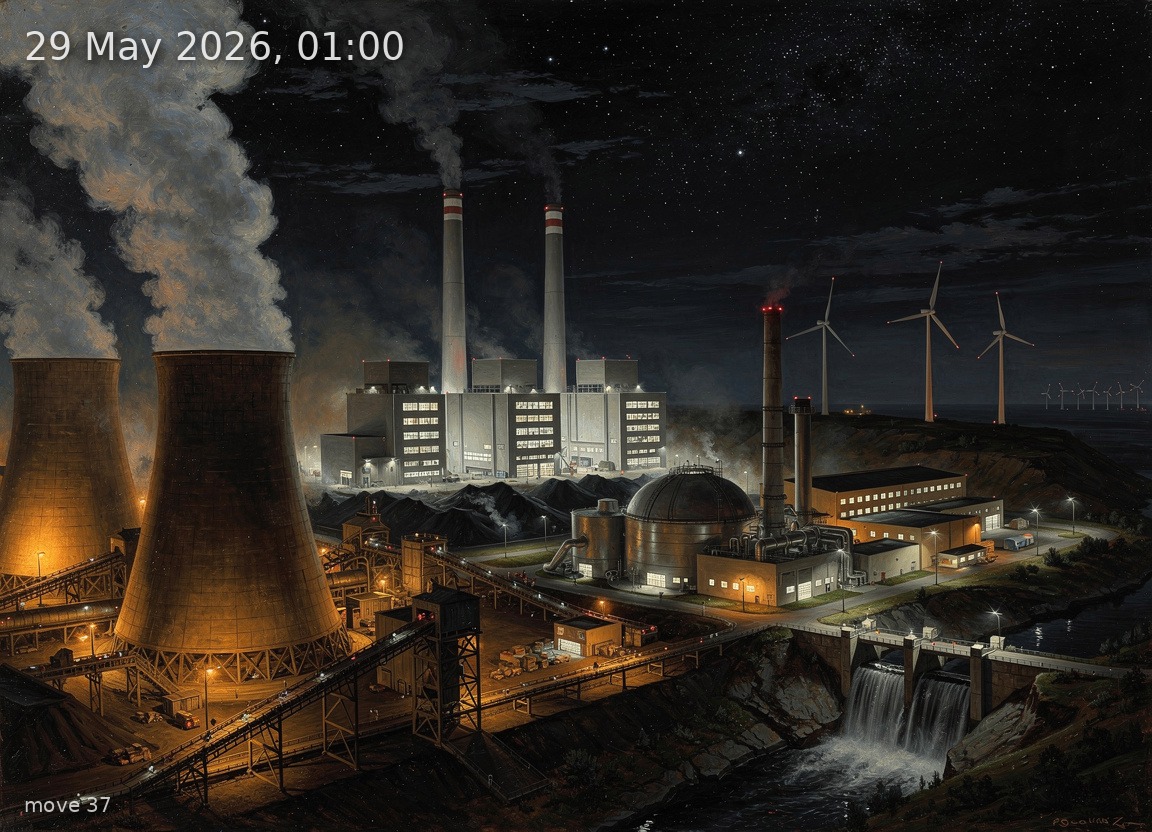
Brown coal and gas dominate overnight generation while 16.3 GW of net imports cover a wide supply gap under calm, clear skies.
Back
Generation mix
Wind onshore 9%
Wind offshore 6%
Biomass 14%
Hydro 7%
Natural gas 25%
Hard coal 11%
Brown coal 29%
35%
Renewable share
3.9 GW
Wind (on + offshore)
0.0 GW
Solar
26.9 GW
Total generation
-16.3 GW
Net import
133.9 €/MWh
Day-ahead price
14.2°C / 2 km/h
Temp / Wind speed
Open-Meteo, Kassel (51.3°N 9.5°E)
3.0% / 0.0 W/m²
Cloud cover / Radiation
440
gCO₂/kWh
Image prompt
Brown coal 7.7 GW dominates the left third of the scene as a cluster of massive hyperbolic cooling towers with thick white-grey steam plumes rising into the black night sky, lit from below by orange sodium lamps illuminating the lignite plant's conveyor belts and boiler houses; natural gas 6.7 GW fills the centre-left as three compact CCGT power blocks with tall single exhaust stacks emitting thin translucent plumes, their turbine halls glowing with interior fluorescent light spilling through windows; biomass 3.9 GW appears centre-right as a mid-sized industrial facility with a domed digester and a modest smokestack, warm amber light from its operational yard; hard coal 2.9 GW sits behind the gas plant as a traditional coal-fired station with a single large rectangular cooling tower and coal stockpiles faintly visible under floodlights; wind onshore 2.4 GW is represented by three widely spaced three-blade turbines on a distant low ridge to the far right, their red aviation warning lights blinking, rotors nearly still in the calm air; wind offshore 1.5 GW suggested by a tiny cluster of turbine silhouettes on the far-right horizon; hydro 1.8 GW appears as a small dam structure in the mid-ground right with a thin cascade of water catching artificial light. The sky is completely black to deep navy, no twilight or sky glow, filled with brilliant stars visible through the 3% cloud cover — a nearly perfectly clear late-spring night. The atmosphere feels heavy and oppressive despite the clear sky, with the industrial haze from thermal plants creating a faint yellowish pall around the sodium-lit facilities, reflecting the high 133.9 EUR/MWh price tension. Lush late-May vegetation — deciduous trees in full leaf, green meadow grass — is barely discernible in the periphery, touched only by stray lamplight, suggesting mild 14°C spring conditions. Foreground shows a quiet two-lane road with faint wet sheen. Rendered as a highly detailed oil painting in the tradition of 19th-century German Romantic landscape painters — rich impasto brushwork, deep chiaroscuro contrasts between the black sky and the fiery industrial glow, atmospheric depth receding into darkness, meticulous engineering accuracy on every cooling tower, turbine nacelle, and exhaust stack. No text, no labels.