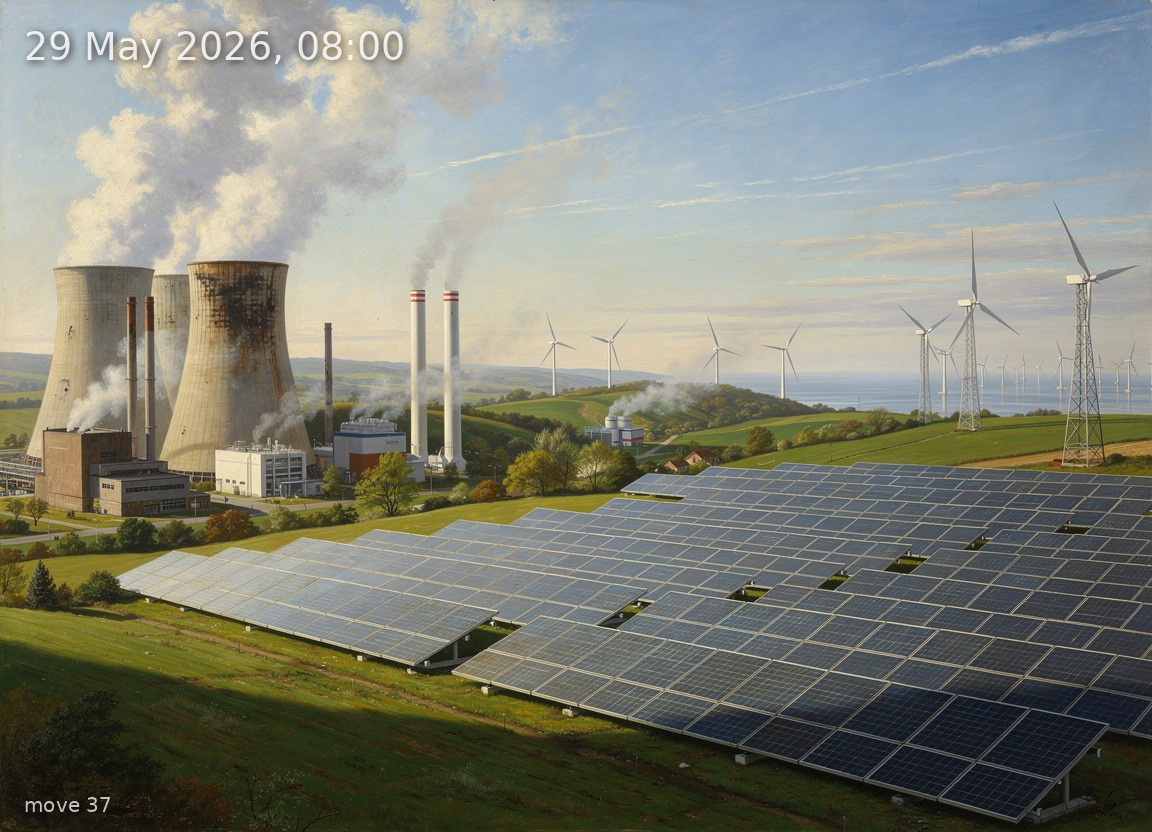
Solar leads at 26.2 GW under clear skies; brown coal and gas provide baseload as net imports cover a 2.3 GW shortfall.
Back
Generation mix
Wind onshore 7%
Wind offshore 7%
Solar 47%
Biomass 8%
Hydro 3%
Natural gas 10%
Hard coal 5%
Brown coal 13%
72%
Renewable share
7.8 GW
Wind (on + offshore)
26.2 GW
Solar
55.5 GW
Total generation
-2.3 GW
Net import
113.6 €/MWh
Day-ahead price
11.4°C / 7 km/h
Temp / Wind speed
Open-Meteo, Kassel (51.3°N 9.5°E)
16.0% / 130.0 W/m²
Cloud cover / Radiation
194
gCO₂/kWh
Image prompt
Solar 26.2 GW dominates the centre and right as vast fields of aluminium-framed crystalline silicon photovoltaic panels glinting under bright morning sun, stretching across green rolling farmland occupying roughly half the canvas. Brown coal 7.4 GW occupies the far left as a cluster of massive hyperbolic cooling towers with thick white-grey steam plumes rising against the sky. Natural gas 5.4 GW appears as two compact CCGT power stations with tall slender exhaust stacks and thin heat shimmer, positioned left of centre. Biomass 4.2 GW is rendered as a modest wood-clad combined heat and power plant with a short cylindrical smokestack emitting faint wisps, nestled among trees in the middle distance. Wind offshore 4.2 GW is visible as a line of large three-blade turbines on lattice-and-tubular towers rising from a hazy sea horizon at the far right edge. Wind onshore 3.7 GW appears as a smaller cluster of three-blade turbines on tubular towers standing on gentle hills behind the solar fields. Hard coal 2.7 GW is a single compact power station with a rectangular block boiler house and two chimneys releasing light grey smoke, visible beside the brown coal plant. Hydro 1.8 GW is suggested by a small concrete dam and reservoir glinting in a valley in the distant background. The time is 08:00 on a late-May morning: full early-morning daylight with the sun low in the east casting long warm shadows across the landscape, sky mostly clear with only thin wisps of high cirrus (16% cloud cover), pale blue above deepening toward the zenith. Spring foliage is lush and bright green, wildflowers dot meadow edges, temperature feels cool at 11°C with faint morning mist lingering in hollows. The atmosphere carries a slightly heavy, hazy quality reflecting the elevated electricity price — a subtle golden-brown tinge near the horizon where industrial emissions diffuse into the morning light. Style: highly detailed oil painting in the tradition of 19th-century German Romantic landscape masters such as Caspar David Friedrich and Carl Blechen, with rich colour, visible impasto brushwork, dramatic atmospheric depth, luminous sky treatment, and meticulous engineering accuracy for every power technology depicted. No text, no labels.