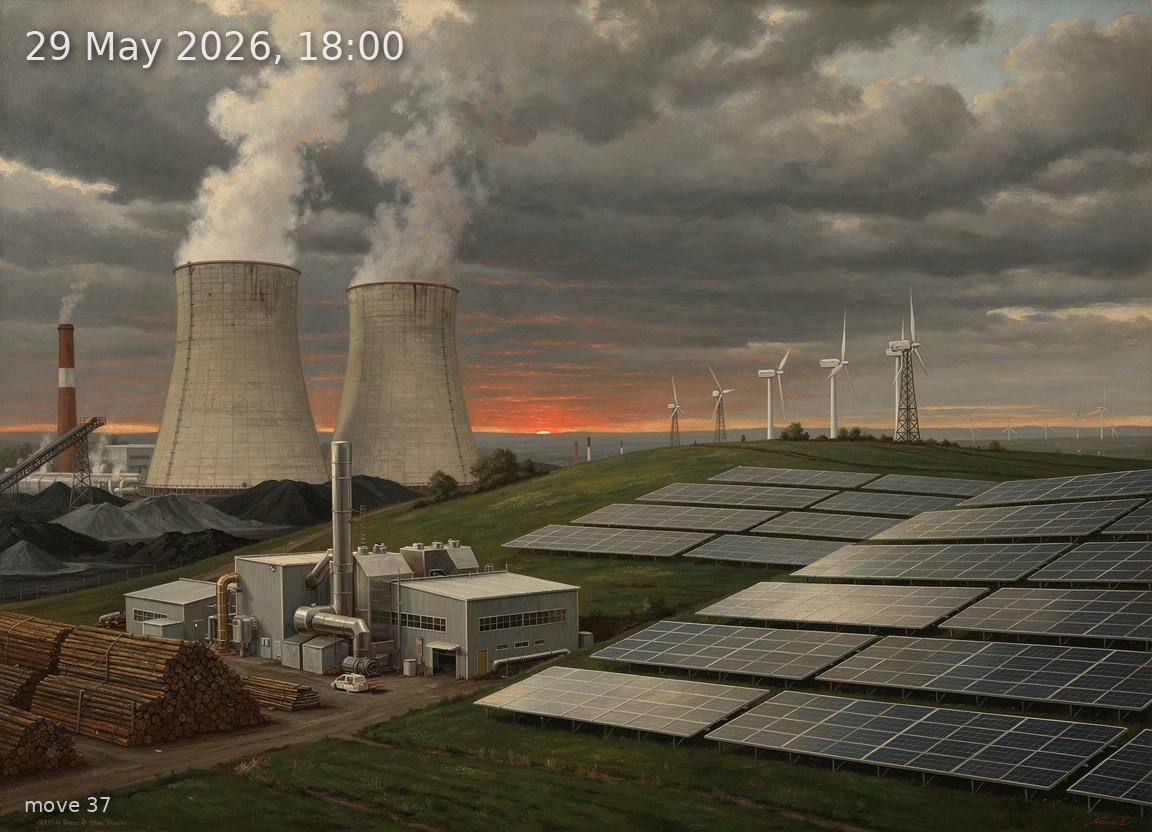
Solar leads at 16 GW with brown coal backup at 6.4 GW; large net imports cover a 16.6 GW generation gap.
Back
Generation mix
Wind onshore 15%
Wind offshore 3%
Solar 42%
Biomass 10%
Hydro 4%
Natural gas 7%
Hard coal 3%
Brown coal 17%
73%
Renewable share
6.6 GW
Wind (on + offshore)
16.0 GW
Solar
38.6 GW
Total generation
-16.6 GW
Net import
137.0 €/MWh
Day-ahead price
28.4°C / 11 km/h
Temp / Wind speed
Open-Meteo, Kassel (51.3°N 9.5°E)
100.0% / 378.0 W/m²
Cloud cover / Radiation
194
gCO₂/kWh
Image prompt
Solar 16.0 GW dominates the right half of the canvas as vast fields of aluminium-framed crystalline silicon PV panels stretching across gentle green farmland, angled toward an overcast sky. Brown coal 6.4 GW occupies the left quarter as three massive hyperbolic cooling towers with thick white steam plumes rising into heavy clouds, beside a conveyor-fed lignite stockpile. Wind onshore 5.6 GW appears as a line of dozen three-blade turbines on lattice and tubular towers across a low ridge in the centre-right, blades turning slowly in light breeze. Biomass 3.9 GW is rendered as a mid-sized industrial plant with a tall stack and adjacent timber storage yard in the centre-left foreground. Natural gas 2.8 GW shows as a compact CCGT facility with a single polished exhaust stack emitting a thin heat shimmer, positioned between the biomass plant and the cooling towers. Hydro 1.7 GW appears as a small concrete dam with spillway in the far left background, nestled in a wooded valley. Wind offshore 1.0 GW is hinted at by a few distant turbines visible on a hazy horizon line far right. Hard coal 1.1 GW is a single smaller smokestack with a wisp of grey exhaust beside the brown coal complex. Time is 18:00 late May dusk: the sky is entirely overcast with thick stratiform clouds, but the lower western horizon shows a warm orange-red glow of rapidly fading sunset light filtering through the cloud base, casting long amber reflections on the PV panel surfaces. The upper sky darkens to slate grey. Temperature is hot — 28.4 °C — so vegetation is lush, deep green, and slightly wilted; the air feels heavy and humid, rendered as atmospheric haze softening distant objects. The oppressive atmosphere reflects the high electricity price: the clouds press low, the air is thick and stifling, steam from the cooling towers merges seamlessly with the overcast. Style: highly detailed oil painting in the tradition of 19th-century German Romantic landscape painters — Caspar David Friedrich meets industrial sublime — rich colour palette of ochre, warm grey, deep green, and amber, visible confident brushwork, strong atmospheric depth and chiaroscuro, meticulous engineering detail on every turbine nacelle, panel frame, and cooling tower shell. No text, no labels.