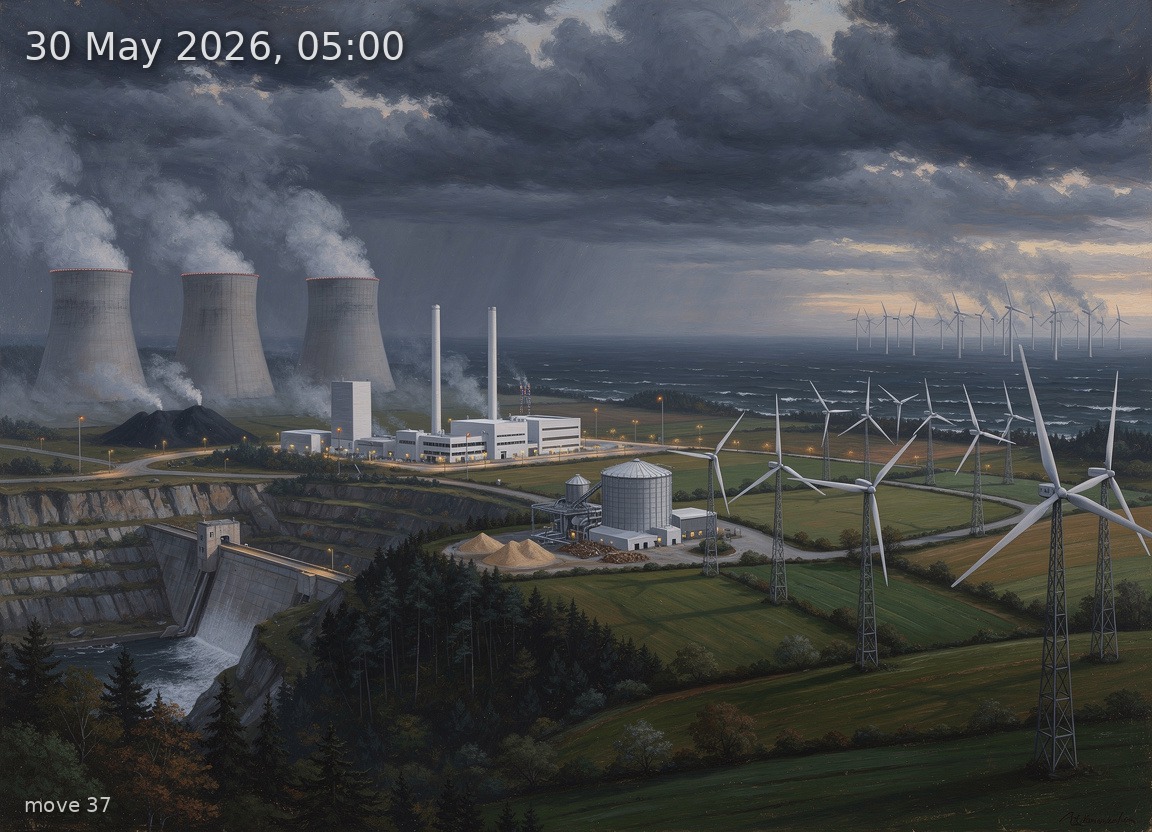
Wind and brown coal anchor a pre-dawn grid importing 8.7 GW under heavy cloud at elevated prices.
Back
Generation mix
Wind onshore 28%
Wind offshore 9%
Solar 2%
Biomass 12%
Hydro 5%
Natural gas 15%
Hard coal 8%
Brown coal 21%
56%
Renewable share
12.1 GW
Wind (on + offshore)
0.5 GW
Solar
32.2 GW
Total generation
-8.7 GW
Net import
125.0 €/MWh
Day-ahead price
15.4°C / 7 km/h
Temp / Wind speed
Open-Meteo, Kassel (51.3°N 9.5°E)
94.0% / 0.0 W/m²
Cloud cover / Radiation
303
gCO₂/kWh
Image prompt
Wind onshore 9.1 GW dominates the right third of the composition as long rows of three-blade turbines on lattice towers stretching across rolling green farmland, rotors turning slowly in light wind; wind offshore 3.0 GW appears as a distant cluster of turbines on the far-right horizon over a dark sea. Brown coal 6.7 GW occupies the left quarter as massive hyperbolic cooling towers emitting thick white steam plumes, with conveyor belts and open-pit mine edges visible at ground level. Natural gas 4.9 GW fills the centre-left as a compact CCGT power station with tall slender exhaust stacks venting thin vapour. Biomass 3.8 GW appears as a mid-sized industrial plant with a cylindrical silo and wood-chip storage yard in the centre. Hard coal 2.5 GW is rendered as a smaller conventional power station with a single square chimney and coal stockpile, positioned between the brown coal towers and the gas plant. Hydro 1.7 GW appears as a concrete dam and spillway nestled in a forested valley in the mid-ground left. Solar 0.5 GW is barely suggested by a small cluster of dark, unlit aluminium-framed crystalline PV panels on a nearby rooftop, receiving no sunlight. The sky is deep blue-grey pre-dawn, 05:00 in late May — the first faint pale luminescence appears along the eastern horizon but no direct sunlight breaks through; 94% cloud cover creates a thick, heavy, oppressive overcast ceiling pressing down on the scene, reinforcing the high-price atmosphere. The landscape is lush late-spring green, temperature around 15°C, with dew-covered grass and mist hugging the valleys. Sodium streetlights cast amber pools along a winding road. The mood is weighty and industrial. Rendered as a highly detailed oil painting in the tradition of 19th-century German Romantic landscape painters — Caspar David Friedrich meets industrial sublime — rich dark colour palette of navy, slate grey, amber, and forest green, visible impasto brushwork, atmospheric depth with layered fog and steam, meticulous engineering detail on every turbine nacelle, cooling tower, and exhaust stack. No text, no labels.