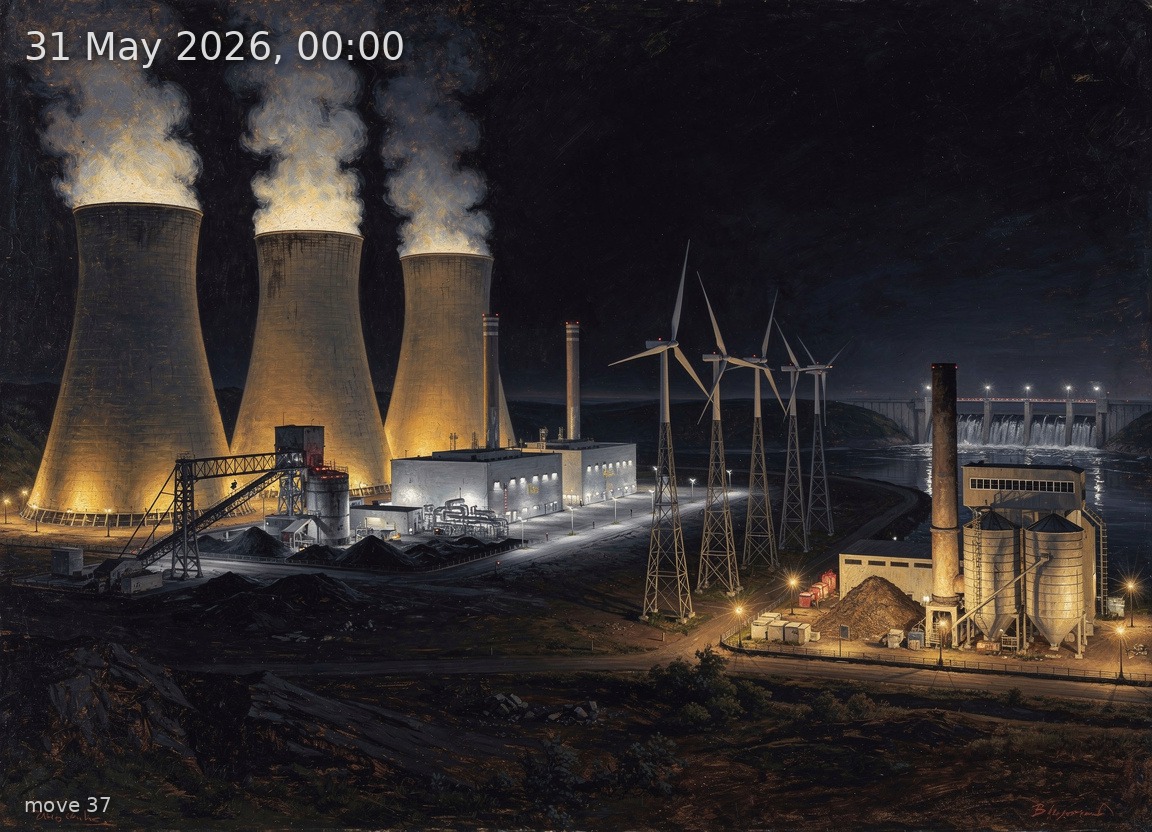
Brown coal and gas anchor overnight generation while low wind and zero solar drive heavy net imports and elevated prices.
Back
Generation mix
Wind onshore 21%
Wind offshore 3%
Biomass 16%
Hydro 7%
Natural gas 17%
Hard coal 10%
Brown coal 26%
46%
Renewable share
5.6 GW
Wind (on + offshore)
0.0 GW
Solar
24.2 GW
Total generation
-16.7 GW
Net import
136.4 €/MWh
Day-ahead price
17.7°C / 2 km/h
Temp / Wind speed
Open-Meteo, Kassel (51.3°N 9.5°E)
75.0% / 0.0 W/m²
Cloud cover / Radiation
377
gCO₂/kWh
Image prompt
Brown coal 6.4 GW dominates the left third of the scene as a massive lignite power station with four hyperbolic cooling towers emitting thick pale steam plumes lit from below by amber sodium lights; onshore wind 5.0 GW occupies the centre-right as a line of tall three-blade turbines on lattice towers with rotors barely turning in near-still air; natural gas 4.1 GW appears as two compact CCGT plants with single tall exhaust stacks venting thin heat haze, positioned centre-left behind the coal station; biomass 4.0 GW is rendered as a mid-sized industrial facility with a rectangular stack and wood-chip storage silos glowing under floodlights at far right; hard coal 2.5 GW appears as a smaller conventional power station with a single large smokestack and conveyor belt, nestled beside the lignite plant; hydro 1.6 GW is suggested by a concrete dam structure in the distant right background with spillway lights reflected in dark water; offshore wind 0.6 GW is a faint cluster of turbine aviation warning lights on the far horizon. The sky is completely dark — deep navy-black, no twilight, no sky glow — with 75% cloud cover creating a heavy, oppressive overcast ceiling barely visible against the blackness. The only illumination comes from sodium streetlights casting orange pools, industrial floodlights on the power stations, and the red aviation lights atop wind turbines and stacks. Late-spring vegetation — full deciduous canopy of oaks and lindens — is just visible as dark silhouettes at 17.7°C. The atmosphere feels heavy and close, reflecting the high electricity price. Style: highly detailed oil painting in the tradition of 19th-century German Romantic landscape painters such as Caspar David Friedrich and Carl Blechen — rich, dark colour palette of indigo, amber, charcoal, and burnt sienna; visible impasto brushwork; dramatic chiaroscuro between artificial light sources and surrounding darkness; atmospheric depth with haze softening distant structures. Meticulous engineering detail on all turbine nacelles, cooling tower parabolic profiles, CCGT exhaust geometries, and conveyor infrastructure. No text, no labels.