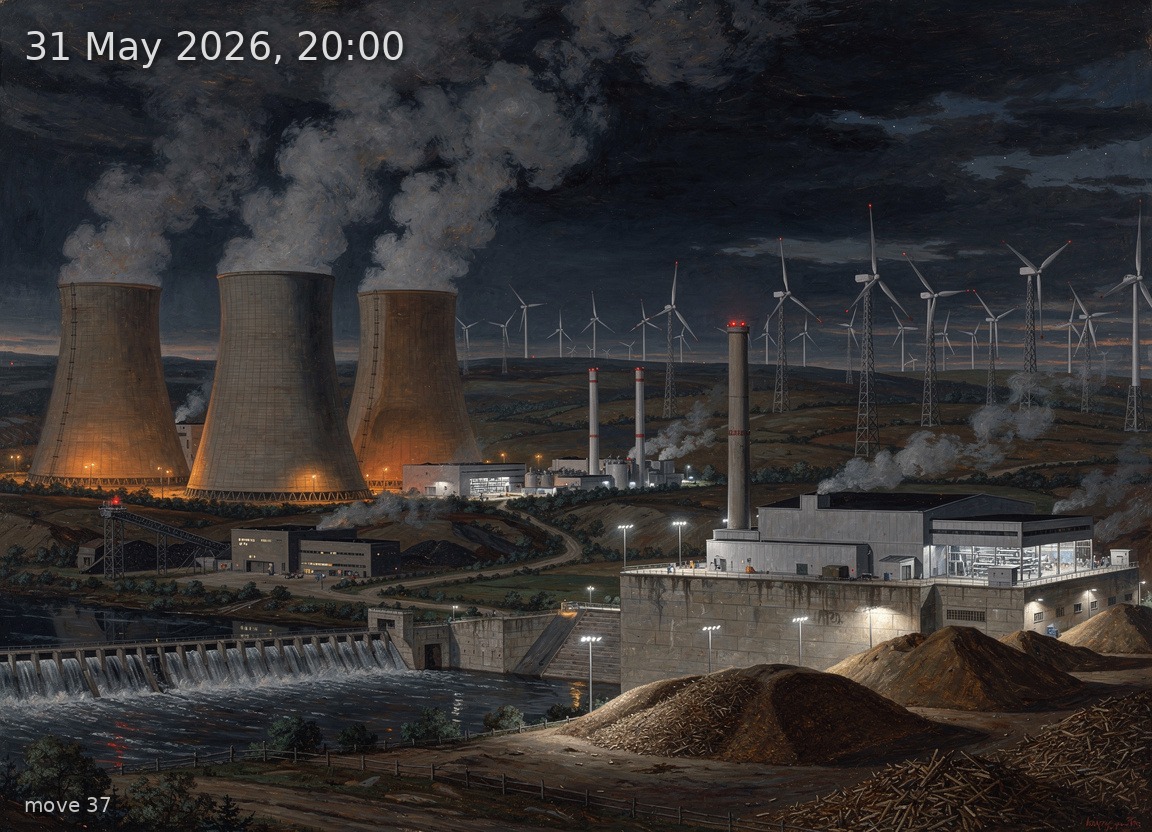
Brown coal, onshore wind, and gas lead generation as heavy imports cover a 19.8 GW shortfall at nightfall.
Back
Generation mix
Wind onshore 28%
Wind offshore 0%
Solar 5%
Biomass 14%
Hydro 6%
Natural gas 16%
Hard coal 8%
Brown coal 24%
53%
Renewable share
8.4 GW
Wind (on + offshore)
1.3 GW
Solar
29.6 GW
Total generation
-19.8 GW
Net import
152.8 €/MWh
Day-ahead price
18.1°C / 12 km/h
Temp / Wind speed
Open-Meteo, Kassel (51.3°N 9.5°E)
100.0% / 1.0 W/m²
Cloud cover / Radiation
330
gCO₂/kWh
Image prompt
Brown coal 7.0 GW dominates the left quarter as a massive lignite power station with three hyperbolic cooling towers emitting thick white-grey steam plumes into the dark sky; onshore wind 8.3 GW spans the entire background and right half as dozens of three-blade turbines on lattice and tubular towers, rotors turning moderately in light wind; natural gas 4.6 GW appears centre-left as a compact CCGT plant with twin slender exhaust stacks venting thin heat shimmer; biomass 4.2 GW sits in the centre-right as a large wood-chip-fed industrial plant with a broad chimney and piled fuel storage; hard coal 2.3 GW is a smaller coal-fired station with a single rectangular stack and coal conveyor beside the lignite complex; hydro 1.7 GW appears as a concrete dam structure with spillway visible in the middle distance near a river; solar 1.3 GW is represented by a small array of aluminium-framed crystalline silicon panels in the foreground, but they are dark and inert, reflecting no light. TIME: 20:00 in late May in Germany — the sky is completely dark, deep navy-black, no twilight glow remaining, no sunset colours. All structures are illuminated only by sodium-orange industrial lighting, glowing control-room windows, and red aviation warning lights atop turbine nacelles and cooling towers. The atmosphere is heavy and oppressive, with a thick blanket of 100% cloud cover pressing low, faintly reflecting the amber industrial glow. Temperature is mild at 18°C — lush late-spring vegetation, green deciduous trees in full leaf, tall grass. High-voltage transmission lines with steel pylons stretch toward the horizon in multiple directions, suggesting heavy power flow. Painted in the style of a highly detailed 19th-century German Romantic oil painting — rich, dark colour palette of deep blues, warm oranges, and smoky greys, visible impasto brushwork, atmospheric depth with industrial haze, meticulous engineering accuracy on every turbine nacelle, cooling tower curve, and panel frame. The mood is sombre and industrious, a Caspar David Friedrich vision of the modern energy landscape at night. No text, no labels.