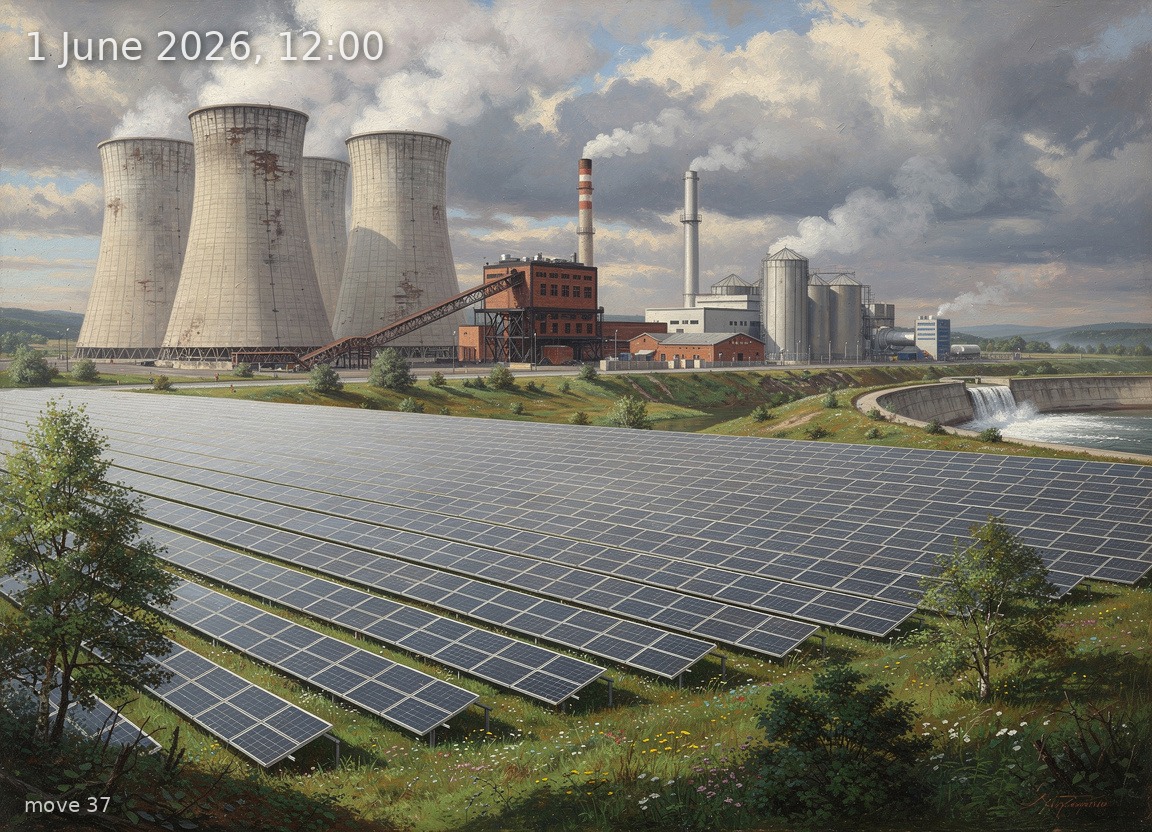
Solar at 42.8 GW leads an 84% renewable midday mix, with lignite and gas filling the thermal floor amid light winds.
Back
Generation mix
Wind onshore 5%
Wind offshore 0%
Solar 70%
Biomass 6%
Hydro 3%
Natural gas 4%
Hard coal 3%
Brown coal 8%
84%
Renewable share
3.1 GW
Wind (on + offshore)
42.8 GW
Solar
61.0 GW
Total generation
-0.3 GW
Net import
93.1 €/MWh
Day-ahead price
19.5°C / 6 km/h
Temp / Wind speed
Open-Meteo, Kassel (51.3°N 9.5°E)
58.0% / 357.0 W/m²
Cloud cover / Radiation
113
gCO₂/kWh
Image prompt
Solar 42.8 GW dominates the scene as a vast plain of crystalline silicon photovoltaic panels stretching across roughly 70% of the canvas, their aluminium frames glinting under broken midday sunlight filtering through scattered cumulus clouds; brown coal 5.1 GW rises at the left as a cluster of three massive hyperbolic concrete cooling towers with thick white steam plumes drifting eastward; biomass 3.6 GW appears as a mid-sized wood-chip power station with conical fuel silos and a single stack emitting pale exhaust, positioned behind the solar field; wind onshore 2.8 GW is rendered as a small group of modern three-blade horizontal-axis turbines on lattice towers at the far right, their rotors barely turning in the still air; natural gas 2.7 GW sits as a compact combined-cycle gas turbine plant with a sleek exhaust stack and visible heat-recovery unit, nestled between the coal towers and the solar field; hydro 1.9 GW is suggested by a reservoir dam with spillway visible in the middle distance at the right; hard coal 1.8 GW appears as a single brick-and-steel power station with a conveyor belt and tall chimney beside the lignite complex; wind offshore 0.3 GW is a faint row of turbines on the far horizon line. The sky is a dramatic interplay of 58% cloud cover — white and grey cumulus breaking apart to reveal deep blue — with full midday sunlight at solar noon casting well-defined shadows. Temperature 19.5 °C: lush early-summer green foliage on deciduous trees, wildflowers in meadow grass between panel rows. The atmosphere carries a slightly heavy, warm quality suggesting the elevated 93 EUR/MWh price — a faint haze near the thermal plants, humid air shimmering above the panels. Style: highly detailed oil painting in the tradition of Caspar David Friedrich and Carl Blechen — rich impasto brushwork, layered atmospheric perspective, Romantic grandeur applied to industrial landscape. Meticulous engineering accuracy on every turbine nacelle, every PV module busbar, every cooling tower's reinforced concrete ribbing. No text, no labels, no people in the foreground.