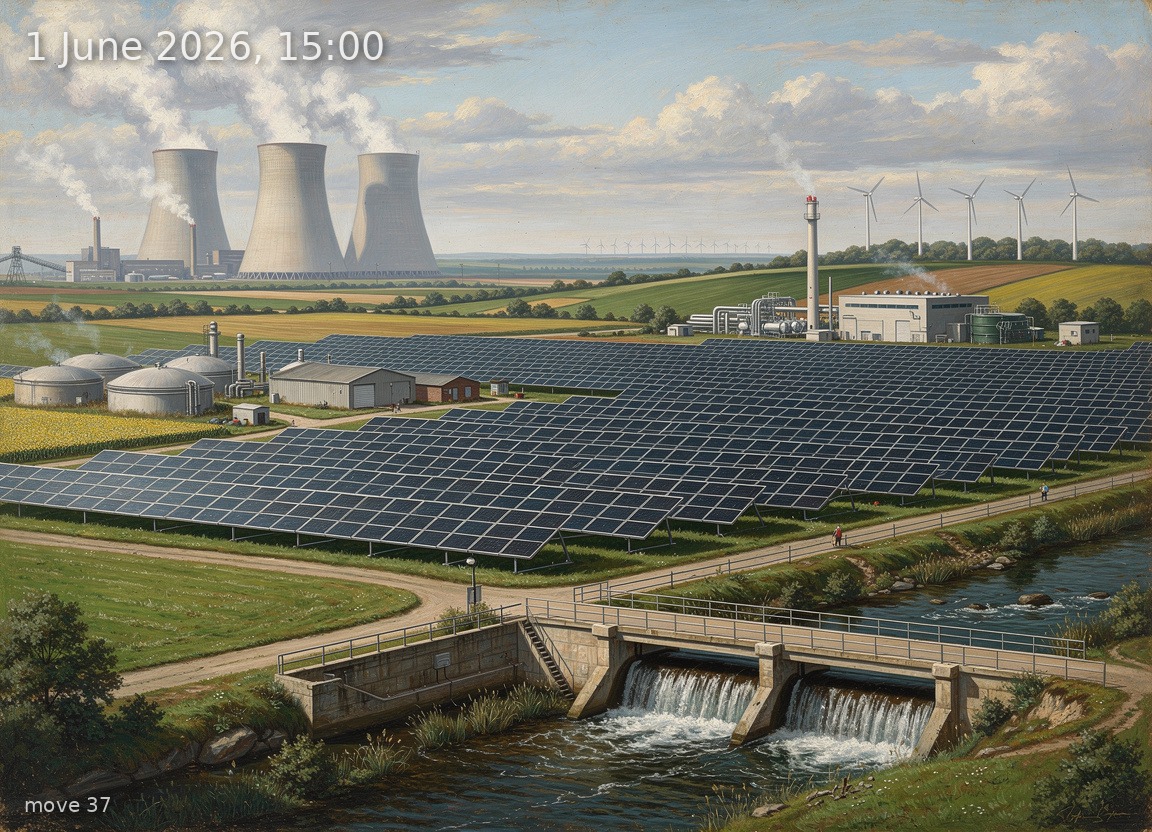
Solar provides 69% of generation at 37.7 GW; net imports of 3.7 GW balance tight afternoon demand.
Back
Generation mix
Wind onshore 5%
Wind offshore 1%
Solar 69%
Biomass 7%
Hydro 4%
Natural gas 4%
Hard coal 2%
Brown coal 8%
86%
Renewable share
3.2 GW
Wind (on + offshore)
37.7 GW
Solar
54.5 GW
Total generation
-3.7 GW
Net import
95.1 €/MWh
Day-ahead price
20.1°C / 8 km/h
Temp / Wind speed
Open-Meteo, Kassel (51.3°N 9.5°E)
61.0% / 120.0 W/m²
Cloud cover / Radiation
99
gCO₂/kWh
Image prompt
Solar 37.7 GW dominates the scene as an enormous expanse of crystalline silicon photovoltaic panels stretching across rolling central German farmland, covering roughly two-thirds of the composition — aluminium-framed panels gleaming under partly cloudy afternoon daylight, angled south on metal racking above green summer grass. Brown coal 4.2 GW occupies the left background as a lignite power station with three massive hyperbolic cooling towers emitting thick white steam plumes. Biomass 3.7 GW appears as a cluster of mid-sized biogas facilities with cylindrical digesters and short stacks amid crop fields in the centre-left middle ground. Wind onshore 2.8 GW shows as a modest line of five three-blade turbines on a low ridge in the right background, their rotors barely turning in the light breeze. Natural gas 2.4 GW is rendered as a compact CCGT plant with a single tall exhaust stack and thin heat shimmer, tucked behind the solar field at centre-right. Hydro 2.3 GW appears as a concrete run-of-river dam with spillway visible along a river cutting through the lower foreground. Hard coal 1.1 GW is a single smaller coal plant with a rectangular stack and modest smoke visible at the far left edge. Wind offshore 0.4 GW is barely suggested as distant turbines on a hazy horizon line. The sky is a high, slightly oppressive ceiling of layered cumulus at 61% cover, allowing diffuse bright daylight at 15:00 in early June — patches of blue between grey-white clouds, sun partially veiled but still strong enough to cast soft shadows. Temperature is a pleasant 20°C; vegetation is lush early-summer green — wheat fields, rapeseed aftermath, deciduous trees in full leaf. The atmosphere carries a faintly heavy, warm quality reflecting the elevated 95 EUR/MWh price — a subtle golden-amber haze near the horizon. Highly detailed oil painting in the tradition of 19th-century German Romantic landscape painters such as Caspar David Friedrich and Carl Blechen — rich saturated colour, visible confident brushwork, atmospheric aerial perspective with depth from foreground river to distant cooling towers. Each energy technology rendered with meticulous engineering accuracy: turbine nacelles, lattice towers, panel wiring, concrete dam buttresses, cooling tower parabolic curves. The scene feels like a monumental masterwork painting of the modern German industrial-pastoral landscape. No text, no labels.