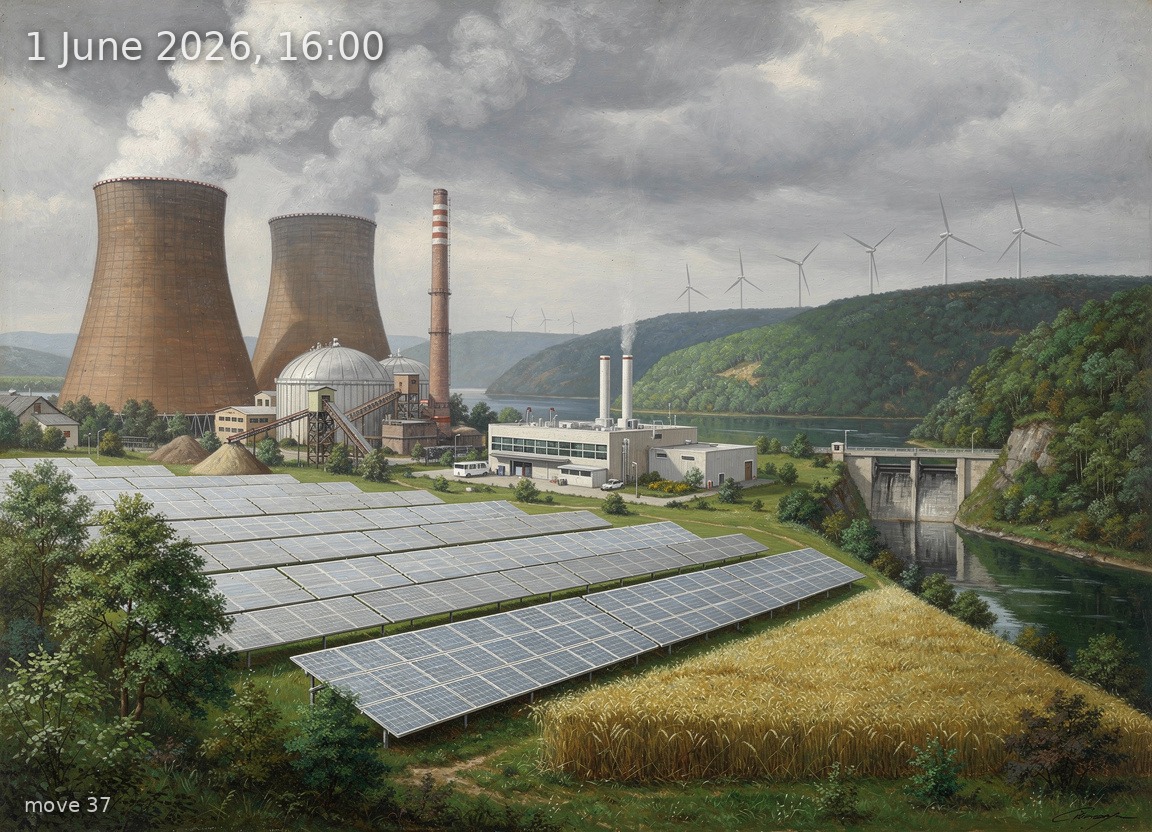
Overcast solar leads at 32 GW but full cloud cover and calm winds force thermal and import support at high prices.
Back
Generation mix
Wind onshore 5%
Wind offshore 1%
Solar 66%
Biomass 8%
Hydro 5%
Natural gas 5%
Hard coal 3%
Brown coal 8%
84%
Renewable share
2.7 GW
Wind (on + offshore)
32.0 GW
Solar
48.3 GW
Total generation
-9.8 GW
Net import
106.7 €/MWh
Day-ahead price
18.6°C / 6 km/h
Temp / Wind speed
Open-Meteo, Kassel (51.3°N 9.5°E)
100.0% / 3.0 W/m²
Cloud cover / Radiation
113
gCO₂/kWh
Image prompt
Solar 32.0 GW dominates the centre and right of the composition as vast fields of aluminium-framed crystalline silicon PV panels stretching across gently rolling central German farmland, their glass surfaces reflecting a flat white-grey sky. Brown coal 4.1 GW occupies the left background as a cluster of massive hyperbolic cooling towers emitting thick steam plumes that merge with the overcast ceiling. Biomass 3.7 GW appears in the left-centre as a large wood-chip-fed power station with a tall industrial chimney and biomass storage domes. Natural gas 2.4 GW is rendered as a compact CCGT plant with twin exhaust stacks and a slender vapour trail, positioned between the coal complex and the solar fields. Wind onshore 2.3 GW appears as a short row of three-blade turbines on a distant ridge, their rotors barely turning in the still air. Hydro 2.3 GW is depicted as a concrete dam with a reservoir nestled in a forested valley at the far right. Hard coal 1.2 GW shows as a single coal-fired plant with conveyor belts and a modest stack behind the solar arrays. Wind offshore 0.3 GW is a faint silhouette of two turbines on the far horizon line. The sky is entirely overcast at 100% cloud cover — a heavy, uniform blanket of grey stratus pressing low, casting flat diffuse light with no shadows, creating an oppressive, high-price atmosphere. It is 4 PM on a June afternoon so full daylight persists but there is no direct sunshine whatsoever — the light is bright yet toneless. Temperature is mild at 18.6°C; vegetation is lush summer green, with mature wheat fields and deciduous trees in full leaf between the solar installations. The air feels heavy and still. High-voltage transmission pylons thread through the middle distance, cables sagging toward distant borders, implying the flow of imports. Painted in the style of a highly detailed 19th-century German Romantic oil painting — rich layered colour, visible impasto brushwork, atmospheric depth receding into haze — yet every technological detail is rendered with engineering precision: turbine nacelles, lattice towers, PV cell grid patterns, cooling tower parabolic curves, CCGT heat-recovery housings. No text, no labels.