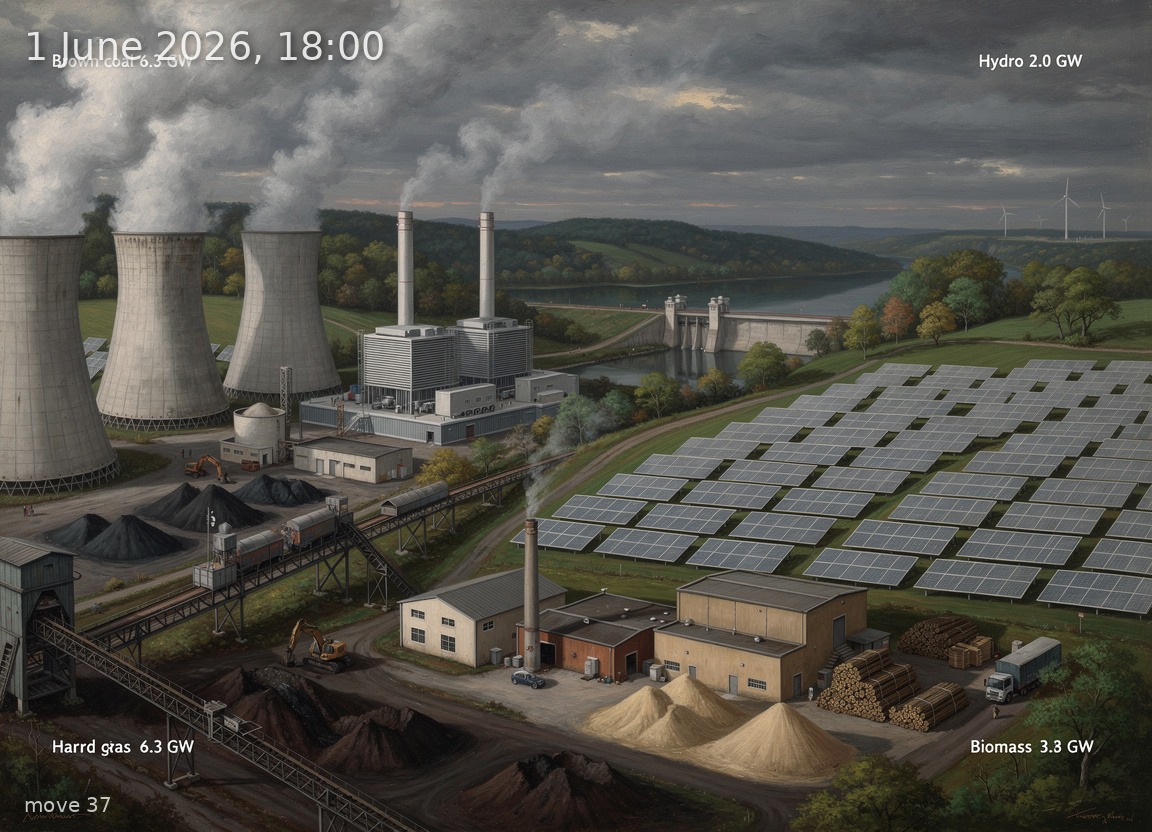
Solar leads at 15.3 GW under overcast skies, but 23 GW net imports fill the gap left by weak wind and high demand.
Back
Generation mix
Wind onshore 4%
Wind offshore 1%
Solar 43%
Biomass 11%
Hydro 5%
Natural gas 12%
Hard coal 8%
Brown coal 17%
63%
Renewable share
1.6 GW
Wind (on + offshore)
15.3 GW
Solar
36.0 GW
Total generation
-23.0 GW
Net import
141.5 €/MWh
Day-ahead price
19.0°C / 8 km/h
Temp / Wind speed
Open-Meteo, Kassel (51.3°N 9.5°E)
98.0% / 121.0 W/m²
Cloud cover / Radiation
258
gCO₂/kWh
Image prompt
Solar 15.3 GW dominates the right half of the scene as vast fields of aluminium-framed crystalline silicon PV panels stretching across gently rolling green farmland, their surfaces reflecting only diffused grey light under near-total overcast. Brown coal 6.3 GW occupies the left foreground as a cluster of massive hyperbolic cooling towers with thick white-grey steam plumes merging into the low cloud ceiling, flanked by conveyor belts carrying dark lignite. Natural gas 4.3 GW appears as two compact CCGT plants with tall single exhaust stacks and heat-recovery units positioned centre-left, thin exhaust streams rising. Hard coal 2.7 GW is rendered as a smaller power station behind the gas units, with a single squat cooling tower and a coal stockpile. Biomass 3.8 GW appears centre-right as a wood-chip-fed CHP plant with a modest smokestack and timber storage yard. Hydro 2.0 GW is visible as a small concrete dam with a reservoir in the distant centre background against forested hills. Wind onshore 1.3 GW and wind offshore 0.3 GW appear as just a few widely spaced three-blade turbines on lattice and tubular towers at the far left horizon, their blades barely turning in the still air. The sky is dusk at 18:00 in June: a heavy, oppressive, nearly uniform 98% overcast with only a faint warm orange-red glow bleeding through a thin gap on the lowest western horizon, the rest a deep grey canopy pressing down on the landscape. The atmosphere feels thick and heavy, reflecting the high electricity price. Lush green early-summer vegetation — tall grasses, leafy deciduous trees — in 19°C warmth. Highly detailed oil painting in the tradition of 19th-century German Romantic landscape painters, rich saturated colour palette dominated by greys and muted greens, visible confident brushwork, deep atmospheric perspective, meticulous engineering accuracy on all infrastructure, dramatic chiaroscuro between the dim dusk light and glowing industrial facilities. No text, no labels.