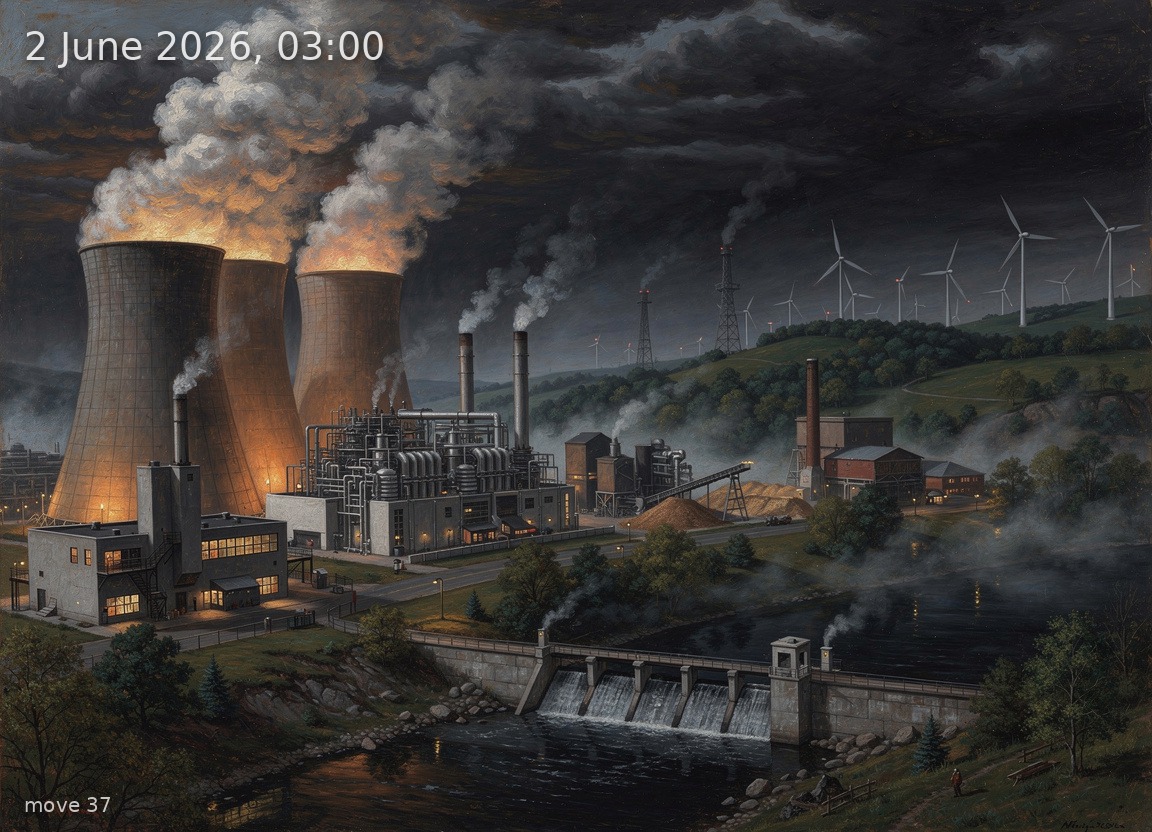
Brown coal, wind, and gas dominate overnight generation while 11.2 GW of net imports cover the consumption gap.
Back
Generation mix
Wind onshore 25%
Wind offshore 8%
Biomass 11%
Hydro 6%
Natural gas 18%
Hard coal 9%
Brown coal 24%
50%
Renewable share
10.5 GW
Wind (on + offshore)
0.0 GW
Solar
32.3 GW
Total generation
-11.1 GW
Net import
120.9 €/MWh
Day-ahead price
13.6°C / 2 km/h
Temp / Wind speed
Open-Meteo, Kassel (51.3°N 9.5°E)
100.0% / 0.0 W/m²
Cloud cover / Radiation
346
gCO₂/kWh
Image prompt
Brown coal 7.6 GW dominates the left quarter as a cluster of massive hyperbolic cooling towers emitting thick white steam plumes lit from below by orange sodium lamps; wind onshore 7.9 GW spans the centre-right as dozens of three-blade turbines on lattice and tubular towers stretching across rolling hills, blades turning slowly; natural gas 5.7 GW appears centre-left as a compact row of CCGT plants with tall single exhaust stacks venting thin heat shimmer; biomass 3.7 GW sits in the middle distance as a modest wood-chip-fed CHP plant with a squat chimney and conveyor belt; hard coal 2.9 GW occupies the far left as a large boiler house with twin rectangular stacks trailing grey smoke; wind offshore 2.6 GW is visible on the far-right horizon as a line of turbines standing in a dark sea; hydro 1.9 GW is represented by a concrete dam with spillway in the foreground valley, water faintly gleaming. Time is 03:00 — deep night, completely dark sky with no twilight or glow, heavy 100% overcast hiding all stars, sky a flat oppressive charcoal-black. Lighting is entirely artificial: amber sodium streetlights line access roads, industrial floodlights cast harsh cones on cooling towers and plant facades, control-room windows glow pale blue. Temperature is mild at 13.6 °C — lush early-summer foliage on deciduous trees, damp grass, a faint ground mist drifting through the turbine field. Wind is nearly calm at 1.9 km/h so turbine blades rotate barely perceptibly and steam plumes rise almost vertically before spreading into the low cloud base. The atmosphere is heavy and oppressive, reflecting the high electricity price — a brooding, dense ceiling of cloud pressing down on the industrial landscape. Style: highly detailed oil painting in the tradition of 19th-century German Romantic landscape painters — rich, dark palette of umber, ochre, slate-grey and deep navy, visible impasto brushwork, atmospheric depth with industrial structures receding into misty darkness, meticulous engineering detail on every turbine nacelle, cooling tower, and exhaust stack. No text, no labels.