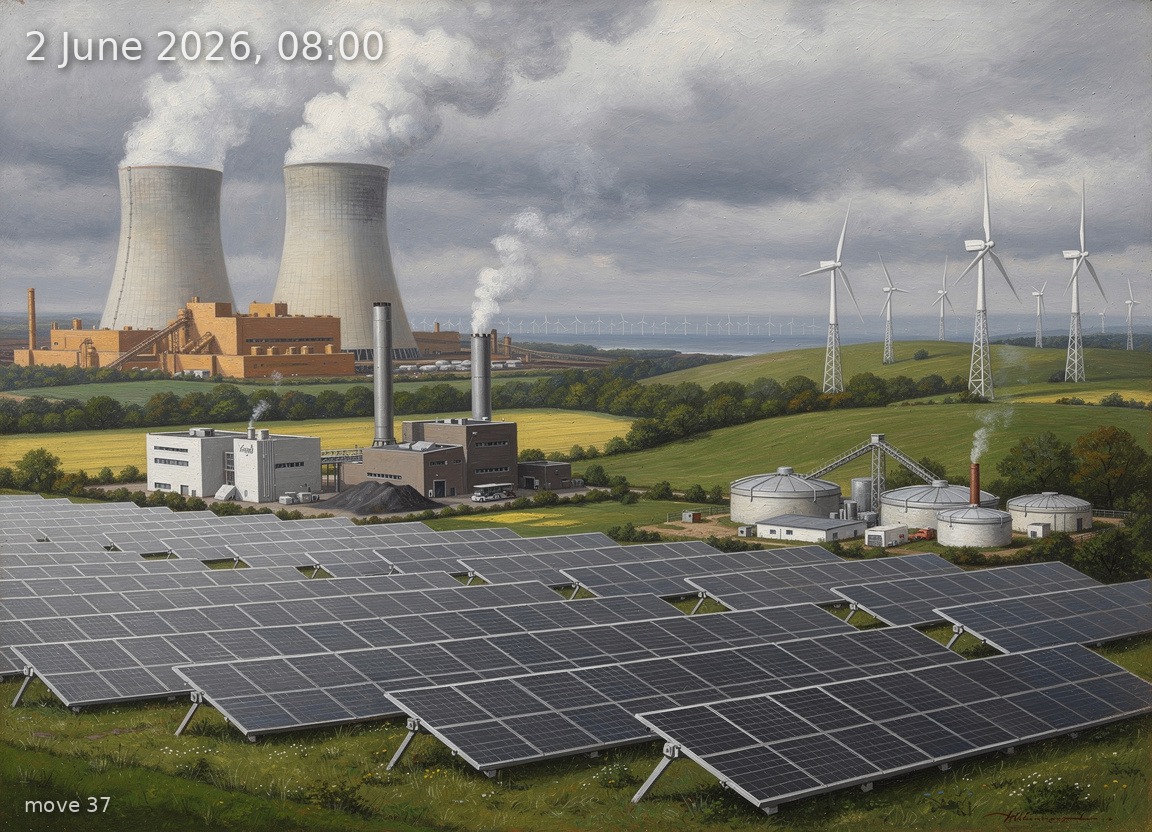
Solar leads at 20 GW despite heavy overcast; brown coal and gas fill the gap as 8.8 GW of net imports are needed.
Back
Generation mix
Wind onshore 13%
Wind offshore 5%
Solar 39%
Biomass 8%
Hydro 4%
Natural gas 10%
Hard coal 6%
Brown coal 14%
69%
Renewable share
9.6 GW
Wind (on + offshore)
20.0 GW
Solar
51.6 GW
Total generation
-8.8 GW
Net import
121.1 €/MWh
Day-ahead price
15.5°C / 4 km/h
Temp / Wind speed
Open-Meteo, Kassel (51.3°N 9.5°E)
99.0% / 64.0 W/m²
Cloud cover / Radiation
218
gCO₂/kWh
Image prompt
Solar 20.0 GW dominates the foreground as vast fields of aluminium-framed crystalline silicon PV panels stretching across flat central German farmland, their surfaces reflecting only dull grey light under total overcast. Wind onshore 6.8 GW appears as scattered clusters of three-blade turbines with white lattice towers on gentle rolling hills to the right, rotors turning almost imperceptibly in negligible wind. Wind offshore 2.8 GW is suggested in the far distance as a faint line of turbines along the hazy horizon. Brown coal 7.5 GW occupies the left background as a massive lignite power station complex with three hyperbolic cooling towers emitting thick white steam plumes that merge upward into the overcast sky. Natural gas 5.4 GW sits centre-left as two compact CCGT plant blocks with tall single exhaust stacks releasing thin heat shimmer. Hard coal 3.4 GW appears as a smaller conventional power station with a single rectangular stack and coal conveyor belt visible behind the gas plant. Biomass 4.0 GW is rendered as a cluster of low industrial biogas facilities with rounded digesters and short chimneys near the right midground among green fields. Hydro 1.9 GW is a modest run-of-river weir with turbine house along a river cutting through the lower right foreground. The sky is entirely filled with a 99% dense, uniform layer of heavy stratiform clouds, oppressive and low-hanging, no blue visible anywhere, diffuse flat daylight of an 08:00 June morning filtering through — bright enough to see clearly but without any shadows or direct sun. The atmosphere feels heavy and pressured, reflecting the high electricity price. Lush green early-summer vegetation — meadow grasses, young wheat, deciduous trees in full leaf — at 15.5 °C. Highly detailed oil painting in the tradition of 19th-century German Romantic landscape painters — Caspar David Friedrich meets industrial realism — rich colour palette dominated by slate greys, steel blues, forest greens, and the warm ochre of coal infrastructure, visible textured brushwork, atmospheric depth with haze and mist between layers, meticulous engineering accuracy on every turbine nacelle, PV module frame, cooling tower hyperbolic curve, and CCGT exhaust stack. No text, no labels.