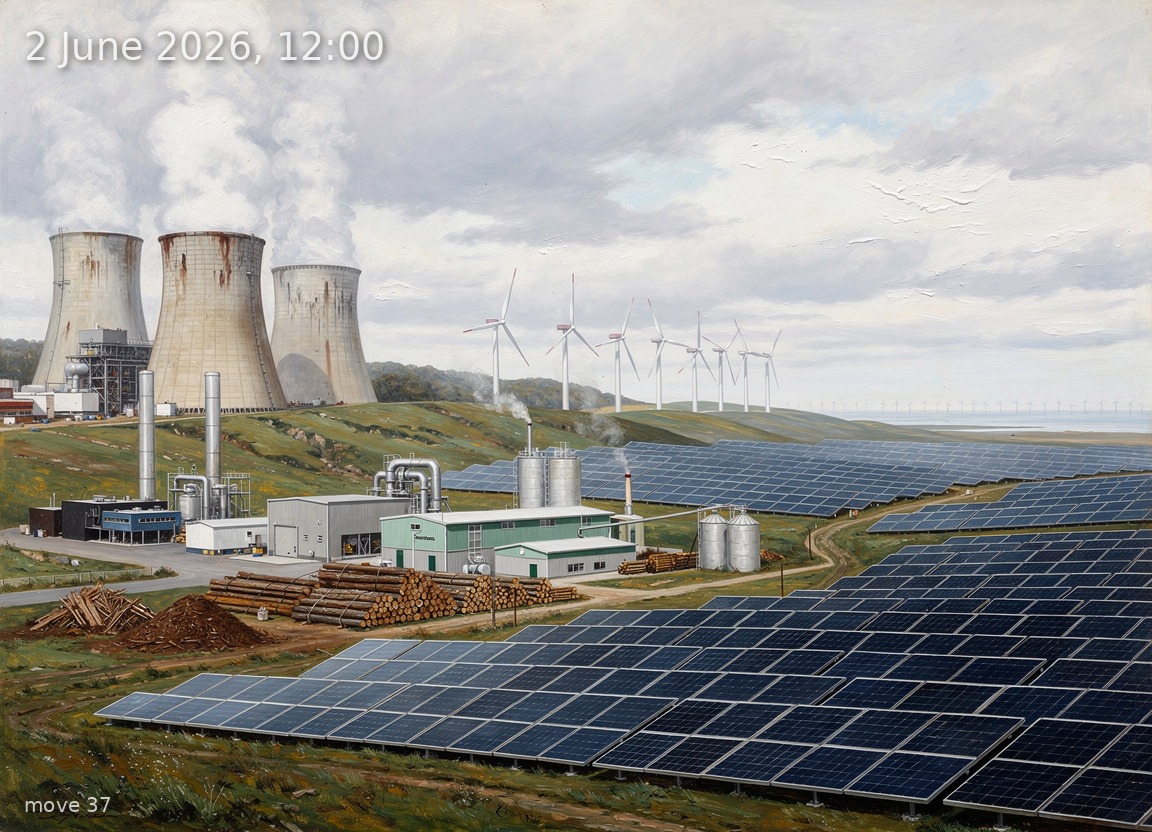
Solar at 38.7 GW drives 85.8% renewable share at midday, with coal and gas providing residual baseload.
Back
Generation mix
Wind onshore 11%
Wind offshore 2%
Solar 63%
Biomass 6%
Hydro 3%
Natural gas 4%
Hard coal 2%
Brown coal 8%
86%
Renewable share
8.2 GW
Wind (on + offshore)
38.7 GW
Solar
61.1 GW
Total generation
+0.3 GW
Net export
80.3 €/MWh
Day-ahead price
22.4°C / 12 km/h
Temp / Wind speed
Open-Meteo, Kassel (51.3°N 9.5°E)
100.0% / 339.0 W/m²
Cloud cover / Radiation
100
gCO₂/kWh
Image prompt
Solar 38.7 GW dominates the right two-thirds of the scene as vast rolling fields of aluminium-framed crystalline silicon PV panels stretching to the horizon, their blue-black surfaces reflecting diffuse white light; brown coal 4.7 GW occupies the far left as a cluster of massive hyperbolic cooling towers with thick white steam plumes rising into a bright but uniformly overcast sky; wind onshore 6.8 GW appears as a line of fifteen tall three-blade turbines on a gentle ridge behind the solar fields, rotors turning slowly in light wind; wind offshore 1.4 GW is suggested by a distant row of smaller turbines along a hazy horizon line at far right; natural gas 2.6 GW sits as two compact CCGT units with slim exhaust stacks and thin heat shimmer near the coal plant; hard coal 1.3 GW appears as a single smaller smokestack facility beside the lignite towers; biomass 3.7 GW is rendered as a mid-sized industrial plant with a timber yard and short chimneys trailing faint grey smoke in the centre-left middle ground; hydro 1.8 GW is a small dam and reservoir visible in a valley at centre-left. The time is noon in early June: full bright daylight but no direct sunshine, the entire sky a flat luminous white-grey ceiling pressing down with a slightly heavy, warm atmosphere. Temperature is 22°C — lush green deciduous trees in full leaf, green grass, wildflowers along field edges. The air feels humid and still, with a faintly oppressive quality reflecting the 80 EUR/MWh price. Style: highly detailed oil painting in the tradition of 19th-century German Romantic landscape painters such as Caspar David Friedrich crossed with industrial realism — rich layered colour, visible confident brushwork, atmospheric aerial perspective with haze softening the distant turbines, meticulous engineering accuracy on every nacelle, panel frame, cooling tower rib, and exhaust stack. No text, no labels, no human figures prominent.