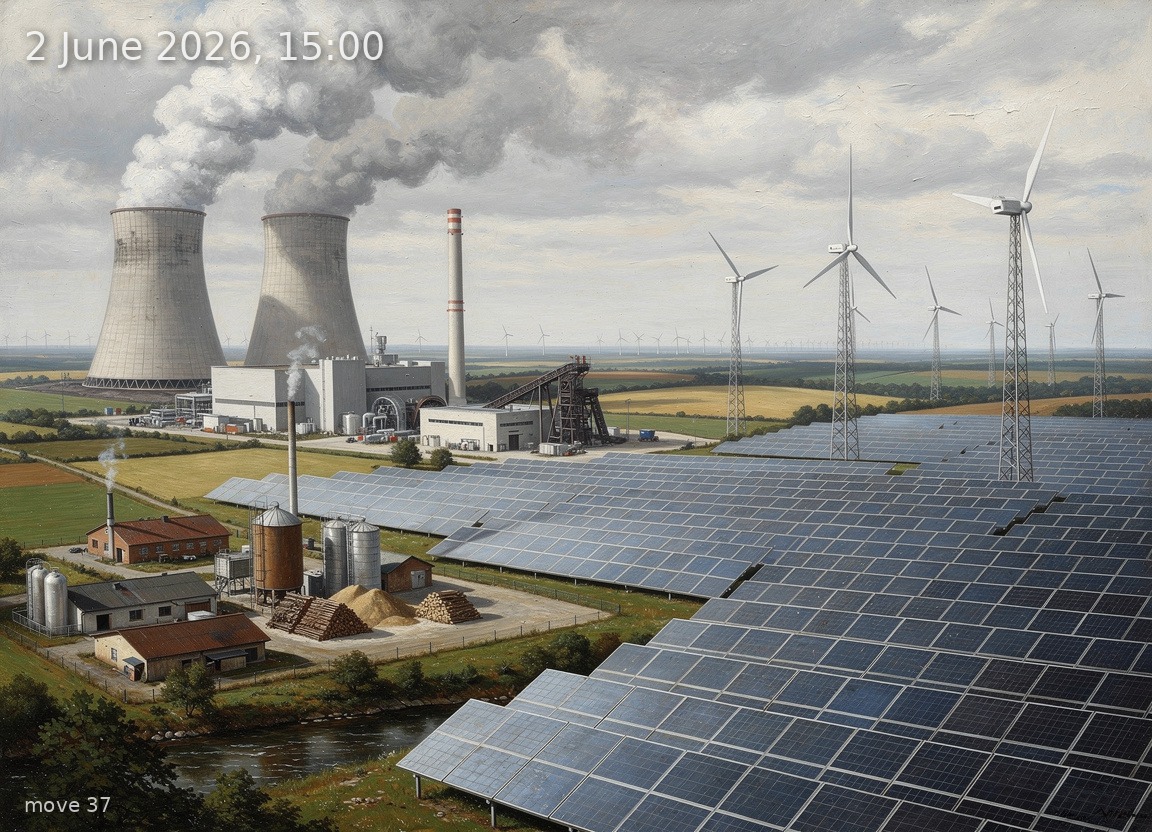
Solar leads at 29.7 GW under full overcast; 7.2 GW net imports and thermal plants cover the residual load.
Back
Generation mix
Wind onshore 14%
Wind offshore 2%
Solar 59%
Biomass 7%
Hydro 4%
Natural gas 5%
Hard coal 3%
Brown coal 7%
85%
Renewable share
7.9 GW
Wind (on + offshore)
29.7 GW
Solar
50.4 GW
Total generation
-7.2 GW
Net import
99.7 €/MWh
Day-ahead price
23.7°C / 21 km/h
Temp / Wind speed
Open-Meteo, Kassel (51.3°N 9.5°E)
100.0% / 88.0 W/m²
Cloud cover / Radiation
104
gCO₂/kWh
Image prompt
Solar 29.7 GW dominates the right two-thirds of the scene as vast fields of aluminium-framed crystalline silicon PV panels stretching across rolling central German farmland, their blue-grey surfaces reflecting a flat white overcast sky; wind onshore 6.8 GW appears as clusters of tall three-blade turbines with white nacelles and lattice towers scattered across gentle hills in the centre-right, blades turning steadily in moderate wind; wind offshore 1.1 GW is suggested as a thin line of distant turbines on the far horizon; brown coal 3.4 GW occupies the left background as a lignite power station with two large hyperbolic cooling towers emitting thick grey-white steam plumes that merge with the overcast ceiling; natural gas 2.3 GW appears as a compact CCGT facility with a single tall exhaust stack and smaller vapour plume just left of centre; hard coal 1.8 GW is rendered as a smaller coal plant with a single rectangular boiler house and chimney releasing a thin exhaust trail, nestled beside the lignite station; biomass 3.6 GW appears as a cluster of modest industrial buildings with wood-chip silos and low stacks in the mid-left; hydro 1.8 GW is shown as a concrete weir with white water cascading in the lower-left foreground. The sky is entirely overcast at 100% cloud cover — a uniform, heavy, oppressive blanket of warm grey clouds with no blue visible, pressing down with a dense atmospheric weight reflecting the high 99.7 EUR/MWh price. Lighting is full June afternoon daylight at 15:00 but entirely diffuse, casting no shadows, with a warm 23.7°C summer atmosphere evident in lush green deciduous trees in full leaf, tall grass, and wildflowers along field edges. High-voltage transmission pylons march across the middle distance, symbolising the import flows. Style: highly detailed oil painting in the tradition of 19th-century German Romantic landscape painters — Caspar David Friedrich meets industrial realism — with rich colour, visible impasto brushwork, deep atmospheric perspective, and meticulous engineering accuracy on every turbine nacelle, panel frame, and cooling tower. No text, no labels.