Solar leads at 16.9 GW but 16.5 GW net imports required as consumption outpaces domestic generation at elevated prices.
Back
Generation mix
Wind onshore 18%
Wind offshore 3%
Solar 40%
Biomass 9%
Hydro 4%
Natural gas 6%
Hard coal 7%
Brown coal 13%
74%
Renewable share
8.5 GW
Wind (on + offshore)
16.9 GW
Solar
41.7 GW
Total generation
-16.5 GW
Net import
131.1 €/MWh
Day-ahead price
23.2°C / 10 km/h
Temp / Wind speed
Open-Meteo, Kassel (51.3°N 9.5°E)
80.0% / 289.0 W/m²
Cloud cover / Radiation
188
gCO₂/kWh
Image prompt
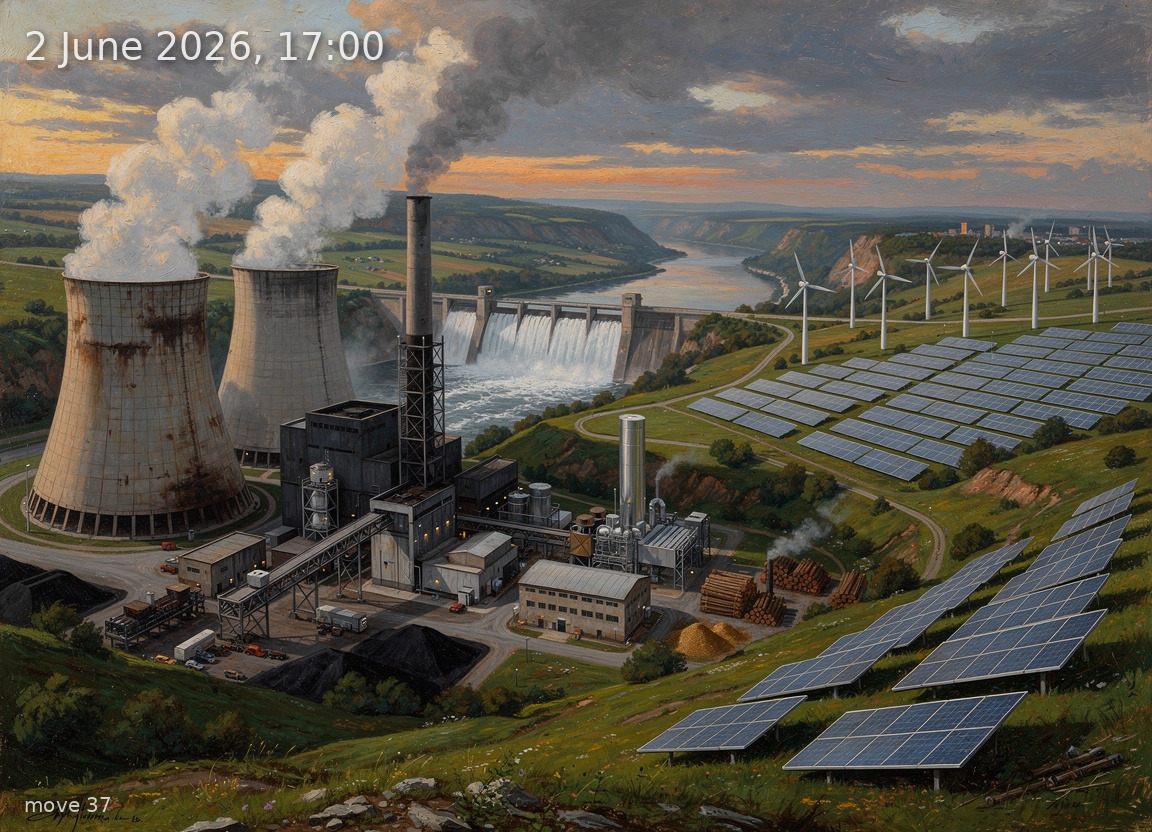
Solar 16.9 GW dominates the right half of the scene as vast fields of aluminium-framed crystalline silicon PV panels stretching across gentle green hillsides; brown coal 5.4 GW occupies the left foreground as three massive hyperbolic cooling towers emitting thick white steam plumes from a sprawling lignite plant; wind onshore 7.5 GW appears as a line of fifteen three-blade turbines with white tubular towers receding along a ridge in the centre-right background; biomass 3.7 GW is rendered as a mid-ground wood-chip power station with a tall stack and timber yard; hard coal 2.8 GW sits left of centre as a dark industrial block with conveyor belts and a pair of rectangular chimneys trailing grey smoke; natural gas 2.6 GW appears as a compact CCGT unit with a single gleaming exhaust stack emitting a thin transparent plume beside the coal works; hydro 1.8 GW is a concrete dam visible in the far background valley with white water cascading; wind offshore 1.0 GW is suggested by a handful of distant turbines on the far horizon line. The sky is dusk lighting at 17:00 Berlin time — the sun is low in the west, partially obscured behind heavy 80% cloud cover in grey-cream layers, casting a warm but diffused orange-amber glow along the lower horizon while the upper sky darkens to steel blue. Temperature is 23°C so vegetation is lush, full summer green, with wildflowers in meadows. Wind is light at 10 km/h — turbine blades turn slowly, grass sways gently. The atmosphere feels oppressive and heavy, reflecting the high 131 EUR/MWh price — a haze hangs over the industrial facilities, the air thick and warm. High-voltage transmission pylons march across the mid-ground, symbolising the large import flows. Style: highly detailed oil painting in the tradition of 19th-century German Romantic landscape painters such as Caspar David Friedrich and Carl Blechen — rich saturated colour, visible impasto brushwork, dramatic atmospheric depth and chiaroscuro, with meticulous engineering accuracy on every turbine nacelle, PV panel frame, cooling tower curve, and industrial structure. No text, no labels.