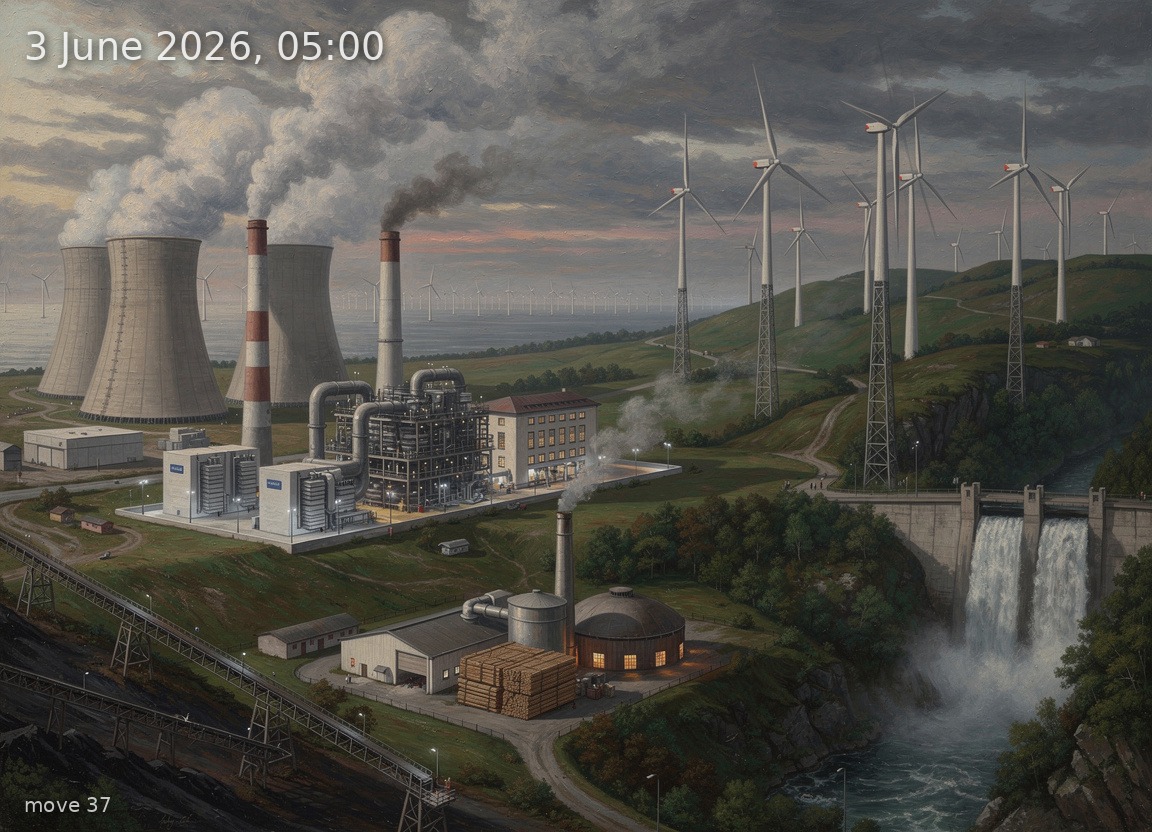
Wind leads at 15.2 GW but heavy brown coal and net imports of 10.9 GW balance a pre-dawn supply gap.
Back
Generation mix
Wind onshore 40%
Wind offshore 6%
Solar 1%
Biomass 10%
Hydro 5%
Natural gas 9%
Hard coal 8%
Brown coal 20%
62%
Renewable share
17.6 GW
Wind (on + offshore)
0.4 GW
Solar
37.6 GW
Total generation
-10.9 GW
Net import
113.3 €/MWh
Day-ahead price
12.5°C / 15 km/h
Temp / Wind speed
Open-Meteo, Kassel (51.3°N 9.5°E)
95.0% / 0.0 W/m²
Cloud cover / Radiation
273
gCO₂/kWh
Image prompt
Wind onshore 15.2 GW dominates the right half of the canvas as dozens of tall three-blade turbines on lattice and tubular towers stretching across rolling green hills, blades visibly turning in moderate wind; brown coal 7.6 GW occupies the left quarter as a cluster of massive hyperbolic cooling towers emitting thick white-grey steam plumes rising into the overcast sky, with conveyor belts of dark lignite visible at their base; natural gas 3.5 GW appears centre-left as two compact CCGT power blocks with tall single exhaust stacks venting thin heat shimmer; hard coal 3.1 GW sits just behind as a traditional coal plant with rectangular boiler house and a single large chimney trailing grey smoke; biomass 3.7 GW is rendered as a mid-sized industrial facility with a domed wood-chip storage silo and a modest smokestack amid stacked timber; wind offshore 2.4 GW is glimpsed in the far background as a line of turbines standing in a grey-blue sea on the distant horizon; hydro 1.7 GW appears as a concrete dam set into a forested valley on the far right, water spilling in a controlled cascade; solar 0.4 GW is represented only by a tiny row of darkened aluminium-framed crystalline silicon panels on a barn roof, completely unlit, reflecting nothing. The sky is pre-dawn at 05:00 in early June: deep blue-grey overhead gradually lightening to a thin pale strip of cold steel-blue light along the eastern horizon, no direct sunlight, no warm tones — only the first faint suggestion of day. The atmosphere feels heavy and oppressive, thick low stratus clouds at 95% cover pressing down on the landscape, hinting at the high electricity price. The temperature is a cool 12.5 °C mid-June morning: lush green grass and leafy deciduous trees, but dew glistens on surfaces and a thin mist hugs the valleys. Artificial light sources punctuate the darkness — sodium-orange glow from industrial facility windows, red aviation warning lights atop turbine nacelles and smokestacks, cool white floodlights illuminating the coal conveyor and gas plant perimeters. Painted in the style of a highly detailed 19th-century German Romantic oil painting — rich, layered colour with visible impasto brushwork, deep atmospheric perspective, dramatic chiaroscuro between the glowing industrial facilities and the brooding pre-dawn sky — yet every engineering detail is rendered with meticulous technical accuracy: turbine nacelle housings, three-blade rotor geometry, cooling tower parabolic profiles, CCGT exhaust diffusers. No text, no labels.