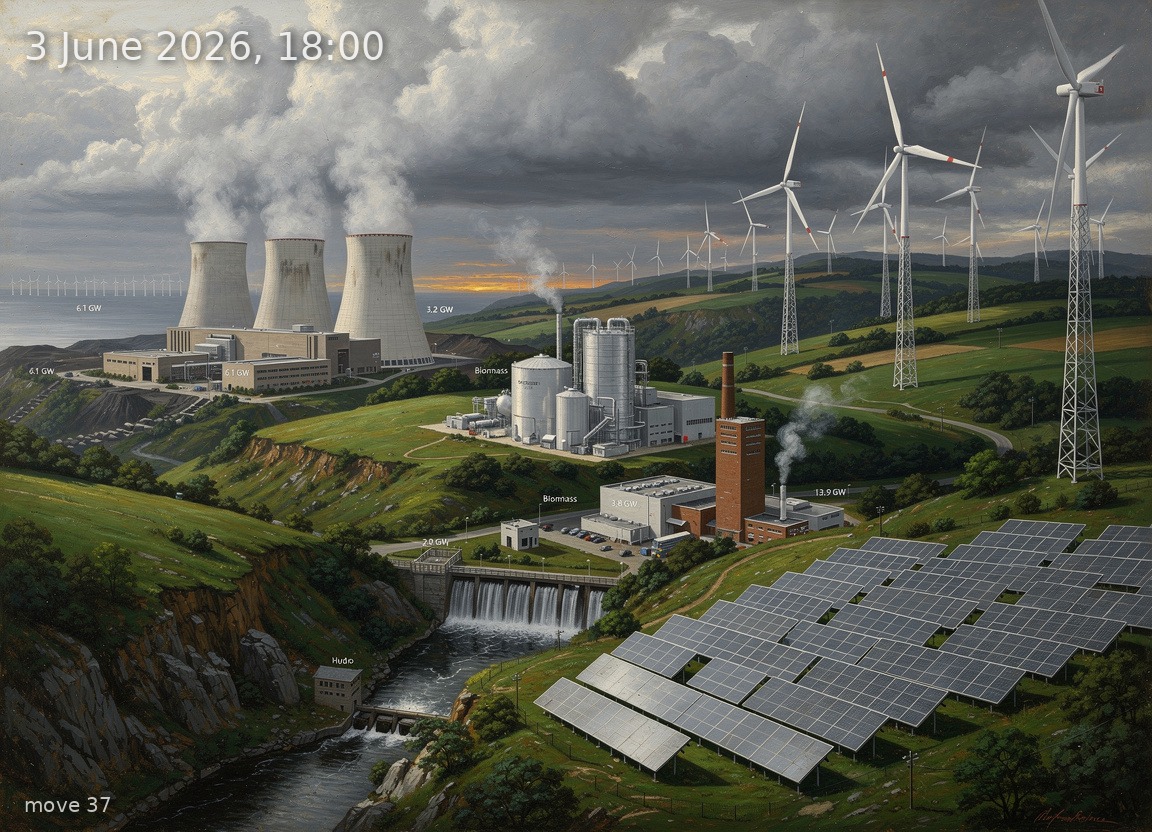
Wind and solar lead at 34.6 GW combined, but 14.8 GW net imports are needed to meet strong evening demand.
Back
Generation mix
Wind onshore 27%
Wind offshore 7%
Solar 31%
Biomass 9%
Hydro 5%
Natural gas 5%
Hard coal 3%
Brown coal 14%
78%
Renewable share
15.0 GW
Wind (on + offshore)
13.9 GW
Solar
44.2 GW
Total generation
-14.8 GW
Net import
122.2 €/MWh
Day-ahead price
18.6°C / 21 km/h
Temp / Wind speed
Open-Meteo, Kassel (51.3°N 9.5°E)
100.0% / 195.0 W/m²
Cloud cover / Radiation
158
gCO₂/kWh
Image prompt
Wind onshore 11.7 GW dominates the right third of the scene as dozens of tall three-blade turbines with white lattice towers stretching across rolling green hills, blades turning visibly in the brisk wind. Solar 13.9 GW fills the centre-right foreground as vast fields of aluminium-framed crystalline silicon PV panels angled toward the overcast sky, their surfaces reflecting diffuse grey light. Brown coal 6.1 GW occupies the left quarter as a massive lignite power station with three hyperbolic concrete cooling towers emitting thick white-grey steam plumes that merge with the heavy cloud ceiling. Biomass 3.8 GW appears as a mid-ground industrial plant with cylindrical silos and a modest stack trailing pale smoke. Wind offshore 3.2 GW is suggested on the distant left horizon as faint silhouettes of turbines standing in a grey sea. Natural gas 2.2 GW sits centre-left as a compact CCGT facility with a single tall exhaust stack and clean metallic cladding. Hydro 2.0 GW appears as a small dam and penstock structure nestled in a valley in the mid-ground. Hard coal 1.2 GW is a smaller conventional power station with a rectangular brick stack beside the brown coal complex. The time is 18:00 on a June evening in central Germany: the sky is fully overcast at 100% cloud cover, with a dull orange-red glow barely breaking through clouds along the lower western horizon as dusk begins. The upper sky is grey darkening to slate blue. The atmosphere is heavy and oppressive, reflecting the high electricity price—a brooding, weighty ceiling of cloud pressing down on the landscape. Lush green summer vegetation covers the hills, temperature around 19°C. Style: highly detailed oil painting in the tradition of 19th-century German Romantic landscape painters such as Caspar David Friedrich and Carl Blechen, with rich deep colour palette, visible textured brushwork, dramatic atmospheric depth, chiaroscuro lighting from the fading western glow. Each energy technology is rendered with meticulous engineering accuracy—turbine nacelles, rotor hubs, PV cell grids, cooling tower parabolic curves, CCGT exhaust geometry. The scene feels monumental and sublime, an industrial pastoral masterwork. No text, no labels.