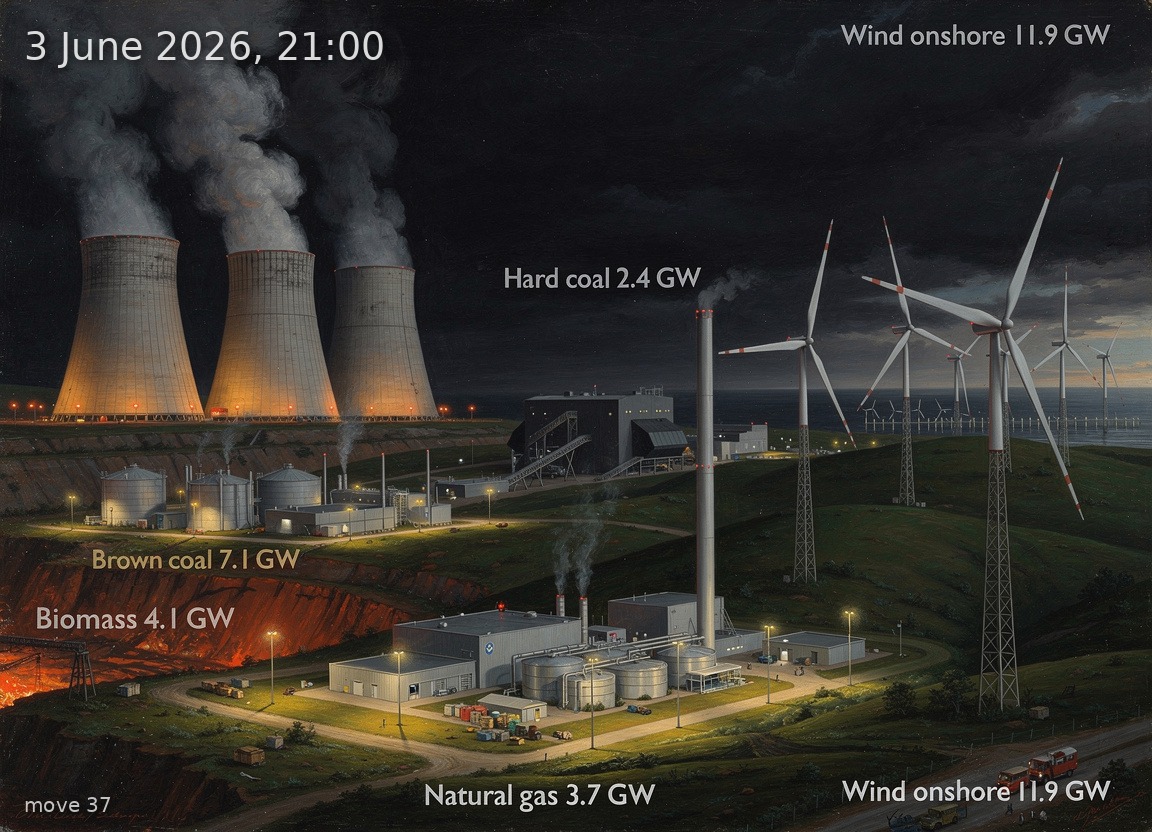
Wind leads generation but post-sunset demand gap requires 19.9 GW net imports and heavy thermal dispatch.
Back
Generation mix
Wind onshore 34%
Wind offshore 11%
Solar 0%
Biomass 12%
Hydro 6%
Natural gas 11%
Hard coal 7%
Brown coal 20%
63%
Renewable share
16.0 GW
Wind (on + offshore)
0.1 GW
Solar
35.4 GW
Total generation
-19.8 GW
Net import
133.4 €/MWh
Day-ahead price
16.8°C / 16 km/h
Temp / Wind speed
Open-Meteo, Kassel (51.3°N 9.5°E)
100.0% / 15.0 W/m²
Cloud cover / Radiation
267
gCO₂/kWh
Image prompt
Wind onshore 11.9 GW dominates the right half of the scene as dozens of three-blade turbines on lattice and tubular towers stretching across rolling green hills, rotors spinning in moderate wind. Wind offshore 4.0 GW appears in the far right background as a row of offshore turbines barely visible on a dark horizon line over a faintly reflective sea. Brown coal 7.1 GW occupies the left quarter as three massive hyperbolic cooling towers with thick white-grey steam plumes rising into the blackness, underlit by orange sodium lamps and the glow from a lignite opencast mine below. Biomass 4.1 GW sits left-centre as a cluster of industrial biogas facilities with cylindrical digesters and small stacks emitting thin vapour, warmly lit by floodlights. Natural gas 3.7 GW appears centre-left as two compact CCGT units with single tall exhaust stacks and a faint heat shimmer, illuminated by facility lighting. Hard coal 2.4 GW is visible behind the gas plant as a single large boiler house with coal conveyors and a moderately sized chimney with a thin exhaust plume. Hydro 2.0 GW appears in the centre as a concrete dam spillway cut into a forested hillside, with small white floodlights marking its structure. TIME: 21:00 in June in Germany — the sky is fully dark, deep navy-black, no twilight glow remaining, no sunset colours; only artificial light sources illuminate the scene. Complete overcast at 100% cloud cover means no stars or moon are visible — the sky is a featureless dark void pressing down heavily. The atmosphere feels dense and oppressive, reflecting the 133.4 EUR/MWh price. Lush early-summer vegetation — full green deciduous trees, thick grass — covers the foreground and middle ground, visible only where light from industrial facilities spills onto them. Sodium-orange streetlights line a small road winding through the scene. Painted in the style of a highly detailed 19th-century German Romantic oil painting — rich, saturated colour, visible impasto brushwork, dramatic chiaroscuro between the glowing industrial installations and the surrounding darkness, atmospheric depth receding into murky distance. Meticulous engineering detail on every technology: turbine nacelles, blade pitch mechanisms, cooling tower reinforced concrete ribs, CCGT heat recovery units. No text, no labels.