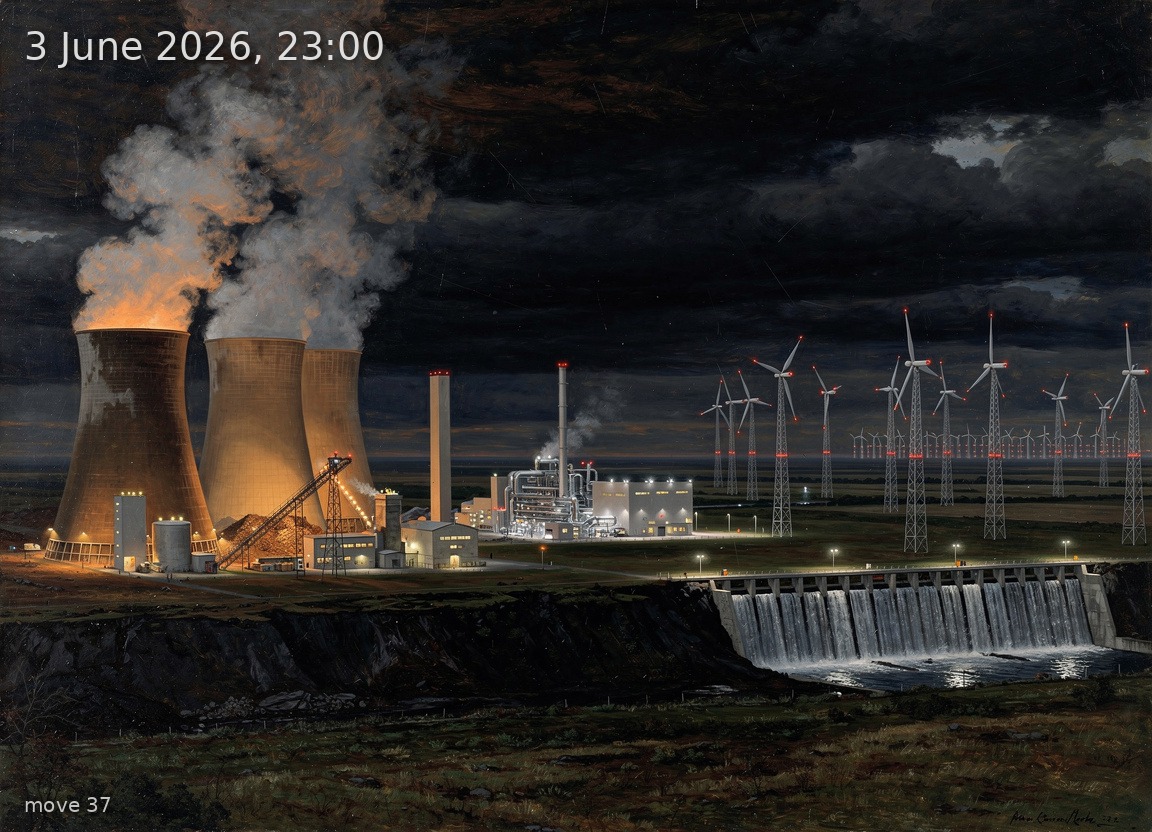
Strong wind dominates a late-night grid requiring 6.4 GW net imports as coal and gas fill the thermal margin.
Back
Generation mix
Wind onshore 44%
Wind offshore 14%
Biomass 10%
Hydro 5%
Natural gas 8%
Hard coal 4%
Brown coal 15%
72%
Renewable share
24.8 GW
Wind (on + offshore)
0.0 GW
Solar
42.4 GW
Total generation
-6.4 GW
Net import
99.4 €/MWh
Day-ahead price
14.9°C / 15 km/h
Temp / Wind speed
Open-Meteo, Kassel (51.3°N 9.5°E)
100.0% / 0.0 W/m²
Cloud cover / Radiation
196
gCO₂/kWh
Image prompt
Wind onshore 18.8 GW spans the right half and recedes into the deep background as dozens of tall three-blade turbines on lattice towers, rotors turning briskly in moderate wind, their red aviation warning lights blinking against a black sky. Wind offshore 5.9 GW appears as a distant cluster of larger turbines on the far-right horizon, barely visible except for their warning lights reflected on a sliver of dark sea. Brown coal 6.5 GW dominates the left foreground as a massive lignite power station with three hyperbolic cooling towers releasing thick white steam plumes lit from below by sodium-orange industrial floodlights. Biomass 4.0 GW sits centre-left as a mid-sized wood-chip-fired plant with a single rectangular stack and a conveyor belt feeding fuel, warmly lit by yellow facility lights. Natural gas 3.4 GW occupies the centre as a compact combined-cycle gas turbine facility with a single tall exhaust stack emitting a thin heat shimmer, illuminated by white LED security lighting. Hydro 2.0 GW appears centre-right as a concrete dam spillway with water flowing, lit by small floodlights. Hard coal 1.8 GW sits to the left of the gas plant as a smaller conventional boiler station with a single cooling tower and a coal conveyor, lit by amber lights. The sky is completely dark, deep navy-to-black, 100% cloud cover blocking all stars and moonlight, creating a heavy oppressive ceiling that presses down on the scene — reflecting the high 99.4 EUR/MWh price. The season is early June: lush green deciduous trees and tall grass are faintly visible in the foreground, swaying in the wind. The air feels damp and cool at 14.9°C. No sunlight, no solar panels anywhere. The landscape stretches across the flat North German Plain. Painted in the style of a highly detailed 19th-century German Romantic oil painting — rich, dark, atmospheric palette of deep blues, blacks, warm oranges, and muted greens — with visible impasto brushwork, dramatic chiaroscuro from the industrial lighting against the pitch-dark sky, meticulous engineering detail on every turbine nacelle, cooling tower, and exhaust stack. The composition evokes Caspar David Friedrich's sublime nocturnal mood merged with industrial realism. No text, no labels.