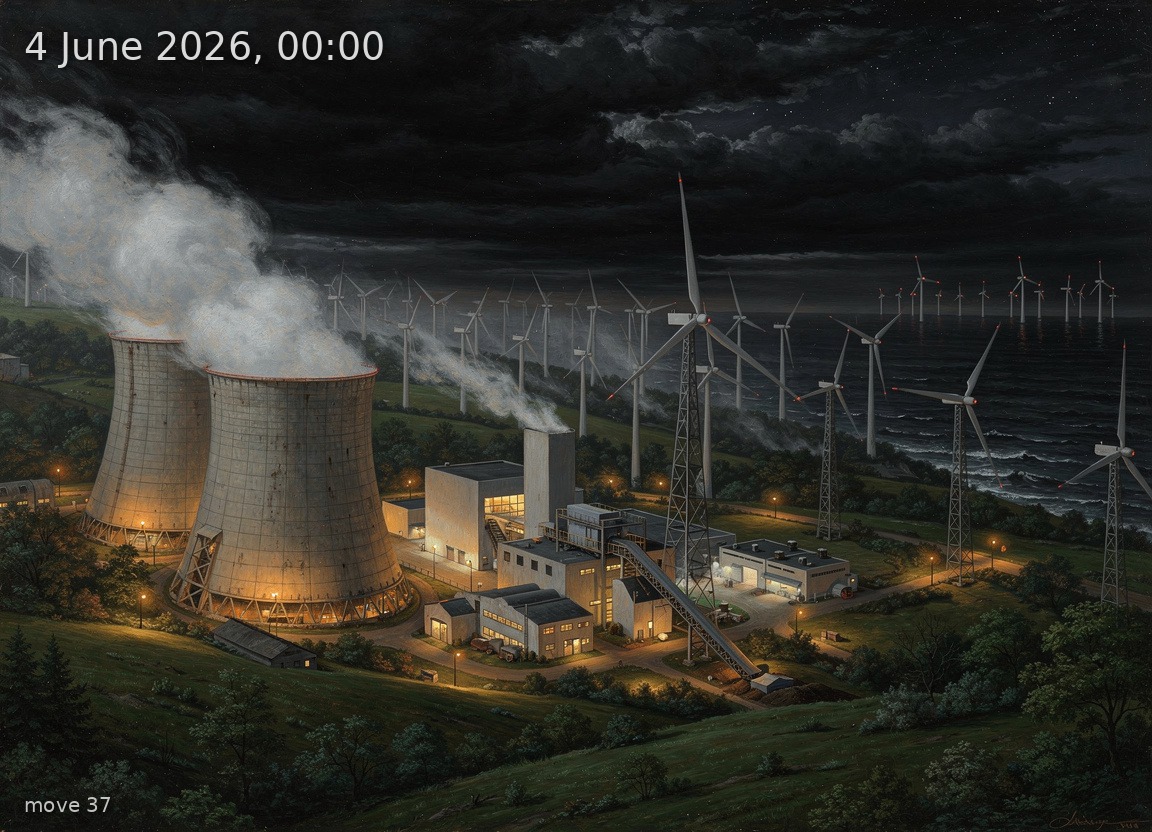
Strong onshore and offshore wind supply two-thirds of overnight generation, with lignite and gas providing baseload support.
Back
Generation mix
Wind onshore 53%
Wind offshore 14%
Biomass 9%
Hydro 4%
Natural gas 7%
Hard coal 4%
Brown coal 10%
79%
Renewable share
30.3 GW
Wind (on + offshore)
0.0 GW
Solar
45.6 GW
Total generation
+0.3 GW
Net export
86.2 €/MWh
Day-ahead price
14.4°C / 20 km/h
Temp / Wind speed
Open-Meteo, Kassel (51.3°N 9.5°E)
76.0% / 0.0 W/m²
Cloud cover / Radiation
146
gCO₂/kWh
Image prompt
Wind onshore 24.0 GW dominates the scene as vast ranks of three-blade turbines on lattice towers stretching across the right two-thirds of the canvas, rotors spinning vigorously in strong wind; wind offshore 6.3 GW appears as a distant cluster of tall offshore turbines visible on the far-right horizon over a dark sea; brown coal 4.7 GW occupies the left foreground as a pair of massive hyperbolic cooling towers with thick white steam plumes rising into the night sky, lit from below by orange sodium lights of an industrial complex; biomass 3.9 GW is rendered as a medium-sized biomass CHP plant with a modest rectangular stack and warm interior glow from conveyor-fed furnace halls, positioned left of centre; natural gas 3.0 GW appears as a compact CCGT plant with twin exhaust stacks and a single smaller cooling tower, placed at centre-left, lit by blue-white industrial floodlights; hydro 1.9 GW is a concrete dam structure in the mid-ground centre with water cascading through turbine outflows, subtly illuminated; hard coal 1.7 GW is a smaller coal plant with a single stack and conveyor infrastructure, partially visible behind the gas plant at far left. The time is midnight: the sky is completely black with no twilight or sky glow, only faint stars occasionally breaking through 76% cloud cover rendered as heavy dark masses overhead. The atmosphere is oppressive and heavy, reflecting the high 86.2 EUR/MWh price—clouds press low, the air feels dense. Temperature is a mild 14°C early June night: lush green vegetation on rolling hills is barely visible in the sodium lamplight, deciduous trees fully leafed. Wind is strong at 20 km/h: grass bends, turbine blades blur with motion, steam plumes shear sideways from cooling towers. Rendered as a highly detailed oil painting in the tradition of 19th-century German Romantic landscape painters—rich, dark colour palette of deep navy, black, warm orange industrial light, and cool grey steam; visible expressive brushwork; atmospheric depth with layers of turbines receding into misty darkness; meticulous engineering accuracy on every nacelle, rotor hub, cooling tower shell, and gas turbine exhaust stack. The painting evokes Caspar David Friedrich's nocturnal sublime, transposed onto an industrial energy landscape. No text, no labels.