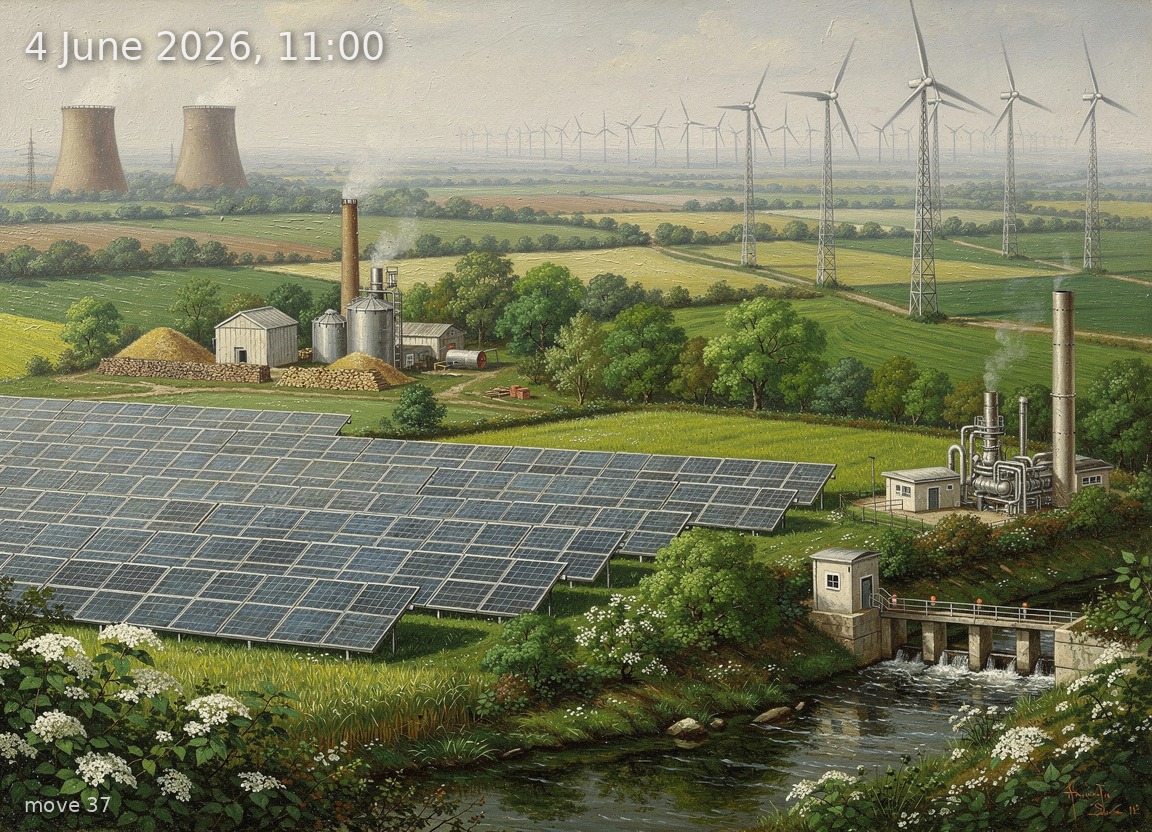
Wind (26.1 GW) and overcast solar (29.3 GW) push Germany to 93% renewables, driving 11.4 GW net exports at zero price.
Back
Generation mix
Wind onshore 32%
Wind offshore 8%
Solar 45%
Biomass 6%
Hydro 3%
Natural gas 2%
Hard coal 1%
Brown coal 3%
93%
Renewable share
26.1 GW
Wind (on + offshore)
29.3 GW
Solar
65.2 GW
Total generation
+11.4 GW
Net export
-0.0 €/MWh
Day-ahead price
18.5°C / 27 km/h
Temp / Wind speed
Open-Meteo, Kassel (51.3°N 9.5°E)
100.0% / 16.0 W/m²
Cloud cover / Radiation
46
gCO₂/kWh
Image prompt
Solar 29.3 GW dominates the foreground as vast fields of aluminium-framed crystalline silicon PV panels stretching across gently rolling central German farmland, covering roughly 45% of the scene; wind onshore 20.8 GW fills the middle distance and right side as dozens of tall three-blade turbines on lattice and tubular towers, rotors spinning briskly in strong wind, occupying about 32% of the composition; wind offshore 5.3 GW appears as a distant row of turbines on the far horizon suggesting the North Sea coast, about 8% of the scene; brown coal 2.2 GW stands at the far left as two hyperbolic cooling towers with thin wisps of steam, small in visual proportion, roughly 3%; biomass 3.7 GW is represented as a modest wood-chip-fed plant with a squat smokestack and wood pile, occupying about 6%; hydro 1.7 GW appears as a small concrete run-of-river weir with a powerhouse beside a green-banked stream, about 3%; natural gas 1.6 GW is a compact single-stack CCGT facility barely running, with a faint heat shimmer from the exhaust, about 2%; hard coal 0.6 GW is a single small coal plant stack with almost no visible emissions, about 1%. TIME: 11:00 Berlin, full daytime but entirely overcast — the sky is a uniform bright pearl-grey, no blue visible, diffuse flat light with no shadows, luminous but sunless. The atmosphere is calm, open, and not oppressive, reflecting a zero electricity price. Lush early-summer vegetation — tall green wheat fields, blooming elderflower hedgerows, bright green deciduous trees in full leaf — at 18.5°C with a fresh breeze bending grasses and rustling leaves. The wind turbine blades show real rotational blur from 27 km/h winds. Style: highly detailed oil painting in the tradition of 19th-century German Romantic landscape painters such as Caspar David Friedrich and Carl Blechen — rich saturated greens and silvery greys, visible impasto brushwork, atmospheric aerial perspective fading into the misty distance, meticulous engineering detail on every turbine nacelle, every PV cell grid line, every cooling tower's parabolic curve, every CCGT exhaust flue. The painting conveys the quiet industrial sublime of a nation powered almost entirely by wind and diffuse light. No text, no labels.