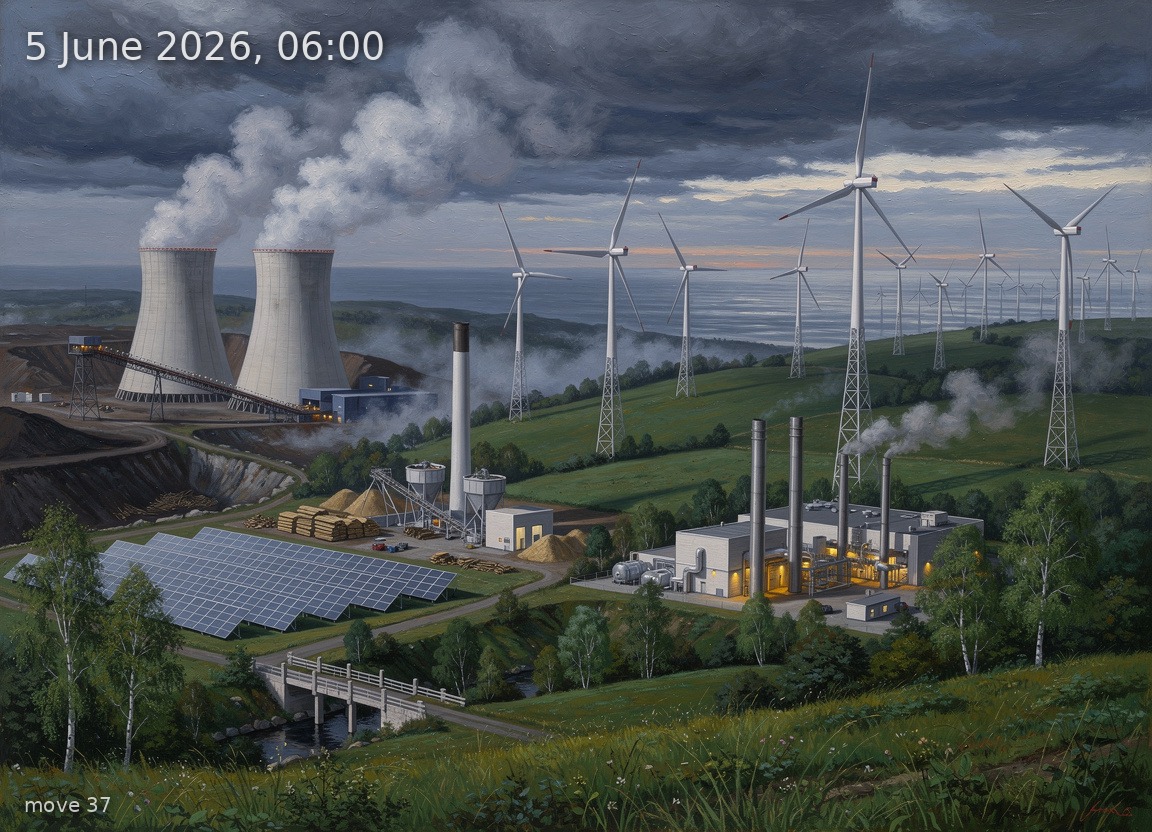
Strong wind dominates at 21.3 GW but net imports of 8.7 GW are needed as overcast skies limit solar at dawn.
Back
Generation mix
Wind onshore 42%
Wind offshore 12%
Solar 7%
Biomass 10%
Hydro 4%
Natural gas 11%
Hard coal 2%
Brown coal 11%
75%
Renewable share
21.3 GW
Wind (on + offshore)
2.8 GW
Solar
39.1 GW
Total generation
-8.8 GW
Net import
114.9 €/MWh
Day-ahead price
10.6°C / 15 km/h
Temp / Wind speed
Open-Meteo, Kassel (51.3°N 9.5°E)
81.0% / 1.0 W/m²
Cloud cover / Radiation
164
gCO₂/kWh
Image prompt
Wind onshore 16.6 GW dominates the right two-thirds of the scene as dozens of tall three-blade turbines with white lattice towers stretching across rolling green hills into the misty distance; wind offshore 4.7 GW appears as a cluster of turbines on the far-right horizon above a grey North Sea sliver; brown coal 4.4 GW occupies the left foreground as two massive hyperbolic cooling towers emitting thick white steam plumes beside a lignite conveyor belt and open pit; natural gas 4.4 GW sits just right of centre as a compact CCGT facility with twin exhaust stacks releasing thin grey exhaust; biomass 3.8 GW is rendered as a mid-ground wood-chip-fired plant with a tall rectangular chimney and stacked timber beside it; solar 2.8 GW appears as a modest field of aluminium-framed crystalline silicon panels in the centre-left middle ground, their surfaces dull and unreflective under thick clouds; hydro 1.6 GW is a small concrete run-of-river weir with white water spilling over it in the left middle distance; hard coal 0.9 GW is a single older smokestack facility barely visible behind the cooling towers. The sky is early dawn at 06:00 in June — a deep blue-grey pre-dawn light with no direct sun, the eastern horizon showing only the faintest pale steel-blue luminescence behind an 81% overcast layer of heavy stratocumulus clouds pressing low and oppressively over the landscape, evoking the high electricity price. The atmosphere is cool at 10.6°C with visible morning mist clinging to valleys. Vegetation is lush early-summer green — tall grasses, young wheat fields, birch and beech trees in full leaf. Wind turbine blades show moderate rotational blur from 15.4 km/h winds. Transmission pylons and high-voltage lines cross the middle ground, symbolising the grid's import dependency. Highly detailed oil painting in the tradition of 19th-century German Romantic landscape painters — Caspar David Friedrich's atmospheric depth merged with industrial realism — rich colour palette of slate blues, moss greens, and warm amber from sodium lights still glowing on facility buildings, visible confident brushwork, meticulous engineering detail on every turbine nacelle, cooling tower ribbing, and panel frame. No text, no labels.