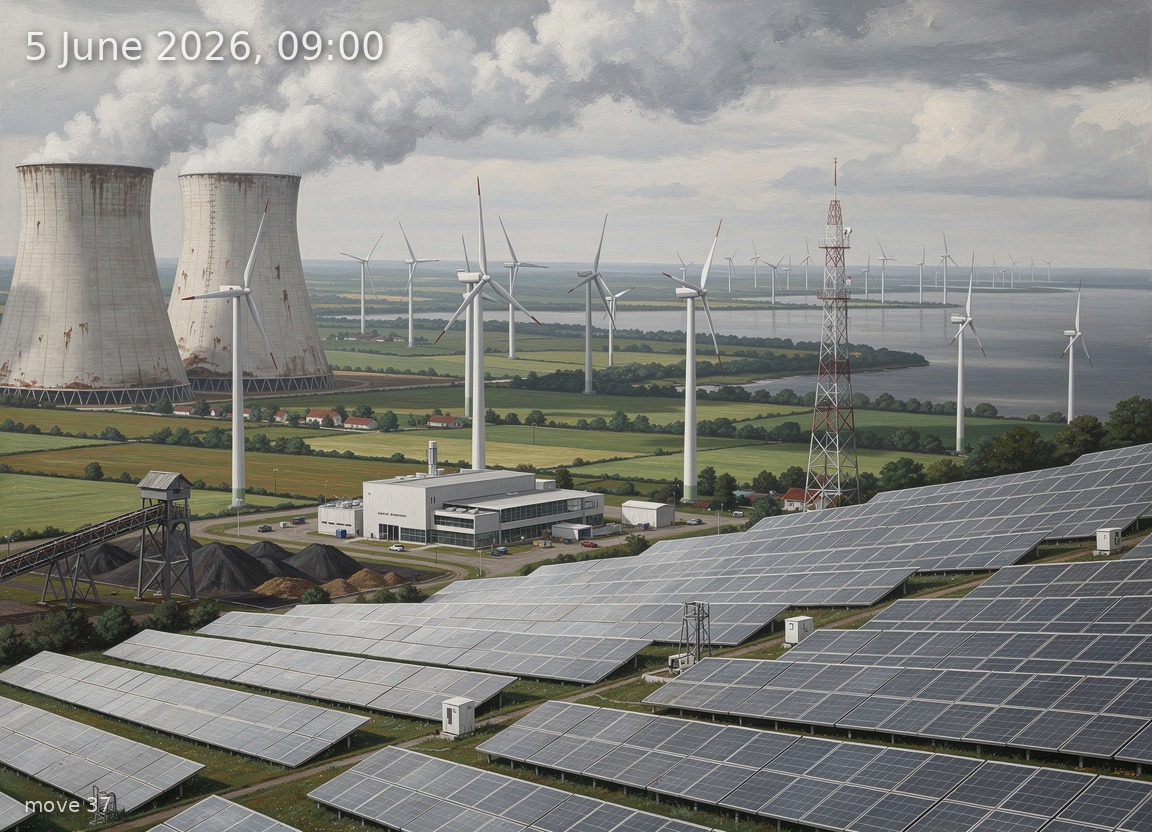
Diffuse solar leads at 21.7 GW with strong wind at 18.2 GW under full overcast, requiring 2.8 GW net imports.
Back
Generation mix
Wind onshore 27%
Wind offshore 7%
Solar 40%
Biomass 8%
Hydro 3%
Natural gas 5%
Hard coal 2%
Brown coal 8%
85%
Renewable share
18.2 GW
Wind (on + offshore)
21.7 GW
Solar
53.7 GW
Total generation
-2.8 GW
Net import
98.3 €/MWh
Day-ahead price
12.6°C / 15 km/h
Temp / Wind speed
Open-Meteo, Kassel (51.3°N 9.5°E)
100.0% / 16.0 W/m²
Cloud cover / Radiation
104
gCO₂/kWh
Image prompt
Solar 21.7 GW dominates the foreground and right side as vast fields of aluminium-framed crystalline silicon PV panels stretching across gentle rolling hills, their glass surfaces reflecting only flat grey light under a completely overcast sky; wind onshore 14.6 GW fills the middle distance as dozens of tall three-blade turbines on lattice and tubular towers, rotors turning steadily in moderate wind across green early-summer farmland; wind offshore 3.6 GW appears as a cluster of turbines on the far horizon above a grey sea inlet; brown coal 4.3 GW occupies the left background as a pair of massive hyperbolic cooling towers emitting thick white steam plumes into the low ceiling of cloud, with a conveyor belt of dark lignite visible; biomass 4.0 GW is rendered as a wood-chip-fed combined heat and power plant with a tall rectangular stack and stored timber rounds beside it, positioned left of centre; natural gas 2.8 GW appears as a compact modern CCGT facility with a single polished exhaust stack and slim heat-recovery unit, positioned centre-left; hydro 1.6 GW is a small concrete run-of-river dam with white water spilling over, tucked into a wooded valley at the far left; hard coal 0.9 GW is a small older power station with a single square chimney emitting a thin grey wisp, barely visible behind the cooling towers. The sky is a heavy, uniform blanket of steel-grey stratus clouds pressing down oppressively, no blue visible anywhere, no direct sunlight, diffuse illumination consistent with full daylight at 09:00 in June but muted and flat. Temperature is cool at 12.6°C: the vegetation is lush early-summer green but colours appear subdued under the overcast. The atmosphere feels weighty and pressured, reflecting an elevated electricity price. Style: highly detailed oil painting in the tradition of 19th-century German Romantic landscape masters such as Caspar David Friedrich and Carl Blechen—rich layered colour, visible confident brushwork, atmospheric depth and sfumato in the clouds, meticulous engineering detail on every turbine nacelle, PV cell grid, cooling tower concrete texture, and exhaust stack. The composition balances industrial grandeur with natural landscape, evoking a modern sublime. No text, no labels.