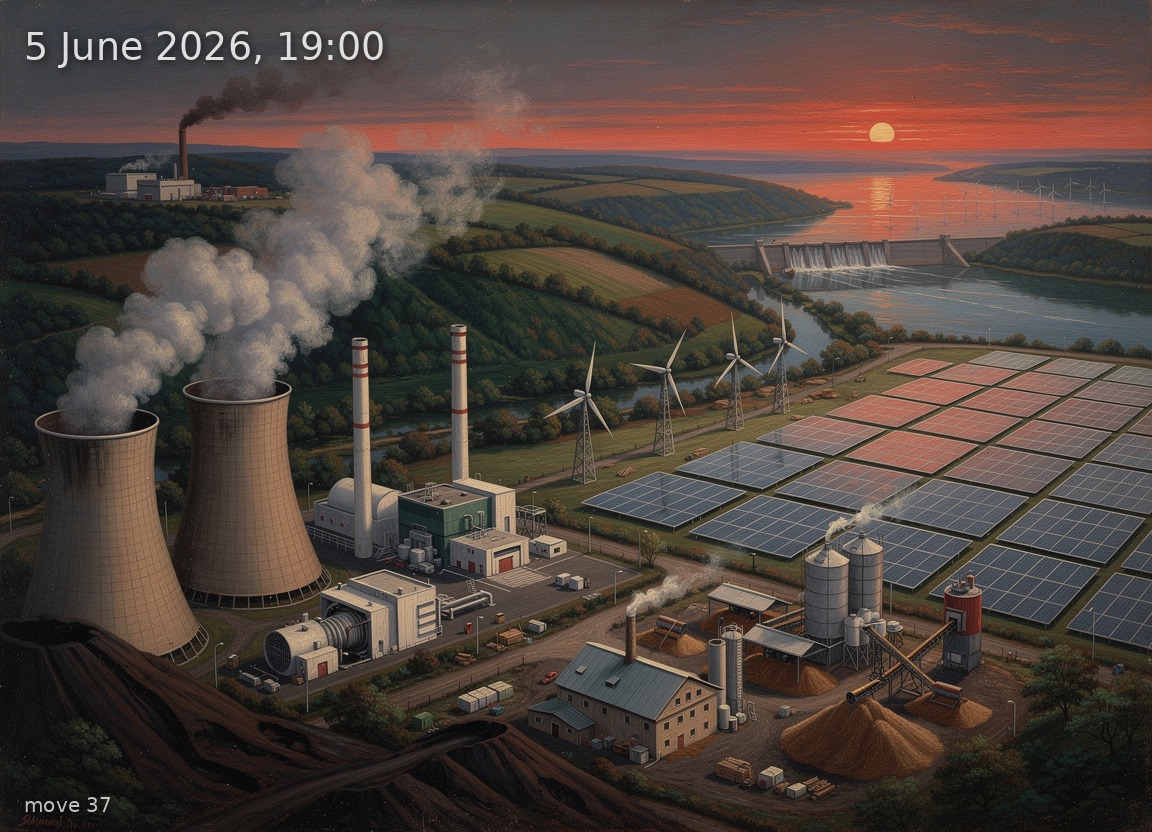
Fading solar and steady brown coal anchor 30 GW domestic output against 54 GW demand, driving heavy net imports.
Back
Generation mix
Wind onshore 13%
Wind offshore 3%
Solar 25%
Biomass 13%
Hydro 6%
Natural gas 16%
Hard coal 5%
Brown coal 18%
61%
Renewable share
4.9 GW
Wind (on + offshore)
7.6 GW
Solar
30.0 GW
Total generation
-24.1 GW
Net import
150.5 €/MWh
Day-ahead price
18.1°C / 7 km/h
Temp / Wind speed
Open-Meteo, Kassel (51.3°N 9.5°E)
48.0% / 59.0 W/m²
Cloud cover / Radiation
261
gCO₂/kWh
Image prompt
Solar 7.6 GW occupies the right quarter as rows of aluminium-framed crystalline silicon PV panels catching the last orange-red rays of a setting sun; brown coal 5.4 GW dominates the left foreground as three massive hyperbolic cooling towers emitting thick white-grey steam plumes; natural gas 4.8 GW sits centre-left as two compact CCGT power blocks with tall single exhaust stacks releasing thin heat shimmer; wind onshore 4.0 GW appears across the mid-ground as a modest line of three-blade turbines on lattice towers, blades barely turning in light breeze; biomass 4.0 GW is rendered centre-right as a cluster of industrial wood-chip facilities with squat chimneys and conveyor belts; hydro 1.9 GW appears as a concrete dam nestled in a green valley in the far middle distance; hard coal 1.4 GW shows as a single coal plant with a rectangular stack trailing dark smoke at the far left; wind offshore 0.9 GW is visible as a tiny cluster of turbines on the distant hazy horizon line. The sky is a dusk scene at 19:00 in June — the sun is very low on the western horizon casting a deep orange-red glow along the bottom edge of the sky, with the upper sky transitioning rapidly from warm amber to deepening steel blue. Clouds cover roughly half the sky in ragged alto-stratus bands lit copper-gold from below. The atmosphere feels heavy and oppressive, reflecting a high electricity price — haze thickens the air, giving the scene a brooding, weighty quality. Temperature is mild at 18°C; lush green deciduous trees and tall summer grasses fill the foreground. The landscape is a broad German river valley with rolling hills. Painted in the style of a highly detailed 19th-century German Romantic oil painting — rich, saturated colours, visible layered brushwork, deep atmospheric perspective — yet every piece of energy infrastructure is rendered with meticulous engineering accuracy: turbine nacelles, three-blade rotors, cooling tower parabolic curves, CCGT exhaust geometries, PV module grid patterns. No text, no labels.