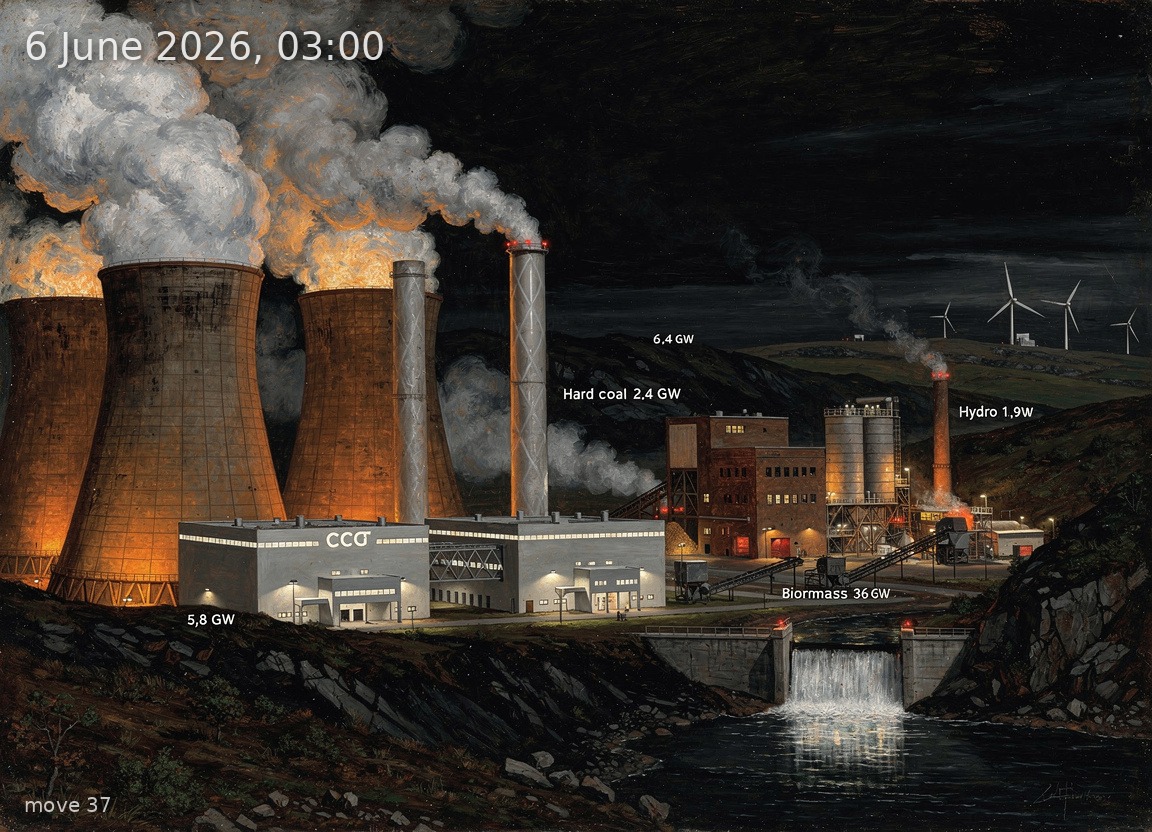
Brown coal and gas dominate overnight generation as near-zero wind forces heavy net imports of 18.2 GW.
Back
Generation mix
Wind onshore 6%
Wind offshore 2%
Biomass 17%
Hydro 9%
Natural gas 27%
Hard coal 11%
Brown coal 29%
33%
Renewable share
1.7 GW
Wind (on + offshore)
0.0 GW
Solar
21.9 GW
Total generation
-18.3 GW
Net import
116.2 €/MWh
Day-ahead price
10.6°C / 1 km/h
Temp / Wind speed
Open-Meteo, Kassel (51.3°N 9.5°E)
100.0% / 0.0 W/m²
Cloud cover / Radiation
452
gCO₂/kWh
Image prompt
Brown coal 6.4 GW dominates the left third of the scene as a massive lignite power station with three hyperbolic cooling towers emitting thick white steam plumes lit from below by orange sodium lamps; natural gas 5.8 GW fills the centre-left as two compact CCGT units with tall single exhaust stacks venting translucent heat shimmer; hard coal 2.4 GW appears centre-right as a smaller coal plant with a single rectangular boiler house and conveyor belt; biomass 3.6 GW is rendered as a cluster of industrial biomass facilities with cylindrical wood-chip silos and modest chimneys glowing warmly; hydro 1.9 GW sits at the far right as a concrete dam with water spilling over a lit spillway; wind onshore 1.4 GW appears as a few distant three-blade turbines on a ridge, rotors barely turning, their red aviation lights blinking faintly; wind offshore 0.4 GW is barely suggested as a single tiny turbine silhouette on a far horizon line over dark water. The sky is completely black and starless under total 100% cloud cover — no moon, no twilight, deep navy-black atmosphere pressing down oppressively to reflect the high 116.2 EUR/MWh price. The entire scene is lit only by artificial light: sodium-orange streetlights along an access road, fluorescent windows in control buildings, the red glow of furnace doors, and the ghostly white steam columns caught in industrial floodlights. The foreground is damp green grass with early-summer wildflowers barely visible, temperature around 10°C suggested by condensation and cool mist rising from the ground. Transmission pylons recede into darkness toward distant borders, hinting at the massive 18 GW import flow. Painted in the style of a highly detailed 19th-century German Romantic oil painting — rich, dark palette of Caspar David Friedrich's night scenes — with visible, textured brushwork, dramatic chiaroscuro, deep atmospheric perspective, but with meticulous engineering accuracy in every cooling tower curve, turbine nacelle, and exhaust stack. No text, no labels.