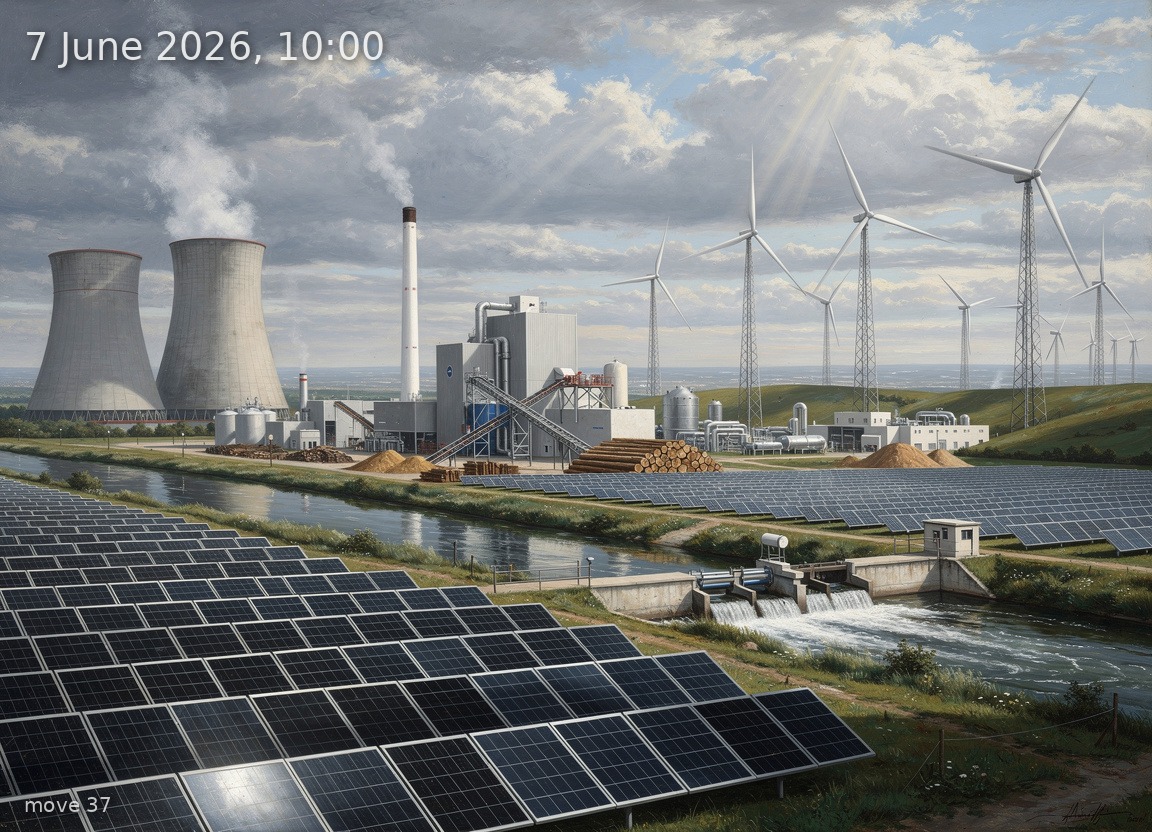
Solar at 31.4 GW and wind at 19.0 GW drive 9.9 GW net exports and a negative electricity price.
Back
Generation mix
Wind onshore 28%
Wind offshore 4%
Solar 53%
Biomass 6%
Hydro 2%
Natural gas 3%
Hard coal 1%
Brown coal 4%
93%
Renewable share
19.0 GW
Wind (on + offshore)
31.4 GW
Solar
59.5 GW
Total generation
+9.9 GW
Net export
-8.0 €/MWh
Day-ahead price
16.8°C / 22 km/h
Temp / Wind speed
Open-Meteo, Kassel (51.3°N 9.5°E)
81.0% / 301.0 W/m²
Cloud cover / Radiation
48
gCO₂/kWh
Image prompt
Solar 31.4 GW dominates the scene as vast fields of aluminium-framed crystalline silicon PV panels stretching across the entire foreground and middle ground, their blue-black surfaces catching filtered light; wind onshore 16.9 GW fills the right two-thirds of the background as dozens of tall three-blade turbines on lattice and tubular towers, rotors turning briskly in strong wind; wind offshore 2.1 GW appears as a distant cluster of turbines on the far-right horizon above a faintly visible sea; biomass 3.7 GW is rendered as a mid-sized wood-chip power plant with a modest smokestack and timber storage yard at left-center; brown coal 2.3 GW sits in the far left as a pair of hyperbolic cooling towers with thin white steam plumes rising; natural gas 1.5 GW appears as a compact CCGT plant with a single sleek exhaust stack beside the cooling towers; hydro 1.3 GW is a small run-of-river weir with turbine house visible along a gentle river winding through the middle distance; hard coal 0.4 GW is a single small industrial chimney barely visible behind the biomass plant. The sky is 81% overcast with layered broken cumulus clouds, but shafts of bright midmorning sunlight pierce through gaps, casting patches of warm illumination across the solar fields — full daytime lighting at 10:00 in June. The atmosphere is calm and expansive, reflecting the negative price — open, airy, unburdened. Temperature is mild at 16.8°C; lush early-summer green vegetation, wildflowers along field margins, deciduous trees in full leaf. Wind visibly animates the scene: grass bending, turbine blades in motion blur. Style: highly detailed oil painting in the tradition of 19th-century German Romantic landscape painters — Caspar David Friedrich meets industrial modernity — rich saturated greens and sky blues, visible confident brushwork, atmospheric aerial perspective, meticulous engineering detail on every turbine nacelle, every PV panel frame, every cooling tower curve. No text, no labels.