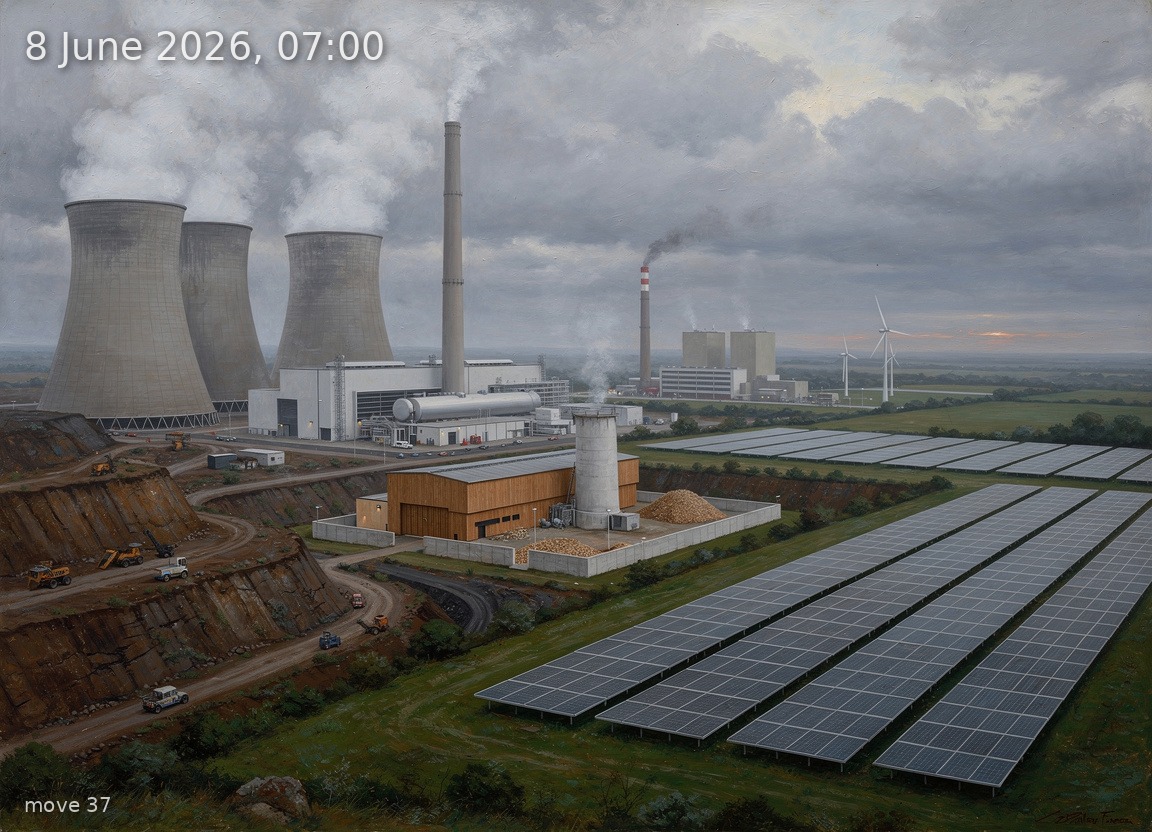
Overcast skies limit solar yield while near-calm winds and high coal and gas output support a 18.8 GW net import requirement.
Back
Generation mix
Wind onshore 11%
Wind offshore 7%
Solar 32%
Biomass 10%
Hydro 4%
Natural gas 13%
Hard coal 6%
Brown coal 18%
64%
Renewable share
7.1 GW
Wind (on + offshore)
12.5 GW
Solar
39.1 GW
Total generation
-18.8 GW
Net import
145.7 €/MWh
Day-ahead price
9.2°C / 1 km/h
Temp / Wind speed
Open-Meteo, Kassel (51.3°N 9.5°E)
100.0% / 1.0 W/m²
Cloud cover / Radiation
252
gCO₂/kWh
Image prompt
Brown coal 6.9 GW dominates the left quarter of the scene as a cluster of massive hyperbolic cooling towers with thick white-grey steam plumes merging into the overcast sky, surrounded by open-pit lignite mine terraces; natural gas 5.0 GW occupies the left-centre as two compact CCGT plants with tall single exhaust stacks emitting thin heat shimmer; hard coal 2.3 GW appears behind them as a smaller conventional power station with a pair of rectangular boiler buildings and a single smokestack; solar 12.5 GW fills the entire right half as vast fields of aluminium-framed crystalline silicon PV panels stretching to the horizon across rolling farmland, their surfaces dull and grey under the dense cloud cover, reflecting no sunlight; wind onshore 4.2 GW appears as a scattered line of tall three-blade turbines with white lattice towers on gentle hills in the mid-ground, their rotors almost motionless in the dead-calm air; wind offshore 2.9 GW is suggested in the far distance as tiny turbines on a grey horizon line above a sliver of the North Sea; biomass 3.8 GW is rendered as a mid-sized wood-clad biomass plant with a short cylindrical stack and a pile of wood chips beside it, positioned between the coal and gas facilities; hydro 1.5 GW appears as a small concrete run-of-river weir with foaming white water in the lower-right foreground. Time of day is early morning at 07:00 in June — the sky is a pale blue-grey pre-dawn-to-dawn transition with no direct sunlight visible, the cloud deck is total and oppressive at 100% cover, lending a heavy, brooding atmosphere consistent with a high electricity price. The temperature is a cool 9.2°C: lush green early-summer vegetation covers the fields but with morning dew and a slight mist clinging to low ground. The air is perfectly still — no motion blur on grass or leaves. Style: highly detailed oil painting in the tradition of 19th-century German Romantic landscape painters such as Caspar David Friedrich and Carl Blechen — rich muted earth tones, visible impasto brushwork, deep atmospheric perspective with layered fog, meticulous engineering detail on every turbine nacelle, cooling tower, PV panel frame, and smokestack. The scene conveys industrial vastness under an indifferent sky. No text, no labels.