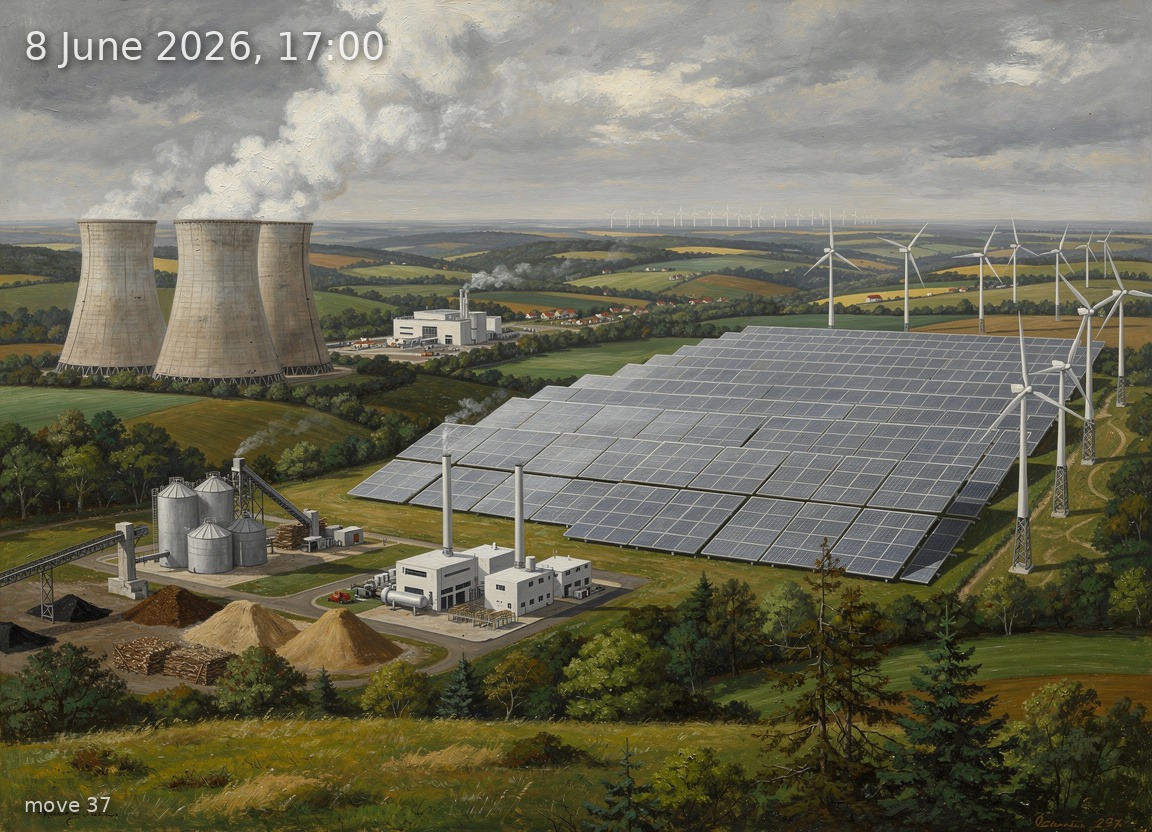
Overcast skies limit solar output; brown coal, gas, and 15 GW net imports bridge the consumption gap.
Back
Generation mix
Wind onshore 15%
Wind offshore 3%
Solar 41%
Biomass 9%
Hydro 3%
Natural gas 10%
Hard coal 6%
Brown coal 13%
72%
Renewable share
8.0 GW
Wind (on + offshore)
17.9 GW
Solar
43.3 GW
Total generation
-15.3 GW
Net import
128.9 €/MWh
Day-ahead price
23.7°C / 19 km/h
Temp / Wind speed
Open-Meteo, Kassel (51.3°N 9.5°E)
98.0% / 18.0 W/m²
Cloud cover / Radiation
197
gCO₂/kWh
Image prompt
Solar 17.9 GW dominates the centre-right as vast fields of aluminium-framed crystalline silicon PV panels stretching across gentle farmland, their surfaces reflecting only dull grey light under total overcast; wind onshore 6.6 GW fills the right quarter as dozens of tall three-blade turbines on lattice and tubular towers, rotors turning at moderate speed in 19 km/h winds; brown coal 5.5 GW occupies the left foreground as a cluster of massive hyperbolic cooling towers with thick white steam plumes drifting eastward against the grey sky; natural gas 4.3 GW appears as a pair of compact CCGT plants with tall narrow exhaust stacks releasing thin heat shimmer just left of centre; biomass 3.7 GW shows as a wood-chip-fed power station with conical fuel silos and a modest smokestack in the mid-ground left; hard coal 2.5 GW is rendered as a single coal-fired plant with precipitator towers and a conveyor belt of dark fuel visible at far left; wind offshore 1.3 GW appears as a distant line of turbines on the horizon suggesting the North Sea coast; hydro 1.5 GW is a small run-of-river station with weir and turbine house nestled along a river in the right foreground. The sky is entirely overcast at 98% cloud cover — a thick, oppressive, unbroken blanket of warm grey stratus with no blue visible, pressing down heavily to convey the 128.9 EUR/MWh price tension. Time is 17:00 dusk in June: the sun is still above the horizon but completely hidden, casting only a faint diffuse warmth with a hint of orange-amber glow low on the western horizon bleeding weakly through the cloud base, the upper sky darkening to slate grey. Temperature is 23.7°C: lush green summer vegetation, full leafy deciduous trees, tall grass in meadows. The landscape is rolling central German terrain — Thuringia or Hesse — with mixed farmland and gentle hills. Highly detailed oil painting in the tradition of 19th-century German Romantic landscape painters — Caspar David Friedrich's atmospheric depth meets Carl Blechen's industrial honesty — rich colour palette of greys, muted greens, ochres, and warm browns, visible impasto brushwork, dramatic chiaroscuro despite diffuse light, meticulous engineering detail on every turbine nacelle, every cooling tower's hyperbolic curve, every PV panel's cell grid. No text, no labels.