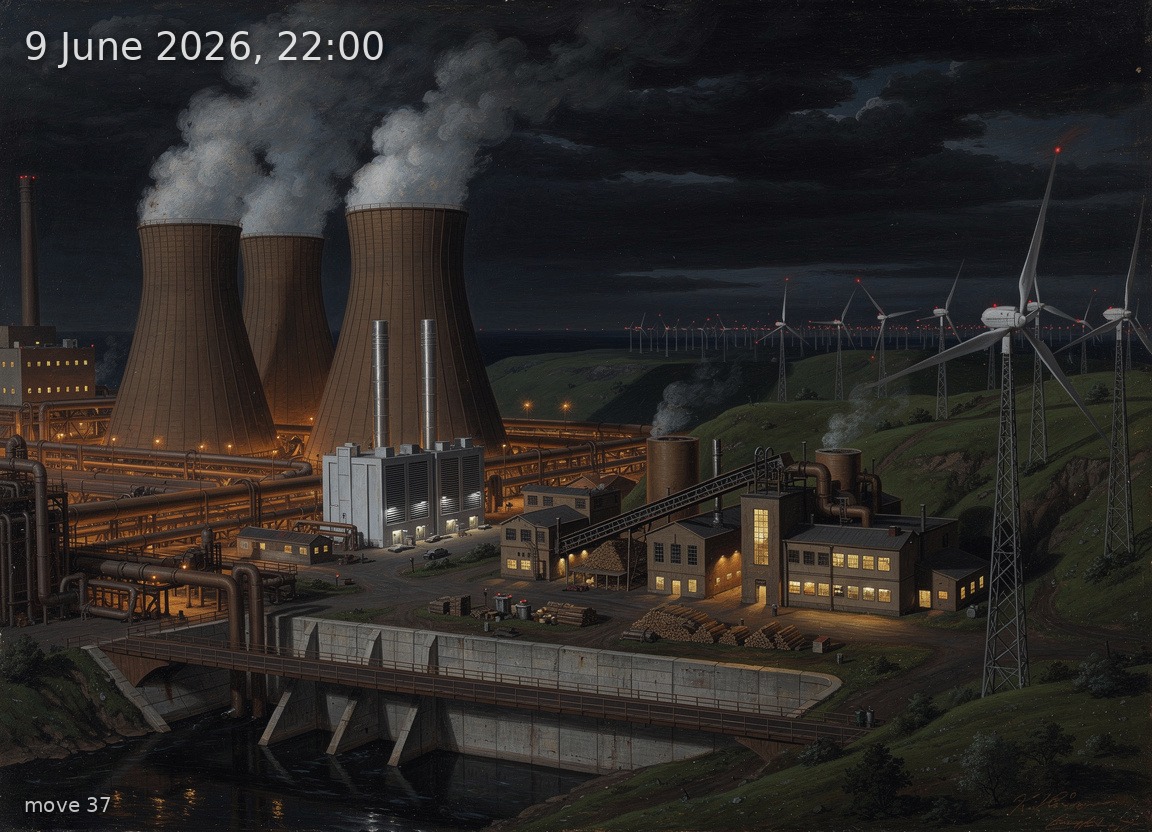
Wind and brown coal anchor nighttime generation as Germany imports roughly 21 GW under elevated prices.
Back
Generation mix
Wind onshore 30%
Wind offshore 10%
Solar 0%
Biomass 13%
Hydro 6%
Natural gas 14%
Hard coal 6%
Brown coal 21%
59%
Renewable share
12.5 GW
Wind (on + offshore)
0.0 GW
Solar
31.5 GW
Total generation
-21.1 GW
Net import
145.0 €/MWh
Day-ahead price
15.1°C / 4 km/h
Temp / Wind speed
Open-Meteo, Kassel (51.3°N 9.5°E)
100.0% / 0.0 W/m²
Cloud cover / Radiation
287
gCO₂/kWh
Image prompt
Brown coal 6.6 GW dominates the left quarter of the scene as three massive hyperbolic cooling towers with thick white steam plumes rising into darkness, lit from below by orange sodium lamps illuminating the sprawling lignite plant infrastructure. Natural gas 4.3 GW appears center-left as two compact CCGT units with tall single exhaust stacks emitting thin heat shimmer, their metallic housings gleaming under floodlights. Biomass 4.2 GW sits just right of center as a cluster of industrial wood-pellet combustion facilities with conveyor belts and modest chimneys glowing warmly. Wind onshore 9.3 GW spans the right third of the composition as dozens of three-blade turbines on lattice and tubular towers stretching across rolling hills, their red aviation warning lights blinking in the darkness, blades turning slowly in light 4.2 km/h wind. Wind offshore 3.3 GW appears in the far background right as a distant line of turbines standing in a dark sea, marked by faint red lights on the horizon. Hard coal 2.0 GW is a single conventional power station with a rectangular smokestack at the far left edge, modestly lit. Hydro 1.9 GW appears as a concrete dam structure nestled in a valley in the mid-ground, water faintly reflecting artificial light. The sky is completely dark, deep navy-black, fully overcast at 100% cloud cover with no stars and no moon visible, no twilight glow whatsoever — pure nighttime at 22:00. The atmosphere feels heavy and oppressive, reflecting 145 EUR/MWh pricing — low-hanging clouds press down on the industrial landscape. Temperature is a mild 15°C early summer night; vegetation is lush green but barely visible, revealed only where floodlights and sodium streetlights cast pools of amber light. A network of high-voltage transmission lines with steel pylons crosses the scene, symbolizing the massive import flows. Painted in the style of a highly detailed 19th-century German Romantic oil painting — rich impasto brushwork, deep chiaroscuro contrasts between industrial fire-glow and surrounding darkness, atmospheric depth with haze and steam merging into the oppressive cloud ceiling. Meticulous engineering detail on every turbine nacelle, cooling tower ribbing, and gas turbine exhaust stack. No text, no labels.