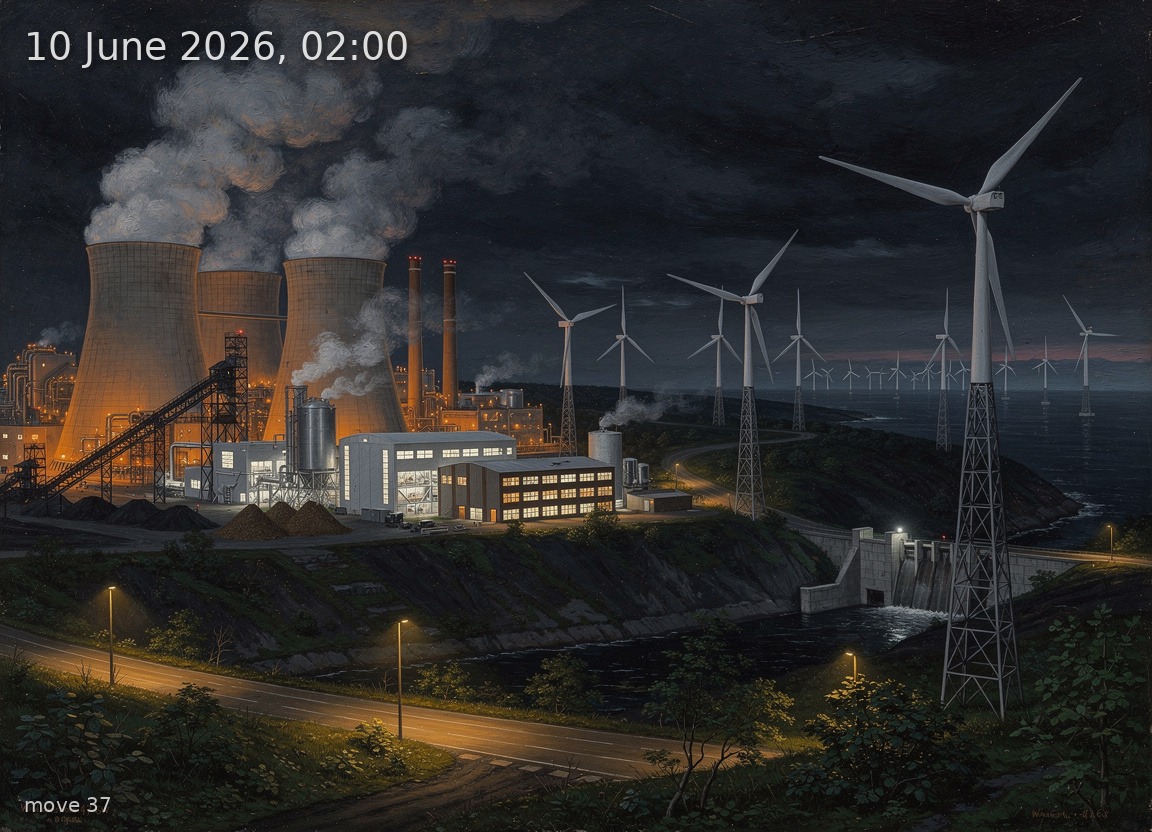
Wind leads at 17.2 GW but 9.5 GW of net imports are needed as brown coal and gas cover residual nighttime load.
Back
Generation mix
Wind onshore 35%
Wind offshore 13%
Biomass 11%
Hydro 5%
Natural gas 11%
Hard coal 6%
Brown coal 19%
65%
Renewable share
17.3 GW
Wind (on + offshore)
0.0 GW
Solar
35.4 GW
Total generation
-9.5 GW
Net import
111.1 €/MWh
Day-ahead price
10.6°C / 9 km/h
Temp / Wind speed
Open-Meteo, Kassel (51.3°N 9.5°E)
98.0% / 0.0 W/m²
Cloud cover / Radiation
249
gCO₂/kWh
Image prompt
Wind onshore 12.5 GW dominates the right half of the scene as dozens of three-blade turbines on tall lattice towers stretching across rolling dark hills, rotors turning steadily; wind offshore 4.7 GW appears in the far-right background as a cluster of offshore turbines visible beyond a dark coastline silhouette; brown coal 6.6 GW occupies the left quarter as a massive lignite power station with three hyperbolic cooling towers emitting thick white steam plumes lit from below by sodium-orange industrial lights; natural gas 3.9 GW sits left of centre as a compact CCGT facility with twin exhaust stacks venting thin vapour, illuminated by floodlights; hard coal 2.0 GW appears as a smaller coal plant with a single tall smokestack and conveyor infrastructure near the lignite station; biomass 3.8 GW is rendered as a mid-sized industrial plant with a cylindrical silo and wood-chip storage yard, warm interior glow visible through windows, positioned centre-left; hydro 1.8 GW appears as a small concrete dam and powerhouse nestled in a valley in the centre-background, with a faint security light on the spillway. The sky is completely dark, deep navy-to-black, 98% overcast with no stars or moon visible, only the faintest differentiation in cloud texture. No solar panels anywhere. The atmosphere is heavy and oppressive, reflecting the high electricity price. Sodium streetlights cast amber pools along a road in the foreground. Temperature is cool at 10.6°C; vegetation is lush early-summer green visible only where artificial light touches it—dew glistens on grass. Painted in the style of a highly detailed 19th-century German Romantic oil painting with rich colour, visible impasto brushwork, and atmospheric depth, combining Caspar David Friedrich's moody grandeur with meticulous industrial-engineering accuracy: turbine nacelles with correct three-blade rotors, aluminium-clad CCGT housings, lignite cooling towers with precise hyperbolic curvature and condensation plumes. No text, no labels.