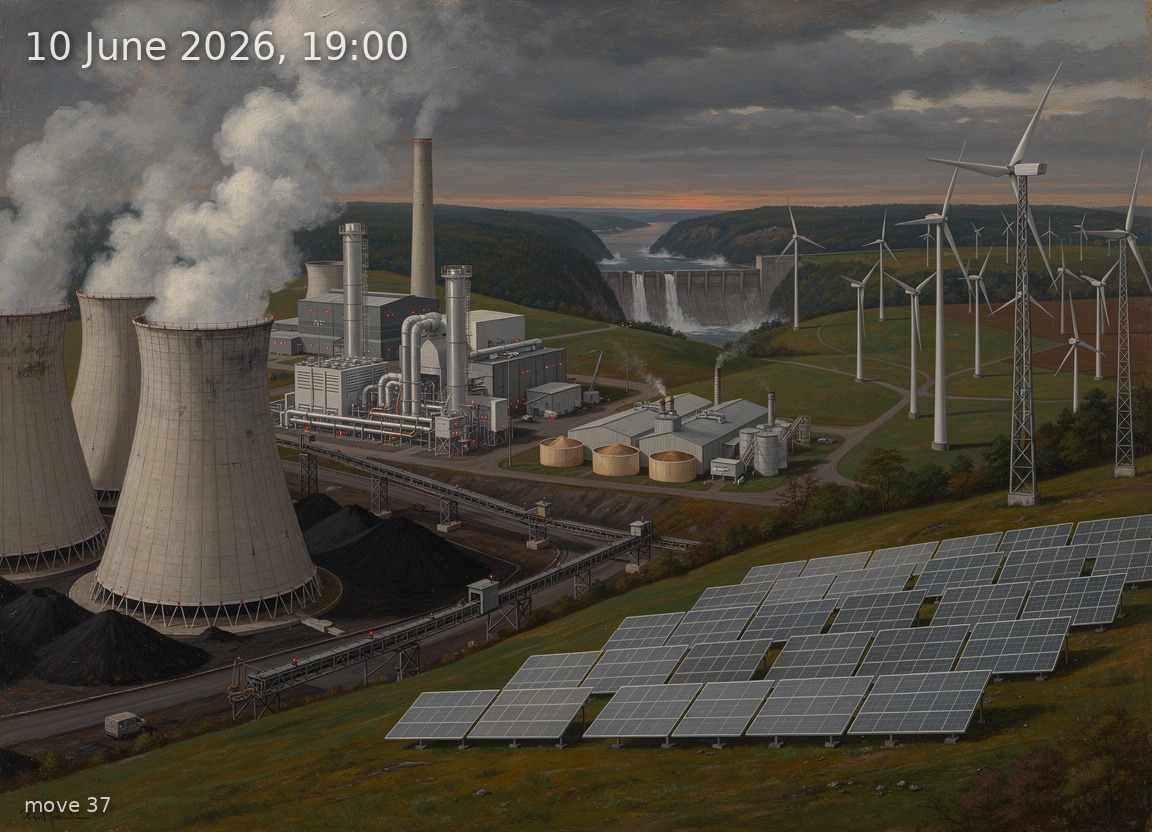
Brown coal and gas anchor a 34.4 GW supply as heavy cloud cover and strong imports meet 58.2 GW evening demand.
Back
Generation mix
Wind onshore 16%
Wind offshore 2%
Solar 17%
Biomass 12%
Hydro 6%
Natural gas 18%
Hard coal 8%
Brown coal 22%
52%
Renewable share
6.1 GW
Wind (on + offshore)
5.8 GW
Solar
34.4 GW
Total generation
-23.7 GW
Net import
171.0 €/MWh
Day-ahead price
16.2°C / 20 km/h
Temp / Wind speed
Open-Meteo, Kassel (51.3°N 9.5°E)
94.0% / 75.0 W/m²
Cloud cover / Radiation
328
gCO₂/kWh
Image prompt
Brown coal 7.6 GW dominates the left quarter of the scene as a cluster of massive hyperbolic cooling towers emitting thick white-grey steam plumes into an overcast sky, with conveyor belts of dark lignite visible at their base. Natural gas 6.1 GW occupies the left-centre as a compact CCGT plant with tall slender exhaust stacks and smaller vapour trails. Solar 5.8 GW appears centre-right as expansive rows of aluminium-framed crystalline silicon PV panels on green farmland, their surfaces dull and unreflective under the heavy clouds, catching only diffuse grey light. Wind onshore 5.4 GW fills the right third as dozens of three-blade turbines on lattice and tubular towers, rotors visibly turning in moderate wind, scattered across rolling hills. Biomass 4.0 GW is rendered as a cluster of modest industrial buildings with short chimneys and woodchip storage silos in the middle distance. Hard coal 2.8 GW appears as a smaller coal-fired station behind the lignite plant, with a single concrete chimney and a smaller cooling tower. Hydro 2.0 GW is depicted as a concrete dam and spillway nestled in a forested valley in the far background. Wind offshore 0.7 GW is barely visible as a few tiny turbines on the far horizon line. The sky is dusk at 19:00 in June — a narrow band of orange-red glow along the lower western horizon rapidly fading into deep grey-blue above, with 94% cloud cover creating a heavy, oppressive ceiling of stratocumulus. The atmosphere feels weighty and pressured, reflecting the high electricity price. Green deciduous trees in full summer leaf frame the scene, with grass at a lush mid-June height, temperature around 16°C lending a cool dampness. Moderate wind at 19.6 km/h bends grasses and stirs leaves. Style: highly detailed oil painting in the tradition of 19th-century German Romantic landscape painters — Caspar David Friedrich meets industrial realism — with rich, moody colour palette of slate greys, warm ambers, and deep greens, visible impasto brushwork, and atmospheric aerial perspective. Meticulous engineering detail on every technology: turbine nacelles, rotor blade pitch mechanisms, cooling tower ribbing, PV cell grid patterns. No text, no labels.