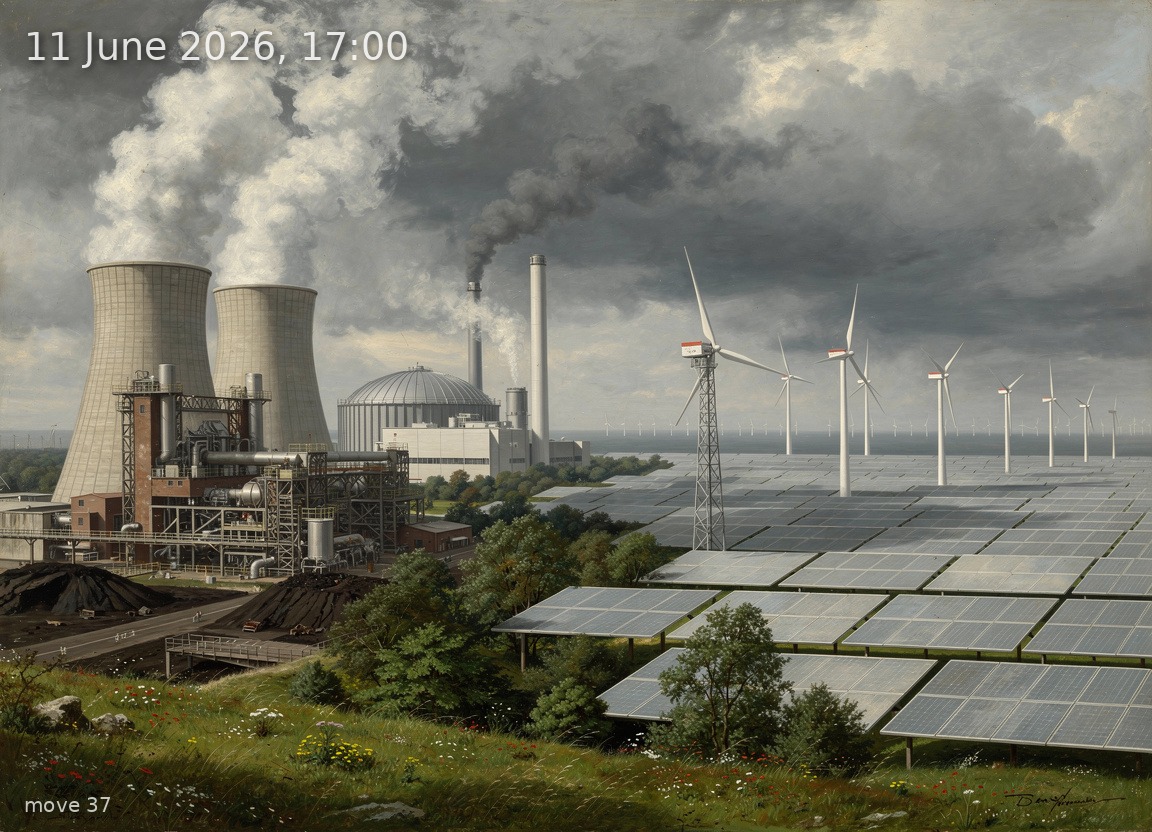
Solar (21.9 GW) and wind (11.8 GW) dominate but 12.9 GW net imports fill a persistent generation gap.
Back
Generation mix
Wind onshore 22%
Wind offshore 4%
Solar 48%
Biomass 8%
Hydro 4%
Natural gas 5%
Hard coal 1%
Brown coal 8%
85%
Renewable share
11.8 GW
Wind (on + offshore)
21.9 GW
Solar
46.0 GW
Total generation
-12.9 GW
Net import
101.6 €/MWh
Day-ahead price
16.6°C / 13 km/h
Temp / Wind speed
Open-Meteo, Kassel (51.3°N 9.5°E)
98.0% / 173.0 W/m²
Cloud cover / Radiation
103
gCO₂/kWh
Image prompt
Solar 21.9 GW dominates the right half of the scene as vast fields of aluminium-framed crystalline silicon PV panels stretching toward the horizon, catching faint diffuse light; wind onshore 10.1 GW fills the centre-right as dozens of tall three-blade turbines on lattice and tubular towers with nacelles slowly turning in moderate wind; wind offshore 1.7 GW appears as a distant cluster of turbines on a hazy horizon line; brown coal 3.9 GW occupies the left foreground as a lignite power station with two massive hyperbolic cooling towers emitting thick white steam plumes; biomass 3.6 GW sits behind the coal plant as a mid-sized facility with a rounded silo and a single smokestack with thin grey exhaust; natural gas 2.2 GW appears as a compact CCGT plant with a single tall exhaust stack and a modest steam plume, placed left of centre; hydro 1.9 GW is a concrete dam built into a hillside at the far left with water cascading through spillways; hard coal 0.6 GW is a small single-stack power station partially hidden behind the lignite complex. The sky is 98% overcast with a thick heavy ceiling of grey stratocumulus, oppressive and dense, reflecting the high electricity price; the lower western horizon glows with a dim orange-red band of fading dusk light at 17:00, the sky above deepening from slate grey to blue-grey. Temperature is a mild 16.6°C in early summer; trees and meadows around the solar field are lush deep green, wildflowers blooming, grass slightly bending in 12.6 km/h wind. Direct radiation is weak, the panels reflecting only pale silvery light rather than bright sunbeams. Atmosphere feels heavy, humid, pressing. Rendered as a highly detailed oil painting in the tradition of 19th-century German Romantic landscape painters — Caspar David Friedrich meets industrial sublime — rich saturated colour, visible thick brushwork, dramatic atmospheric depth and chiaroscuro, meticulous engineering detail on every turbine nacelle, every PV cell edge, every cooling tower's ribbed concrete surface. No text, no labels.