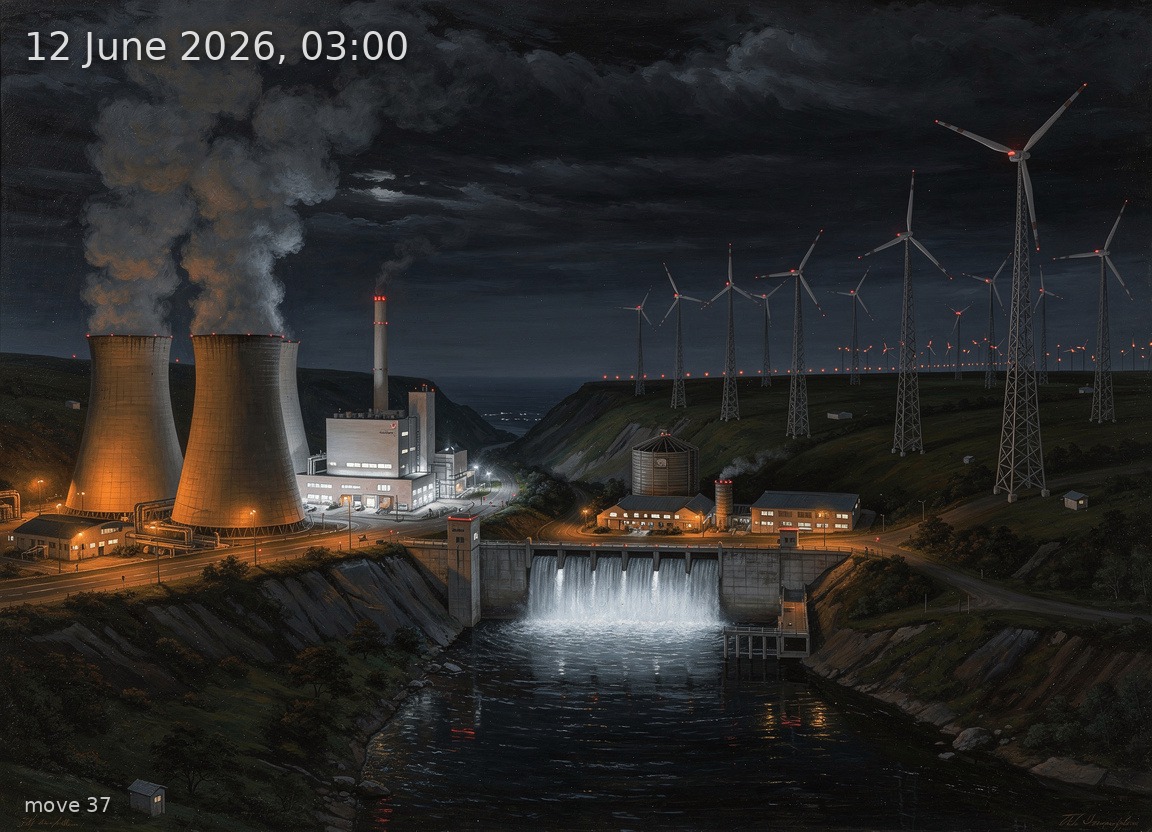
Wind leads overnight generation at 18.4 GW, but 8.9 GW net imports bridge the gap to 44.3 GW demand.
Back
Generation mix
Wind onshore 41%
Wind offshore 11%
Biomass 10%
Hydro 6%
Natural gas 10%
Hard coal 5%
Brown coal 17%
68%
Renewable share
18.4 GW
Wind (on + offshore)
0.0 GW
Solar
35.4 GW
Total generation
-8.9 GW
Net import
92.1 €/MWh
Day-ahead price
10.7°C / 14 km/h
Temp / Wind speed
Open-Meteo, Kassel (51.3°N 9.5°E)
99.0% / 0.0 W/m²
Cloud cover / Radiation
227
gCO₂/kWh
Image prompt
Wind onshore 14.4 GW dominates the right half of the scene as dozens of tall three-blade turbines with lattice towers stretching across rolling hills, their red aviation warning lights blinking in the darkness; wind offshore 4.0 GW appears as a distant cluster of turbines on the far-right horizon over a dark sea glimpsed through a valley gap; brown coal 6.1 GW occupies the left foreground as a massive lignite power station with three hyperbolic cooling towers exhaling thick white-grey steam plumes lit from below by sodium-orange industrial floodlights; natural gas 3.4 GW sits left of centre as a compact CCGT plant with a single tall exhaust stack and a visible heat shimmer, illuminated by harsh white facility lighting; hard coal 1.8 GW appears as a smaller coal plant behind the gas facility with a rectangular boiler house and a single squat cooling tower; biomass 3.7 GW is rendered centre-right as a mid-sized wood-chip power station with a conical fuel silo and a modest chimney trailing thin smoke; hydro 2.0 GW appears in the centre as a concrete dam structure with illuminated spillway in a river valley. The sky is completely black with 99% cloud cover obscuring all stars — a heavy, oppressive overcast ceiling pressing down, consistent with a 92.1 EUR/MWh price atmosphere. No moon, no twilight, no sky glow — it is 3 AM in deep night. The only light sources are sodium streetlights casting amber pools on access roads, the industrial floodlights of the power stations, blinking red turbine lights, and faint reflections on wet ground suggesting cool 10.7°C June dampness. Mid-June vegetation is lush — dense deciduous trees in full dark-green leaf, tall grass on hillsides, all rendered in shadow with subtle artificial light highlights. Style: highly detailed oil painting in the tradition of 19th-century German Romantic landscape painters — rich colour palette of deep navy, amber, grey-white steam, visible confident brushwork, atmospheric depth and chiaroscuro, meticulous engineering detail on every turbine nacelle, cooling tower hyperbolic curve, and exhaust stack. The painting captures the sublime industrial nocturne of a working grid. No text, no labels.