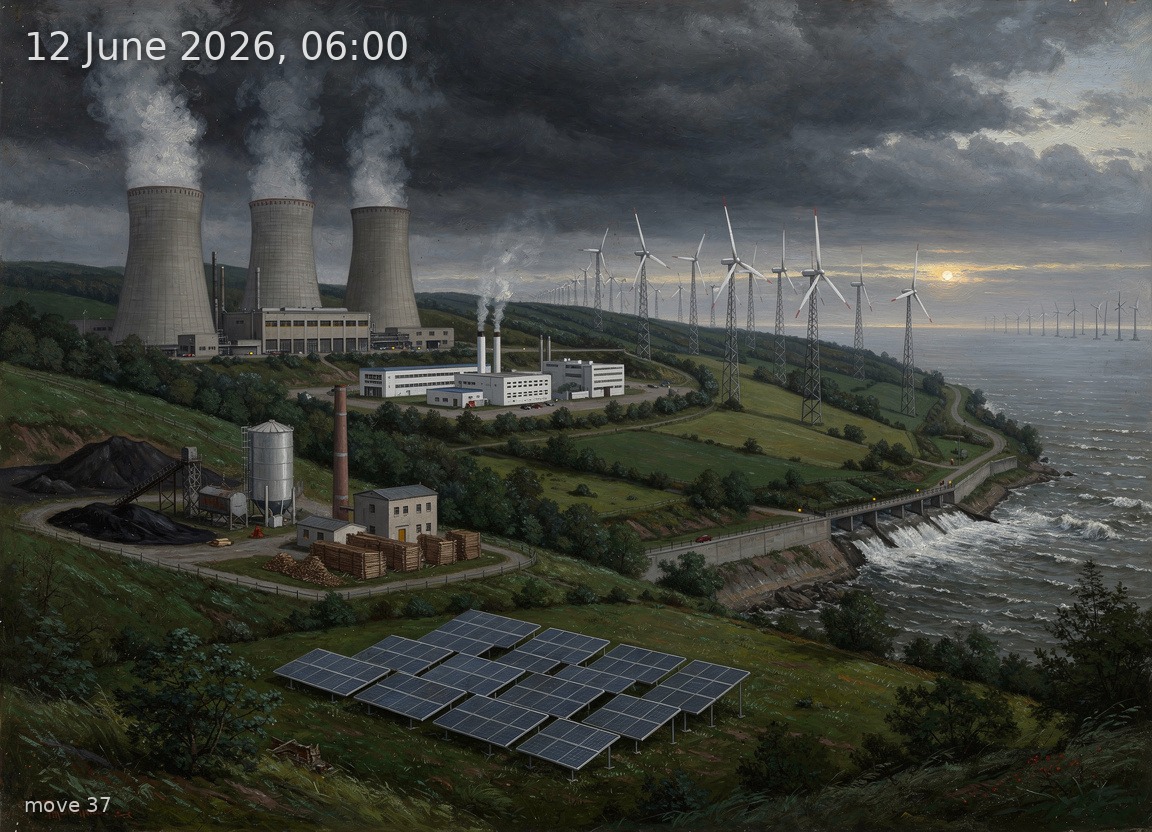
Strong onshore wind leads generation but 16 GW net imports are needed under full cloud cover and elevated prices.
Back
Generation mix
Wind onshore 42%
Wind offshore 8%
Solar 6%
Biomass 10%
Hydro 5%
Natural gas 8%
Hard coal 5%
Brown coal 16%
71%
Renewable share
19.0 GW
Wind (on + offshore)
2.2 GW
Solar
38.1 GW
Total generation
-16.0 GW
Net import
117.8 €/MWh
Day-ahead price
11.3°C / 19 km/h
Temp / Wind speed
Open-Meteo, Kassel (51.3°N 9.5°E)
100.0% / 0.0 W/m²
Cloud cover / Radiation
211
gCO₂/kWh
Image prompt
Wind onshore 16.2 GW dominates the right two-thirds of the scene as vast ranks of three-blade turbines on lattice towers stretching across rolling green hills, blades visibly spinning in strong wind; wind offshore 2.9 GW appears as a distant cluster of turbines on the far-right horizon above a grey sea; brown coal 6.3 GW occupies the left foreground as a massive lignite power station with three hyperbolic cooling towers emitting thick white steam plumes rising into the overcast; natural gas 2.9 GW sits as a compact CCGT plant with twin exhaust stacks and a smaller vapour trail, positioned left of centre; biomass 3.8 GW appears as a medium-sized industrial facility with a cylindrical silo and a single smokestack amid stacked timber, placed centre-left; hard coal 1.9 GW is rendered as a smaller coal plant with a conveyor belt and dark stockpile near the lignite station; hydro 1.9 GW is a concrete run-of-river weir visible along a swollen river cutting through the middle ground; solar 2.2 GW is a modest field of aluminium-framed crystalline silicon panels in the centre, catching no direct light, reflecting only flat grey sky. The sky is early dawn at 06:00 in June—deep blue-grey pre-dawn light, no direct sun, no warm colours on the horizon, only a faint pale luminescence to the east behind total 100% cloud cover forming a heavy, oppressive low ceiling. The atmosphere feels pressured and dense, reflecting high electricity prices. Temperature is cool at 11°C; vegetation is lush early-summer green but muted in the dim light. Wind-bent grasses and swaying tree lines convey 19 km/h gusts. Painted in the style of a highly detailed 19th-century German Romantic oil painting—rich, dark palette, visible impasto brushwork, atmospheric depth and chiaroscuro, with meticulous engineering accuracy for every turbine nacelle, cooling tower, and industrial structure. No text, no labels.