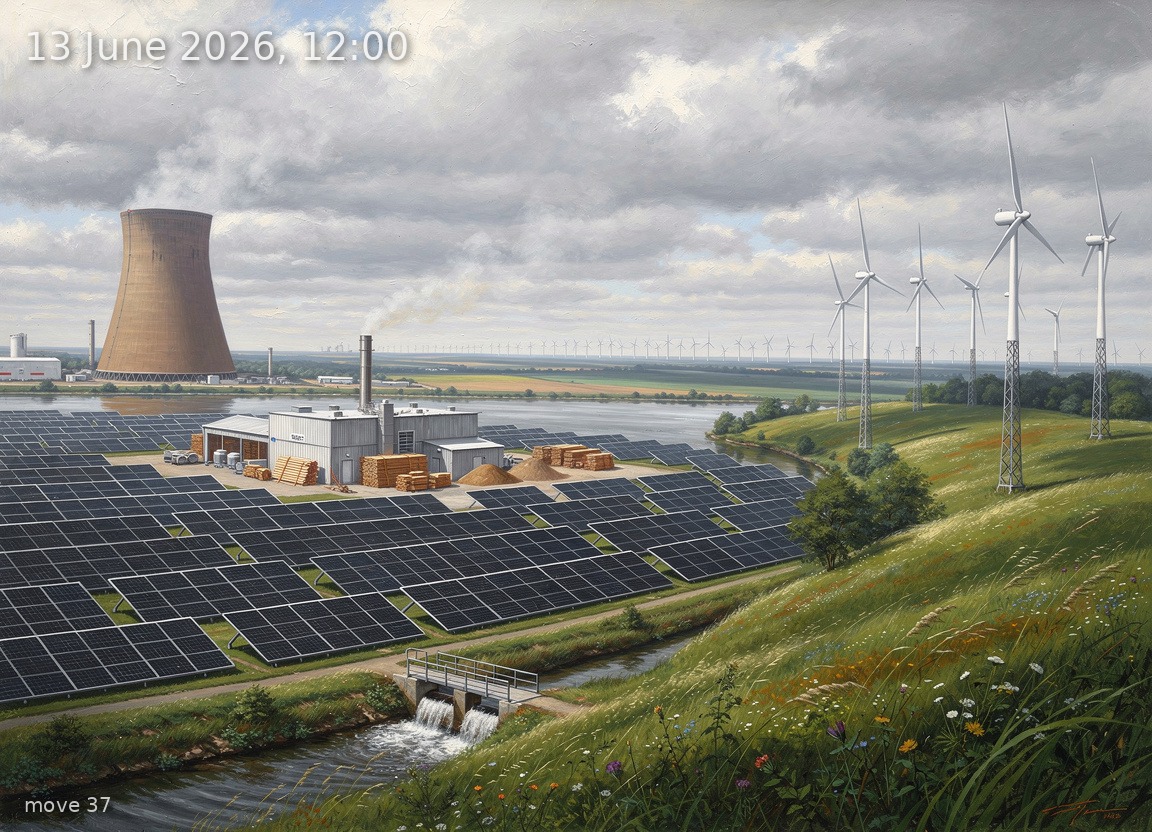
Solar (37.9 GW) and wind (18.9 GW) drive 95.7% renewable generation, pushing prices to −27.4 EUR/MWh.
Back
Generation mix
Wind onshore 25%
Wind offshore 4%
Solar 59%
Biomass 6%
Hydro 2%
Natural gas 2%
Hard coal 0%
Brown coal 2%
96%
Renewable share
18.9 GW
Wind (on + offshore)
37.9 GW
Solar
64.7 GW
Total generation
+13.2 GW
Net export
-27.4 €/MWh
Day-ahead price
19.0°C / 23 km/h
Temp / Wind speed
Open-Meteo, Kassel (51.3°N 9.5°E)
93.0% / 263.0 W/m²
Cloud cover / Radiation
29
gCO₂/kWh
Image prompt
Solar 37.9 GW dominates the scene as vast fields of aluminium-framed crystalline silicon PV panels stretching across the entire foreground and middle ground, covering more than half the canvas; wind onshore 16.2 GW appears as dozens of tall three-blade turbines with white nacelles and lattice towers arrayed across rolling green hills in the right third of the scene, their blades visibly angled by a brisk breeze bending the summer grass; wind offshore 2.7 GW is suggested by a distant line of turbines on a hazy horizon beyond a river; biomass 3.7 GW occupies the left-centre as a modest wood-chip power station with a low industrial stack and stored timber piles; brown coal 1.4 GW appears in the far left as a single large hyperbolic cooling tower with only a thin wisp of steam; hydro 1.4 GW is a small run-of-river weir with visible turbine housing along a green-banked stream in the lower left; natural gas 1.2 GW is a compact CCGT unit with a single slim exhaust stack and minimal emissions plume tucked behind the biomass plant; hard coal 0.2 GW is a barely visible small stack in the deep background, nearly dormant. The sky is heavily overcast at 93% cloud cover—a thick blanket of pale grey stratus—yet it is full midday daylight, bright and diffuse, with no shadows and a soft silvery luminosity filtering through; occasional brighter patches hint at the high sun behind the clouds. Temperature is a pleasant 19°C; lush green deciduous foliage, wildflowers, and tall summer grasses populate the landscape. The atmosphere feels calm, expansive, and open, reflecting the deeply negative electricity price—no oppressive mood, just vast quiet abundance. Rendered as a highly detailed oil painting in the tradition of 19th-century German Romantic landscape masters such as Caspar David Friedrich and Carl Blechen, with rich colour, visible impasto brushwork, atmospheric aerial perspective, and meticulous engineering detail on every turbine nacelle, PV module frame, and cooling tower. No text, no labels.