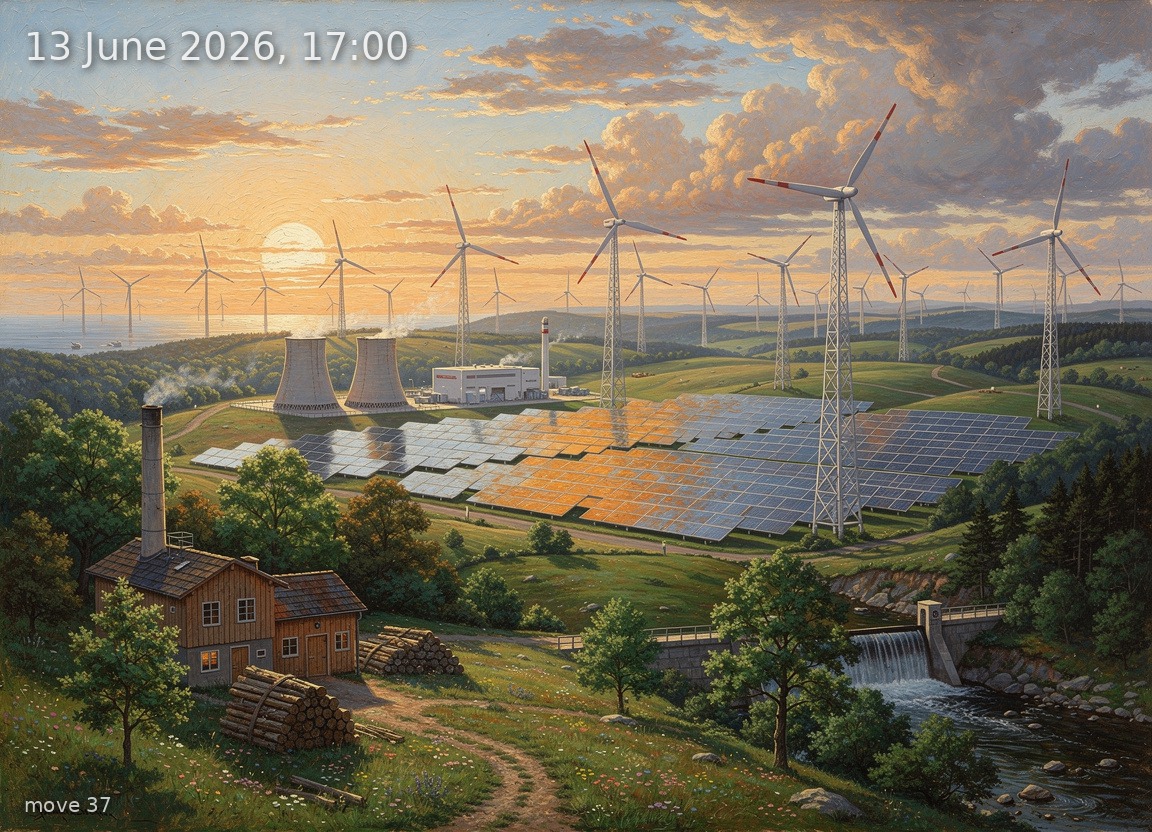
Onshore wind and solar each near 24 GW drive 10.2 GW net exports and a negative clearing price.
Back
Generation mix
Wind onshore 40%
Wind offshore 6%
Solar 40%
Biomass 6%
Hydro 2%
Natural gas 2%
Hard coal 0%
Brown coal 3%
95%
Renewable share
27.2 GW
Wind (on + offshore)
23.8 GW
Solar
59.2 GW
Total generation
+10.2 GW
Net export
-4.2 €/MWh
Day-ahead price
19.5°C / 28 km/h
Temp / Wind speed
Open-Meteo, Kassel (51.3°N 9.5°E)
56.0% / 350.0 W/m²
Cloud cover / Radiation
35
gCO₂/kWh
Image prompt
Wind onshore 23.9 GW dominates the scene as dozens of tall three-blade turbines with white lattice towers sweeping across rolling green hills from the centre to the right, rotors spinning briskly in strong wind; solar 23.8 GW fills the middle-ground as vast fields of aluminium-framed crystalline silicon PV panels angled toward the low western sun, glinting with warm orange-gold reflections; wind offshore 3.3 GW appears on the far left horizon as a cluster of turbines rising from a distant silvery North Sea sliver; biomass 3.7 GW is rendered as a modest wood-clad power station with a single smokestack and stacked timber nearby, nestled among trees at the left foreground; brown coal 1.6 GW appears as a small pair of hyperbolic cooling towers with thin steam plumes in the distant left background, deliberately diminished in scale; natural gas 1.3 GW sits as a compact CCGT unit with a single clean exhaust stack beside the cooling towers; hydro 1.4 GW is suggested by a small concrete dam and spillway in a forested valley at the far right edge. The sky is a dusk scene at 17:00 in mid-June Berlin time: the sun is low in the west, casting long golden-orange light across the landscape, the upper sky transitioning from pale blue to warm amber near the horizon, with broken cumulus clouds covering roughly half the sky, their undersides lit in peach and copper tones. The atmosphere feels calm and spacious, reflecting the negative electricity price — no oppressive weight, just open expansive air. Lush green deciduous trees in full summer leaf, wildflowers in meadows, temperature suggesting a mild pleasant 19.5°C evening. Wind is visible in bending grasses and spinning turbine blades. Highly detailed oil painting in the tradition of 19th-century German Romantic landscape painters — rich saturated colour, visible impasto brushwork, atmospheric aerial perspective with hazy blue distances — yet every piece of energy infrastructure is rendered with meticulous engineering accuracy: turbine nacelles, blade pitch mechanisms, PV cell grid patterns, cooling tower parabolic geometry, CCGT exhaust stacks. The composition evokes a masterwork industrial landscape painting. No text, no labels.