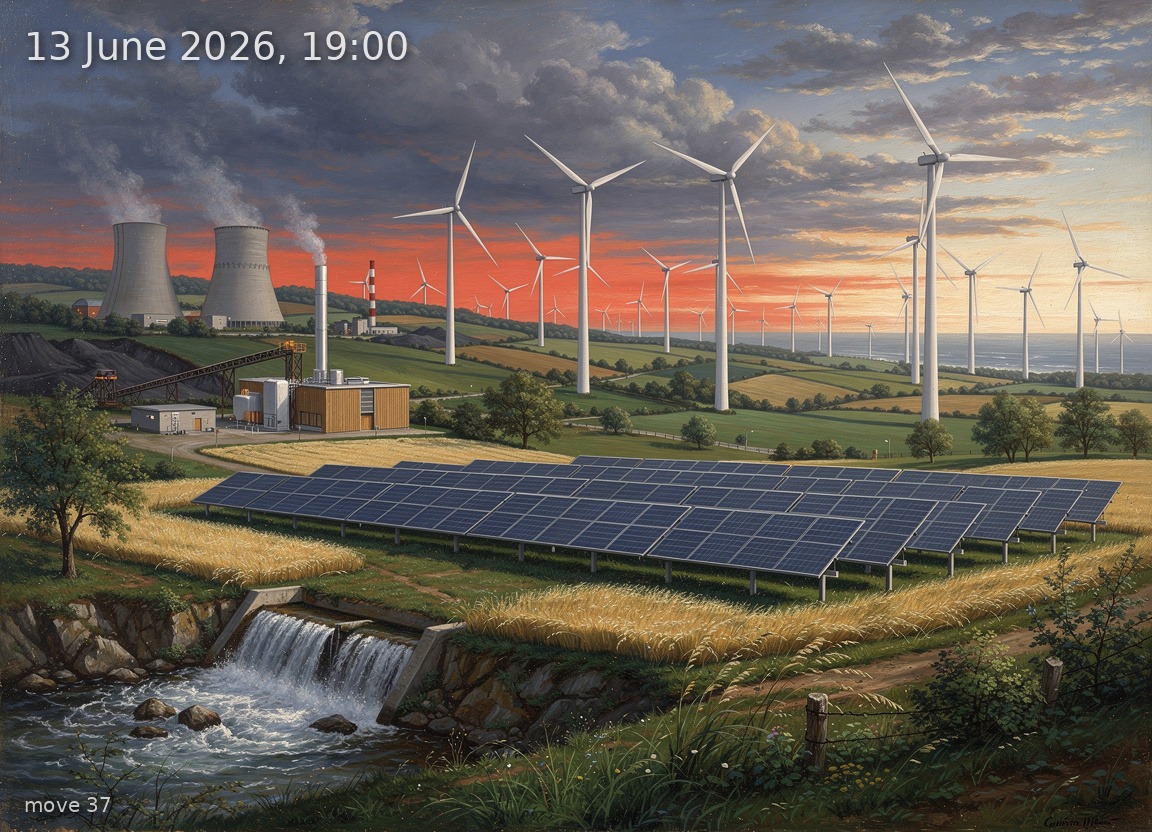
Strong onshore wind at 31.2 GW and fading solar at 8.2 GW drive 93.6% renewables and 5.1 GW net export.
Back
Generation mix
Wind onshore 57%
Wind offshore 11%
Solar 15%
Biomass 7%
Hydro 4%
Natural gas 3%
Hard coal 1%
Brown coal 3%
94%
Renewable share
37.3 GW
Wind (on + offshore)
8.2 GW
Solar
55.0 GW
Total generation
+5.1 GW
Net export
33.4 €/MWh
Day-ahead price
17.7°C / 27 km/h
Temp / Wind speed
Open-Meteo, Kassel (51.3°N 9.5°E)
72.0% / 132.0 W/m²
Cloud cover / Radiation
44
gCO₂/kWh
Image prompt
Wind onshore 31.2 GW dominates the scene as vast ranks of three-blade turbines with white tubular towers stretching across rolling green farmland from the centre to the far right, their rotors spinning visibly in strong wind; wind offshore 6.1 GW appears as a distant cluster of taller turbines on the hazy horizon line above a faint strip of grey sea at far right; solar 8.2 GW is rendered as a broad field of aluminium-framed crystalline silicon photovoltaic panels in the centre-left foreground, catching the last amber light; biomass 4.0 GW is a modest timber-clad biomass plant with a single stack emitting thin white vapour at mid-left; hydro 2.0 GW is a small concrete run-of-river weir with churning white water visible in a river valley at lower left; brown coal 1.8 GW appears as a pair of small hyperbolic cooling towers with faint steam plumes and a conveyor belt of dark lignite at the far left background; natural gas 1.4 GW is a compact CCGT unit with a single polished exhaust stack and minimal exhaust haze tucked beside the cooling towers; hard coal 0.4 GW is a single modest smokestack barely visible behind the gas plant. The sky is a dusk sky at 19:00 in June — a band of warm orange-red glow along the lower western horizon rapidly giving way to deepening blue-grey and early indigo overhead, with 72% cloud cover rendered as broken stratocumulus in grey and violet tones lit from below by the sunset. The landscape is lush mid-June German countryside — tall green grass, wheat fields beginning to ripen, scattered deciduous trees in full leaf — swayed by 27 km/h winds. The atmosphere is calm and open, reflecting a moderate electricity price. Painted in the style of a highly detailed 19th-century German Romantic oil painting — rich saturated colour, visible confident brushwork, atmospheric aerial perspective with depth and luminosity — yet every piece of energy infrastructure rendered with meticulous engineering accuracy: turbine nacelles, three-blade rotors, lattice sub-structures, PV panel grids, cooling tower parabolic geometry. No text, no labels.