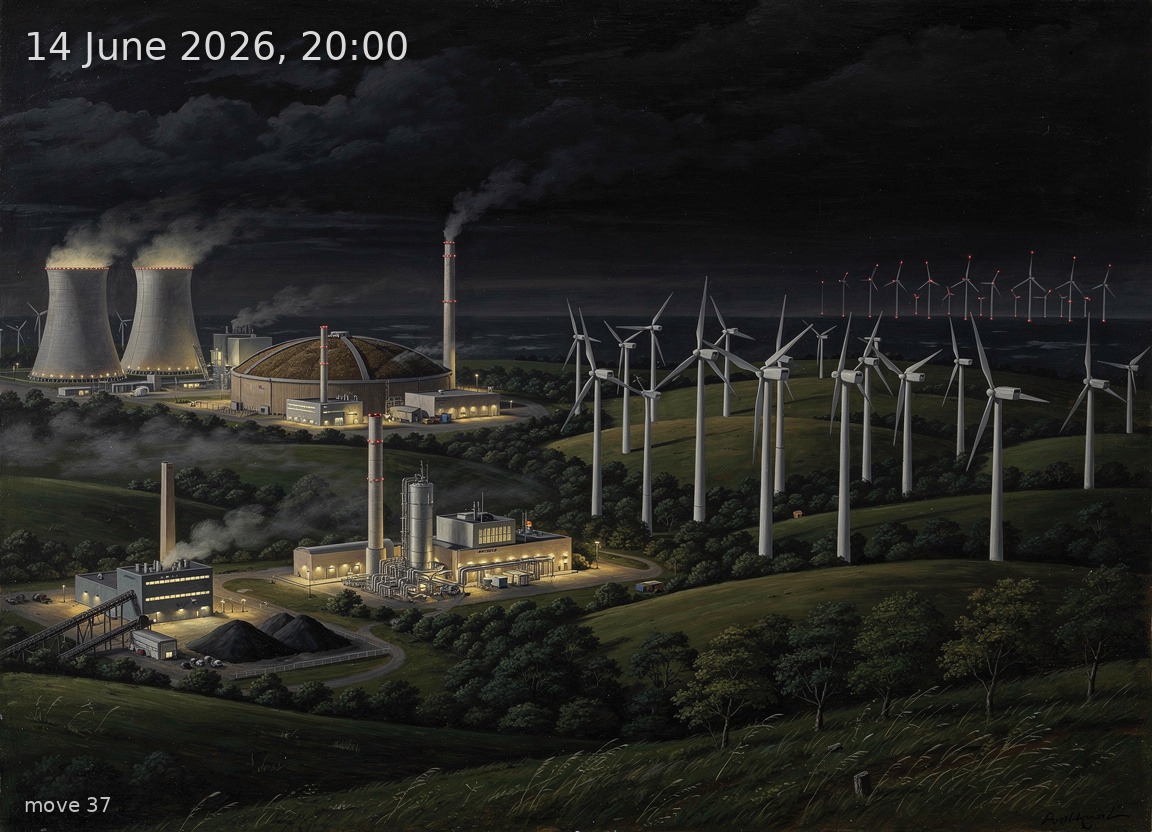
Strong onshore wind drives 85.6% renewable share at nightfall; modest thermal and 2.1 GW net imports close the gap.
Back
Generation mix
Wind onshore 56%
Wind offshore 12%
Solar 5%
Biomass 9%
Hydro 4%
Natural gas 6%
Hard coal 3%
Brown coal 5%
86%
Renewable share
32.5 GW
Wind (on + offshore)
2.5 GW
Solar
47.8 GW
Total generation
-2.1 GW
Net import
94.9 €/MWh
Day-ahead price
14.9°C / 13 km/h
Temp / Wind speed
Open-Meteo, Kassel (51.3°N 9.5°E)
90.0% / 23.0 W/m²
Cloud cover / Radiation
95
gCO₂/kWh
Image prompt
Wind onshore 26.6 GW dominates the scene as vast ranks of three-blade turbines with white tubular towers and detailed nacelles stretching across rolling central German hills, occupying over half the canvas from centre to right; wind offshore 5.9 GW appears as a distant cluster of taller turbines on the far-right horizon, their aviation warning lights glowing red against the dark sky; biomass 4.1 GW is rendered as a mid-ground combined heat-and-power plant with a wood-chip storage dome and a single chimney emitting pale steam, occupying a modest area left of centre; natural gas 3.0 GW appears as a compact CCGT facility with a single tall exhaust stack and visible heat-recovery unit, placed in the left-centre middleground; brown coal 2.4 GW is depicted as a pair of hyperbolic cooling towers with faint steam plumes and conveyor belt infrastructure, positioned at the left edge; hard coal 1.5 GW shows as a smaller coal-fired station with a rectangular stack beside a coal yard, just inside the left third; solar 2.5 GW is barely visible as a small array of aluminium-framed crystalline silicon panels in the foreground catching no light, inert under the dark sky; hydro 1.8 GW appears as a concrete run-of-river weir with turbine housing along a small river in the lower foreground. TIME: 20:00 in mid-June Berlin — the sky is fully dark, deep navy to black, no twilight glow remaining, no sunset colours; all facilities are lit by warm sodium-vapour streetlights and industrial floodlights casting orange pools on wet surfaces. The atmosphere is heavy and oppressive with 90% cloud cover forming a low, thick, featureless ceiling pressing down; temperature is a mild 14.9°C with lush green deciduous trees and tall grass bending moderately in 13.4 km/h winds. The turbine blades show visible rotational blur. The overall mood reflects the moderately high 94.9 EUR/MWh price — a dense, brooding industrial atmosphere. Style: highly detailed oil painting in the tradition of 19th-century German Romantic landscape painters such as Caspar David Friedrich, with rich dark colour palette, visible expressive brushwork, dramatic chiaroscuro from artificial lighting against the black sky, atmospheric depth with mist and steam merging into the low clouds, meticulous engineering detail on every piece of infrastructure. No text, no labels.