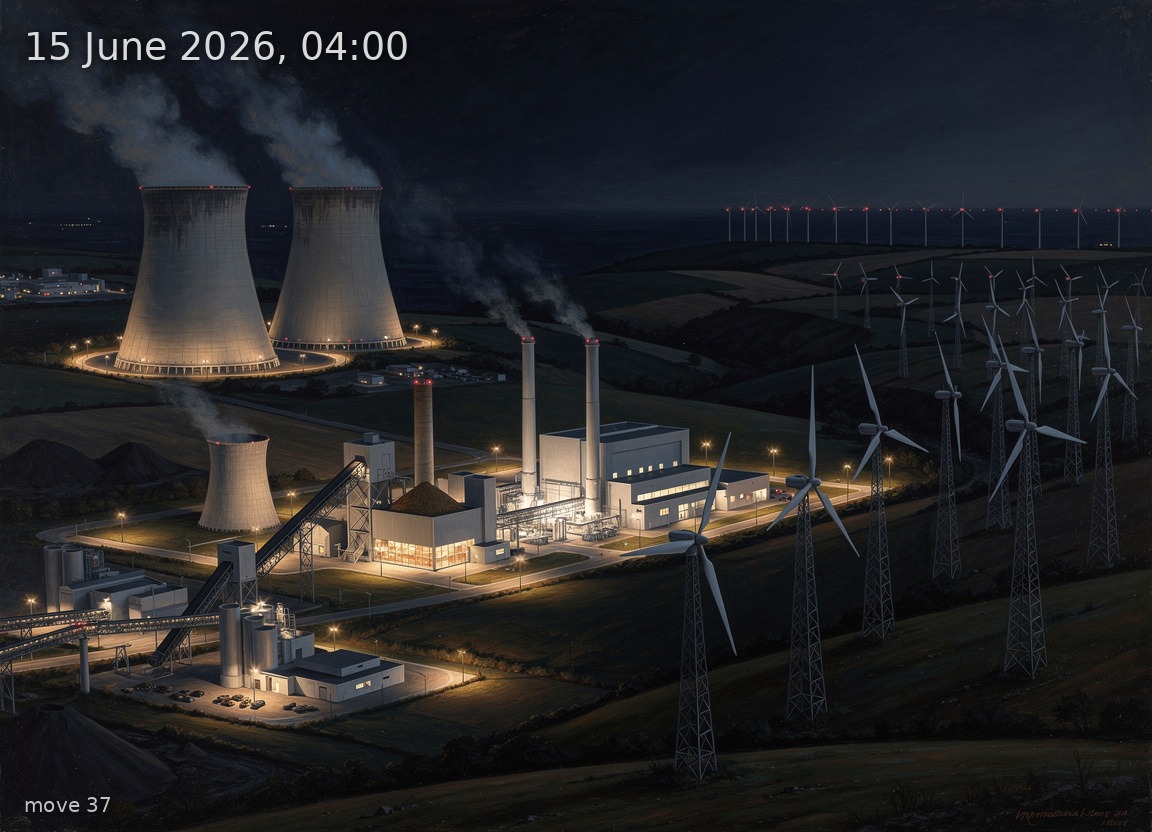
Strong overnight wind at 27.3 GW covers most demand; thermal plants and 1.5 GW net imports fill the remainder.
Back
Generation mix
Wind onshore 51%
Wind offshore 16%
Solar 0%
Biomass 9%
Hydro 4%
Natural gas 10%
Hard coal 4%
Brown coal 7%
79%
Renewable share
27.3 GW
Wind (on + offshore)
0.0 GW
Solar
41.2 GW
Total generation
-1.5 GW
Net import
84.4 €/MWh
Day-ahead price
10.3°C / 16 km/h
Temp / Wind speed
Open-Meteo, Kassel (51.3°N 9.5°E)
16.0% / 0.0 W/m²
Cloud cover / Radiation
135
gCO₂/kWh
Image prompt
Wind onshore 20.8 GW dominates the right two-thirds of the scene as vast ranks of three-blade turbines on lattice towers stretching across rolling central German hills into deep darkness, rotors visibly spinning in moderate wind. Wind offshore 6.5 GW appears in the far-right background as a faint line of red aviation warning lights on towering offshore turbines silhouetted above a distant dark horizon. Natural gas 4.0 GW occupies the centre-left as a compact CCGT power station with twin exhaust stacks emitting thin heat shimmer, lit by sodium floodlights casting amber pools on concrete aprons. Biomass 3.7 GW sits just left of centre as a medium-sized plant with a wood-chip conveyor and a single squat smokestack, warmly illuminated from within. Brown coal 3.0 GW commands the far left as two hyperbolic cooling towers releasing pale steam plumes that drift across the scene, the plant's coal bunkers and conveyor belts visible under harsh industrial lighting. Hard coal 1.5 GW appears as a smaller single cooling tower and boiler house adjacent to the brown coal complex. Hydro 1.7 GW is suggested by a concrete dam spillway in the lower-left foreground, water glinting faintly under a security light. The sky is completely dark — a deep navy-black dome with scattered bright stars visible through only 16% cloud cover, absolutely no twilight or sky glow. The air temperature is cool at 10°C; early summer foliage on deciduous trees is lush but rendered in deep shadow tones. The atmosphere feels heavy and subtly oppressive, reflecting the 84 EUR/MWh price — a faint industrial haze hangs in layers across the middle ground, diffusing the amber and white artificial lights. Style: highly detailed oil painting in the tradition of 19th-century German Romantic landscape painters — Caspar David Friedrich's nocturnal sensibility merged with meticulous industrial realism. Rich, dark colour palette of Prussian blue, lamp black, raw umber, and warm cadmium amber from artificial light. Visible confident brushwork in the sky and steam plumes, precise engineering detail on turbine nacelles, cooling tower parabolic curves, and CCGT stack geometry. Atmospheric depth achieved through layered haze and diminishing light. No text, no labels.