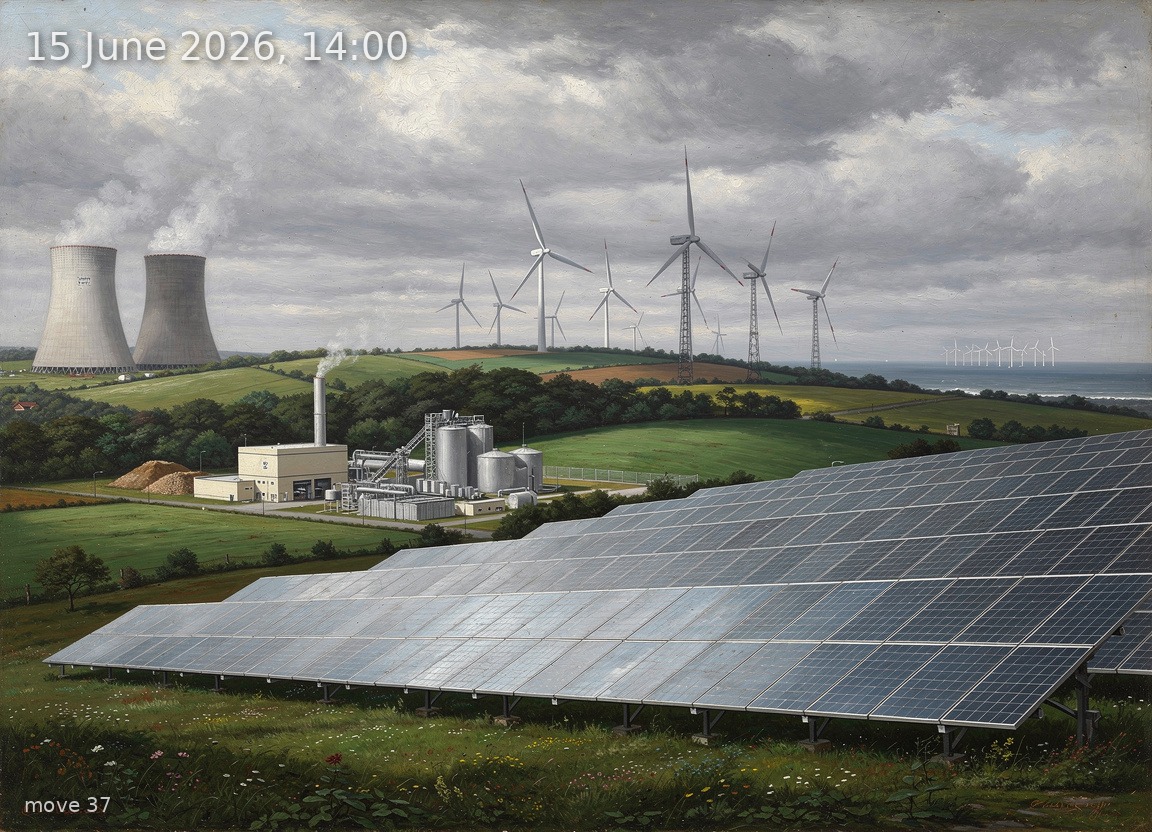
Overcast solar at 40.5 GW and 23.3 GW wind drive 91% renewables, pushing 13.8 GW net exports and negative prices.
Back
Generation mix
Wind onshore 25%
Wind offshore 6%
Solar 53%
Biomass 5%
Hydro 2%
Natural gas 3%
Hard coal 2%
Brown coal 4%
91%
Renewable share
23.4 GW
Wind (on + offshore)
40.5 GW
Solar
75.7 GW
Total generation
+13.8 GW
Net export
-2.9 €/MWh
Day-ahead price
15.0°C / 20 km/h
Temp / Wind speed
Open-Meteo, Kassel (51.3°N 9.5°E)
100.0% / 27.0 W/m²
Cloud cover / Radiation
60
gCO₂/kWh
Image prompt
Solar 40.5 GW dominates the scene as vast fields of aluminium-framed crystalline silicon PV panels stretching across rolling central German farmland, occupying over half the canvas from centre to right; wind onshore 19.0 GW appears as dozens of three-blade turbines on tall lattice and tubular towers scattered across green hills in the middle distance, blades visibly turning in moderate wind; wind offshore 4.3 GW is suggested by a sliver of distant North Sea horizon at far right with a cluster of offshore turbines barely visible through haze; biomass 3.6 GW is rendered as a modest wood-chip power station with a single square stack and fuel storage silos at centre-left; brown coal 3.0 GW occupies the far left as two hyperbolic concrete cooling towers with thin white steam plumes rising into the grey sky; natural gas 2.3 GW sits as a compact combined-cycle gas turbine plant with a slender exhaust stack and small vapour trail just left of centre; hydro 1.6 GW appears as a small dam and penstock structure nestled in a forested valley in the left background; hard coal 1.3 GW is a single smaller stack with a low dark plume beside the brown coal towers. The time is 14:00 full daylight but the sky is entirely overcast—a uniform flat blanket of pale grey stratus clouds with no blue patches and no direct sun, diffuse silvery light illuminating everything evenly without sharp shadows. Temperature is a cool 15°C; the June vegetation is lush deep green with wildflowers in meadows but the atmosphere feels damp and subdued. The air is calm and open despite the clouds, reflecting the negative electricity price—no oppressive weight, just a quiet abundance. Painted as a highly detailed oil painting in the tradition of 19th-century German Romantic landscape masters like Caspar David Friedrich and Carl Blechen: rich layered colour, visible confident brushwork, atmospheric aerial perspective with soft edges in the distance, meticulous engineering detail on every turbine nacelle, every PV module rail, every cooling tower's parabolic curve and concrete texture. The composition balances industrial infrastructure with pastoral landscape, monumental yet serene. No text, no labels, no people.