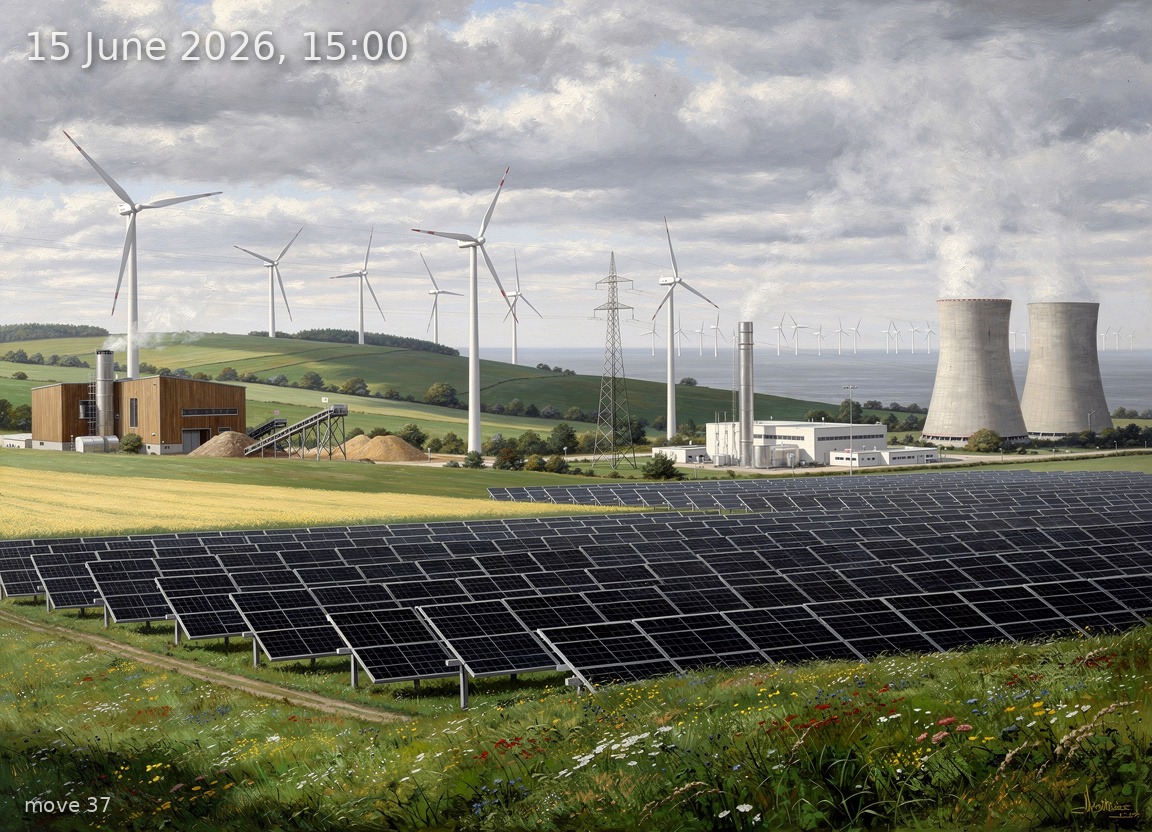
Solar (38.3 GW) and wind (23.8 GW) drive 92.6% renewables, yielding 11.3 GW net export and negative prices.
Back
Generation mix
Wind onshore 27%
Wind offshore 6%
Solar 53%
Biomass 5%
Hydro 2%
Natural gas 3%
Hard coal 2%
Brown coal 3%
93%
Renewable share
23.8 GW
Wind (on + offshore)
38.3 GW
Solar
72.7 GW
Total generation
+11.3 GW
Net export
-0.9 €/MWh
Day-ahead price
15.9°C / 20 km/h
Temp / Wind speed
Open-Meteo, Kassel (51.3°N 9.5°E)
90.0% / 119.0 W/m²
Cloud cover / Radiation
50
gCO₂/kWh
Image prompt
Solar 38.3 GW dominates the scene as an immense expanse of aluminium-framed crystalline silicon photovoltaic panels stretching across rolling green fields occupying more than half the canvas; wind onshore 19.6 GW fills the middle distance as dozens of tall three-blade turbines on lattice and tubular towers, rotors turning briskly in moderate wind; wind offshore 4.2 GW appears at the far horizon as a line of turbines rising from a grey North Sea sliver; biomass 3.6 GW is rendered as a mid-sized timber-clad power plant with a modest stack and woodchip storage yard at left; natural gas 2.2 GW sits as a compact CCGT facility with a single polished exhaust stack emitting a thin heat shimmer; brown coal 2.0 GW appears as a pair of hyperbolic concrete cooling towers with lazy white steam plumes and a lignite conveyor belt; hard coal 1.2 GW is a smaller classical brick power station with a single square chimney releasing a faint grey wisp; hydro 1.6 GW is suggested by a cascading weir and small reservoir dam nestled in a wooded valley at the far left. The sky is a luminous high overcast—90% cloud cover in layered silver-grey stratus with bright diffuse daylight filtering through at full midday intensity, no direct sun disk visible, but the landscape is well lit in soft shadowless light. Lush mid-June vegetation: bright green deciduous trees, wildflower meadows, rapeseed fields fading to golden stubble. Temperature mild at 16 °C, atmosphere calm and open, conveying the ease of a negative-price hour. Style: highly detailed oil painting in the tradition of 19th-century German Romantic landscape painters—Caspar David Friedrich meets industrial realism—rich layered colour, visible confident brushwork, atmospheric aerial perspective receding into hazy distance, meticulous engineering detail on every turbine nacelle, every PV cell grid line, every cooling tower ribbing. No text, no labels.