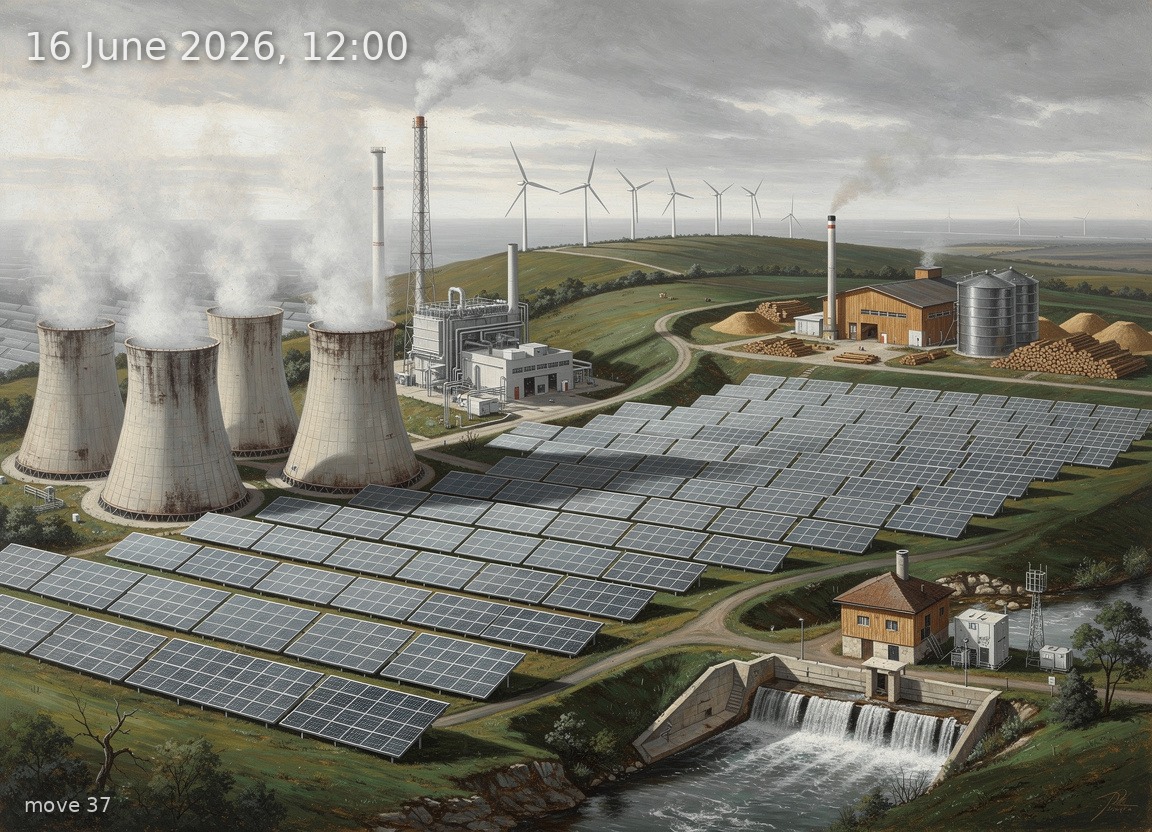
Overcast solar at 33.1 GW leads generation; brown coal and gas fill gaps as Germany imports 5.7 GW.
Back
Generation mix
Wind onshore 11%
Wind offshore 1%
Solar 59%
Biomass 7%
Hydro 3%
Natural gas 8%
Hard coal 3%
Brown coal 9%
80%
Renewable share
6.6 GW
Wind (on + offshore)
33.1 GW
Solar
56.4 GW
Total generation
-5.7 GW
Net import
66.5 €/MWh
Day-ahead price
16.4°C / 16 km/h
Temp / Wind speed
Open-Meteo, Kassel (51.3°N 9.5°E)
99.0% / 43.0 W/m²
Cloud cover / Radiation
137
gCO₂/kWh
Image prompt
Solar 33.1 GW dominates the centre and right of the composition as vast fields of aluminium-framed crystalline silicon photovoltaic panels stretching across gentle green rolling hills, their glass surfaces reflecting a flat white-grey overcast sky; brown coal 5.2 GW occupies the left foreground as a cluster of massive hyperbolic concrete cooling towers emitting thick columns of white steam that merge into the low cloud base; natural gas 4.7 GW appears as a pair of compact combined-cycle gas turbine plants with tall slender exhaust stacks and visible heat shimmer just left of centre; wind onshore 5.9 GW is rendered as a line of roughly a dozen three-blade turbines on lattice and tubular steel towers along a ridge in the middle distance, blades turning moderately in the breeze; wind offshore 0.6 GW is suggested by two or three distant turbines barely visible on a far grey horizon line; biomass 3.7 GW appears as a wood-clad industrial facility with a short smokestack and wood-chip storage silos in the right middle ground; hydro 1.7 GW is a small concrete run-of-river weir and powerhouse nestled along a river in the lower right foreground; hard coal 1.5 GW is a single smaller power station with a tall brick chimney and a dark coal pile beside it, placed behind the gas plant on the left. The lighting is full midday daylight but entirely diffuse — no shadows, no direct sun, a uniformly bright 99% overcast sky in flat pearl-grey tones stretching horizon to horizon, a few degrees above 16 °C so the vegetation is lush early-summer green with wildflowers. The atmosphere is slightly heavy and humid, haze softening distant elements, consistent with a moderate 66.5 EUR/MWh price — not oppressive but muted and weighty. Style: highly detailed oil painting in the tradition of 19th-century German Romantic landscape painters such as Caspar David Friedrich and Carl Blechen, with rich layered colour, visible confident brushwork, atmospheric aerial perspective and depth, yet meticulous technical accuracy in rendering every turbine nacelle, PV cell grid pattern, cooling tower parabolic profile, and CCGT exhaust geometry. The scene reads as a monumental industrial pastoral, no text, no labels.