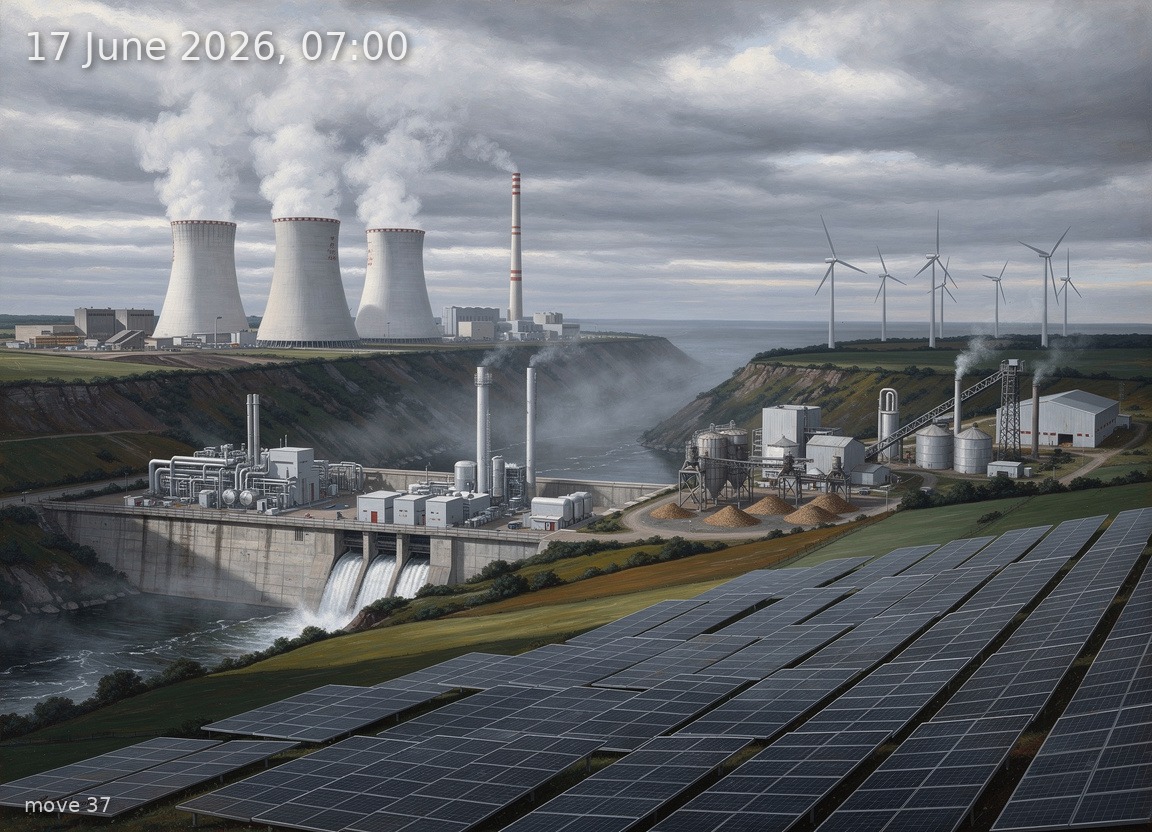
Overcast calm morning forces heavy coal, gas, and import reliance despite mid-June solar at 11.2 GW.
Back
Generation mix
Wind onshore 5%
Wind offshore 2%
Solar 32%
Biomass 11%
Hydro 5%
Natural gas 20%
Hard coal 6%
Brown coal 20%
55%
Renewable share
2.2 GW
Wind (on + offshore)
11.2 GW
Solar
34.9 GW
Total generation
-23.2 GW
Net import
136.7 €/MWh
Day-ahead price
13.7°C / 3 km/h
Temp / Wind speed
Open-Meteo, Kassel (51.3°N 9.5°E)
100.0% / 1.0 W/m²
Cloud cover / Radiation
302
gCO₂/kWh
Image prompt
Solar 11.2 GW dominates the right third of the scene as vast fields of aluminium-framed crystalline silicon PV panels stretching across gently rolling farmland, their surfaces reflecting only dull grey light under total overcast; brown coal 6.9 GW occupies the left background as a massive lignite power station with four hyperbolic cooling towers emitting thick white steam plumes that merge into the low cloud ceiling; natural gas 6.8 GW appears centre-left as a modern combined-cycle gas turbine complex with tall slender exhaust stacks trailing thin heat haze; biomass 3.9 GW is rendered centre-right as a cluster of medium-sized industrial plants with cylindrical wood-pellet silos and modest chimneys; wind onshore 1.6 GW appears as a sparse group of three-blade turbines on a distant ridge, their rotors nearly motionless in the still air; wind offshore 0.6 GW is suggested by a few turbine silhouettes barely visible on a flat grey horizon line; hard coal 2.0 GW stands beside the brown coal station as a smaller conventional plant with a single large stack; hydro 1.8 GW appears as a concrete dam with cascading water in the mid-ground valley. The time is dawn at 07:00 in June — the sky is a uniform blanket of heavy grey-white stratus with no blue visible, first pale morning light filtering through from the east giving a flat, shadowless illumination with a cool blue-grey cast. Temperature is 13.7°C so lush green mid-June vegetation covers the landscape — dense deciduous trees in full leaf, tall grass, wildflowers — but the atmosphere feels oppressive and heavy, reflecting the high electricity price. A faint mist clings to the valley floor near the hydro dam. The overall mood is weighty and industrially tense. Rendered as a highly detailed oil painting in the tradition of 19th-century German Romantic landscape masters like Caspar David Friedrich crossed with industrial realism — rich layered colour, visible confident brushwork, atmospheric depth and chiaroscuro, meticulous engineering detail on every turbine nacelle, cooling tower profile, and panel frame. No text, no labels.