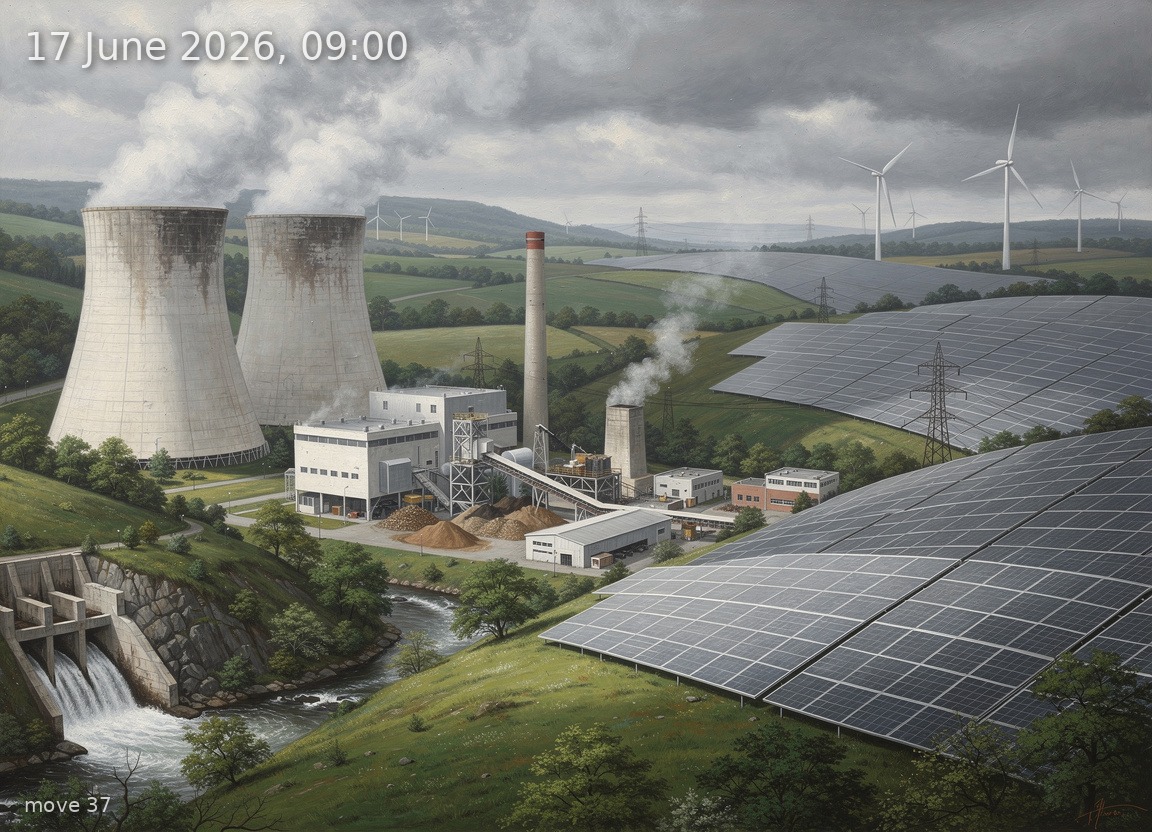
Overcast skies limit solar output; low wind forces heavy thermal dispatch and ~10 GW net imports at elevated prices.
Back
Generation mix
Wind onshore 2%
Wind offshore 2%
Solar 55%
Biomass 8%
Hydro 3%
Natural gas 13%
Hard coal 4%
Brown coal 13%
70%
Renewable share
2.2 GW
Wind (on + offshore)
28.7 GW
Solar
52.0 GW
Total generation
-10.3 GW
Net import
105.8 €/MWh
Day-ahead price
15.2°C / 6 km/h
Temp / Wind speed
Open-Meteo, Kassel (51.3°N 9.5°E)
100.0% / 5.0 W/m²
Cloud cover / Radiation
198
gCO₂/kWh
Image prompt
Solar 28.7 GW dominates the scene as vast fields of aluminium-framed crystalline silicon PV panels stretching across the entire right half and centre-right of the composition, their glass surfaces reflecting only flat grey light under total overcast; brown coal 6.8 GW occupies the left foreground as a cluster of massive hyperbolic cooling towers with thick white-grey steam plumes merging into the low cloud deck; natural gas 6.6 GW appears just left of centre as a pair of compact CCGT power stations with tall single exhaust stacks and thin heat shimmer; biomass 3.9 GW is rendered as a mid-ground industrial facility with wood-chip conveyors, a squat chimney, and a modest plume; hard coal 2.0 GW sits behind the lignite complex as a smaller conventional power station with a single rectangular cooling tower; hydro 1.8 GW appears as a concrete dam structure at the far left edge with white water cascading over spillways; wind onshore 1.0 GW and wind offshore 1.1 GW are represented by a sparse handful of three-blade turbines on lattice towers at the far horizon, their rotors barely turning. The sky is a uniform heavy blanket of 100% cloud cover in layered tones of slate, ash, and dull silver—no blue anywhere, no sun disk visible, fully diffuse morning daylight at 09:00 with flat, shadowless illumination. The atmosphere feels oppressive and weighty, suggesting high electricity prices. The landscape is early-summer central German rolling terrain with green deciduous trees in full leaf, grass meadows, and gentle hills, temperature around 15°C conveyed through cool-toned greens and a damp quality to the air. Power transmission pylons with high-voltage lines cross the mid-ground, symbolising the substantial import flows. Rendered as a highly detailed oil painting in the tradition of 19th-century German Romantic landscape painters—Caspar David Friedrich meets industrial realism—with rich layered colour, visible confident brushwork, atmospheric aerial perspective creating depth, and meticulous engineering accuracy in every turbine nacelle, panel frame, and cooling tower curve. No text, no labels.