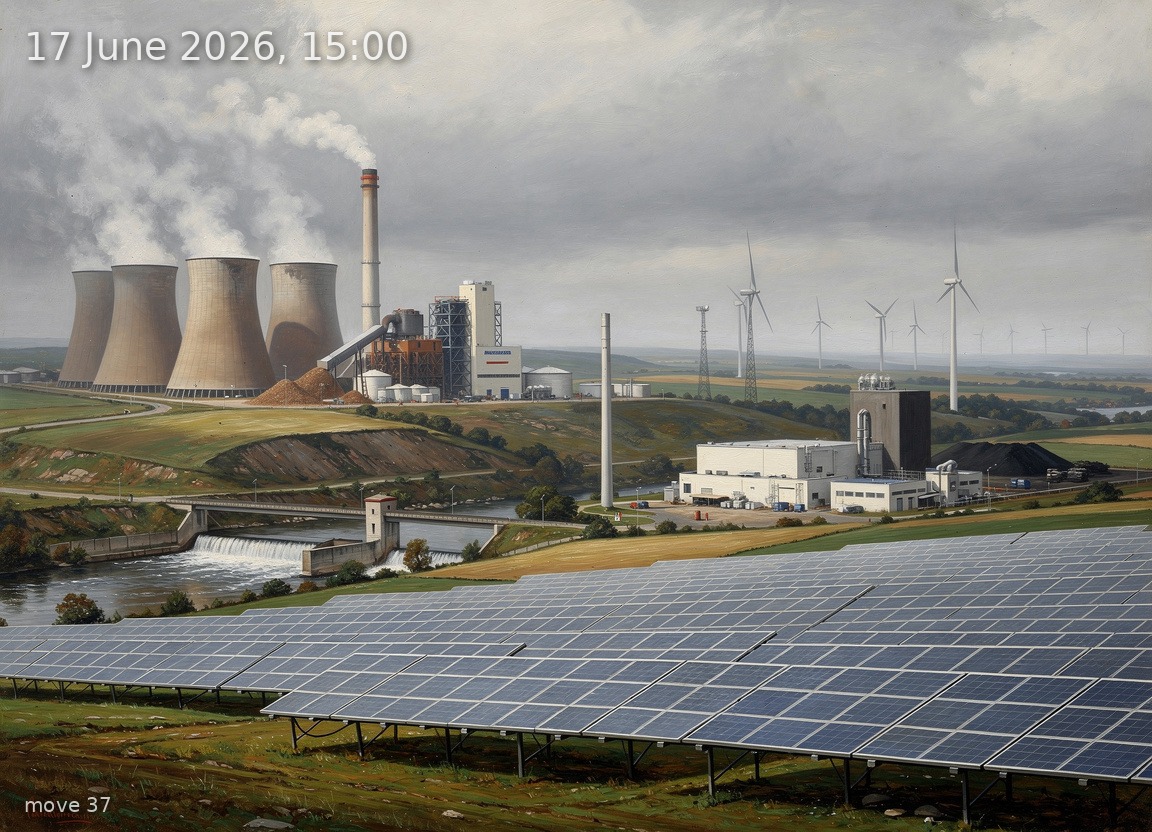
Overcast solar still leads at 33 GW; light winds and thermal plants support; Germany imports 4.8 GW net.
Back
Generation mix
Wind onshore 10%
Wind offshore 6%
Solar 61%
Biomass 7%
Hydro 3%
Natural gas 4%
Hard coal 2%
Brown coal 7%
86%
Renewable share
8.4 GW
Wind (on + offshore)
33.0 GW
Solar
53.8 GW
Total generation
-4.8 GW
Net import
76.0 €/MWh
Day-ahead price
23.7°C / 8 km/h
Temp / Wind speed
Open-Meteo, Kassel (51.3°N 9.5°E)
100.0% / 47.0 W/m²
Cloud cover / Radiation
96
gCO₂/kWh
Image prompt
Solar 33.0 GW dominates the scene as vast fields of aluminium-framed crystalline silicon PV panels stretching across the entire centre and right foreground, covering rolling farmland; brown coal 3.9 GW appears as a cluster of massive hyperbolic cooling towers on the far left emitting thick white steam plumes; biomass 3.5 GW sits as a medium-scale wood-chip-fed power station with a tall exhaust stack and conveyor belts adjacent to the cooling towers; wind offshore 3.2 GW is suggested by a line of three-blade turbines on the distant misty horizon; wind onshore 5.2 GW appears as a scattered group of tall lattice-tower and tubular-tower three-blade turbines with slowly turning rotors on the gentle hills behind the solar fields; natural gas 2.2 GW is depicted as a compact CCGT plant with a single slender exhaust stack and low-profile turbine hall nestled between the coal complex and the solar arrays; hydro 1.7 GW appears as a modest concrete run-of-river dam with spillway visible in a river cutting through the mid-ground; hard coal 1.2 GW is a smaller conventional coal plant with a square chimney and coal bunkers beside the lignite complex. Full daylight at 3 PM but the entire sky is a uniform, heavy, oppressive blanket of solid overcast cloud — no blue sky visible, no direct sunlight, flat diffuse illumination casting almost no shadows. The atmosphere feels dense and weighted, reflecting a 76 EUR/MWh price. Summer vegetation: lush green deciduous trees in full canopy, tall grasses, wildflowers in meadow edges, temperature around 24°C giving a warm humid haze. The turbines barely rotate in the near-calm air. Highly detailed oil painting in the tradition of 19th-century German Romantic landscape painters — rich layered colour, visible confident brushwork, atmospheric depth with sfumato haze toward the horizon — yet every piece of energy infrastructure rendered with meticulous engineering accuracy: turbine nacelles and blade pitch mechanisms, PV module junction boxes and racking systems, cooling tower parabolic profiles, CCGT exhaust diffusers. The composition reads as an encyclopaedic industrial landscape masterwork. No text, no labels.