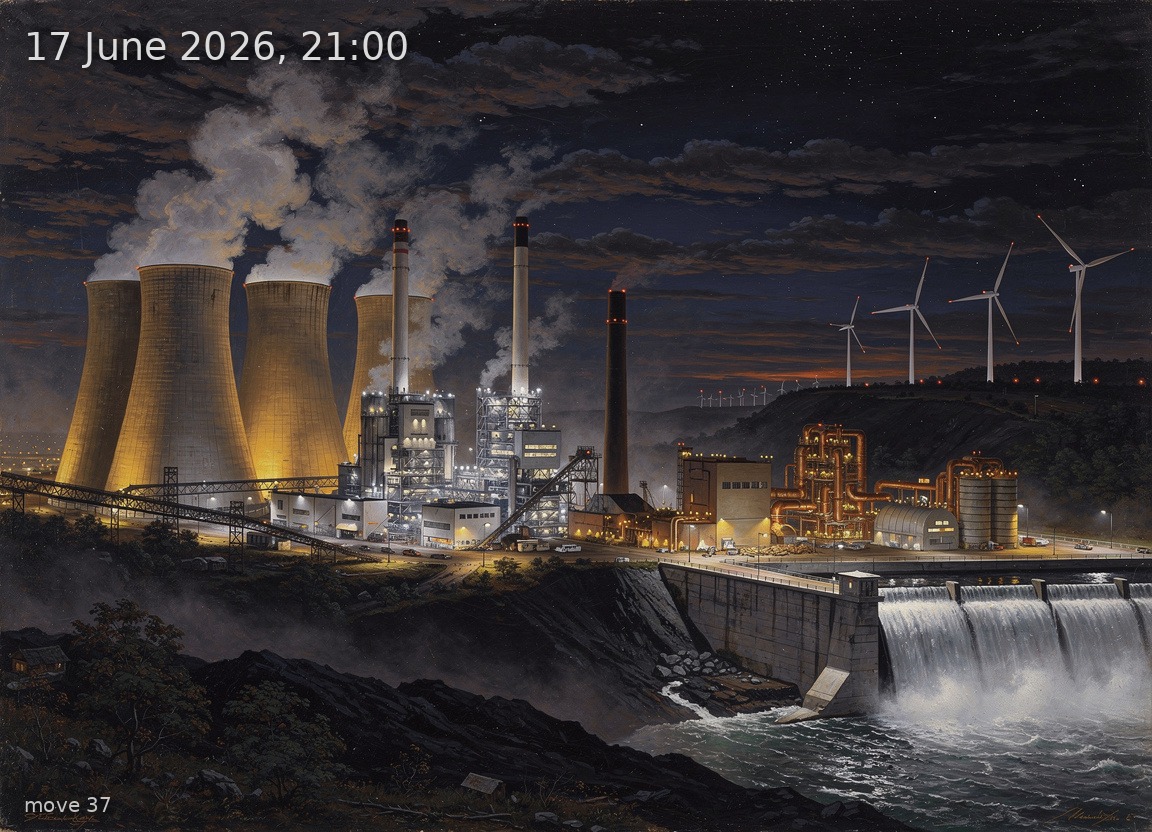
Brown coal, gas, and imports dominate as solar drops to near-zero and wind remains weak on a warm summer night.
Back
Generation mix
Wind onshore 12%
Wind offshore 10%
Solar 1%
Biomass 13%
Hydro 6%
Natural gas 23%
Hard coal 9%
Brown coal 25%
42%
Renewable share
6.8 GW
Wind (on + offshore)
0.2 GW
Solar
30.5 GW
Total generation
-24.8 GW
Net import
164.1 €/MWh
Day-ahead price
22.1°C / 5 km/h
Temp / Wind speed
Open-Meteo, Kassel (51.3°N 9.5°E)
49.0% / 7.0 W/m²
Cloud cover / Radiation
390
gCO₂/kWh
Image prompt
Brown coal 7.6 GW dominates the left third of the scene as a massive lignite power station with four hyperbolic cooling towers emitting thick white steam plumes into the night sky, their concrete surfaces lit by amber sodium floodlights; natural gas 7.1 GW occupies the centre-left as a cluster of modern CCGT units with tall slender exhaust stacks venting shimmering heat haze, lit by harsh industrial spotlights; hard coal 2.9 GW appears centre-right as a smaller coal plant with a single large chimney and conveyor belt infrastructure, glowing under yellow work lights; biomass 4.1 GW is rendered as a wood-chip-fed CHP facility with a distinctive short wide stack and illuminated fuel storage silos just right of centre; hydro 1.8 GW appears as a concrete dam with spillway in the right-centre middle ground, white floodlights reflecting off cascading water; wind onshore 3.7 GW shows as a line of five three-blade turbines on a ridge in the right background, red aviation warning lights blinking on their nacelles, blades turning very slowly in light breeze; wind offshore 3.1 GW is suggested by distant turbines on the far-right horizon with tiny red lights. The sky is completely dark — deep navy-black, no twilight, no sunset glow — it is 21:00 in mid-June, fully night. A half-clouded sky partially obscures stars. The atmosphere feels heavy and oppressive, reflecting the high electricity price: a faint industrial haze hangs low, sodium-orange light pollution reflects off steam and clouds from below. Warm summer vegetation — lush green deciduous trees and tall grass — is visible in foreground where light spills, suggesting 22°C warmth. High-voltage transmission pylons with glowing insulators stretch across the middle ground connecting the facilities, symbolising the massive import flows. Painted in the style of a highly detailed 19th-century German Romantic oil painting — rich impasto brushwork, dramatic chiaroscuro between deep shadow and industrial illumination, atmospheric depth with layered smoke and steam, meticulous engineering accuracy on every cooling tower, turbine nacelle, and exhaust stack. No text, no labels.