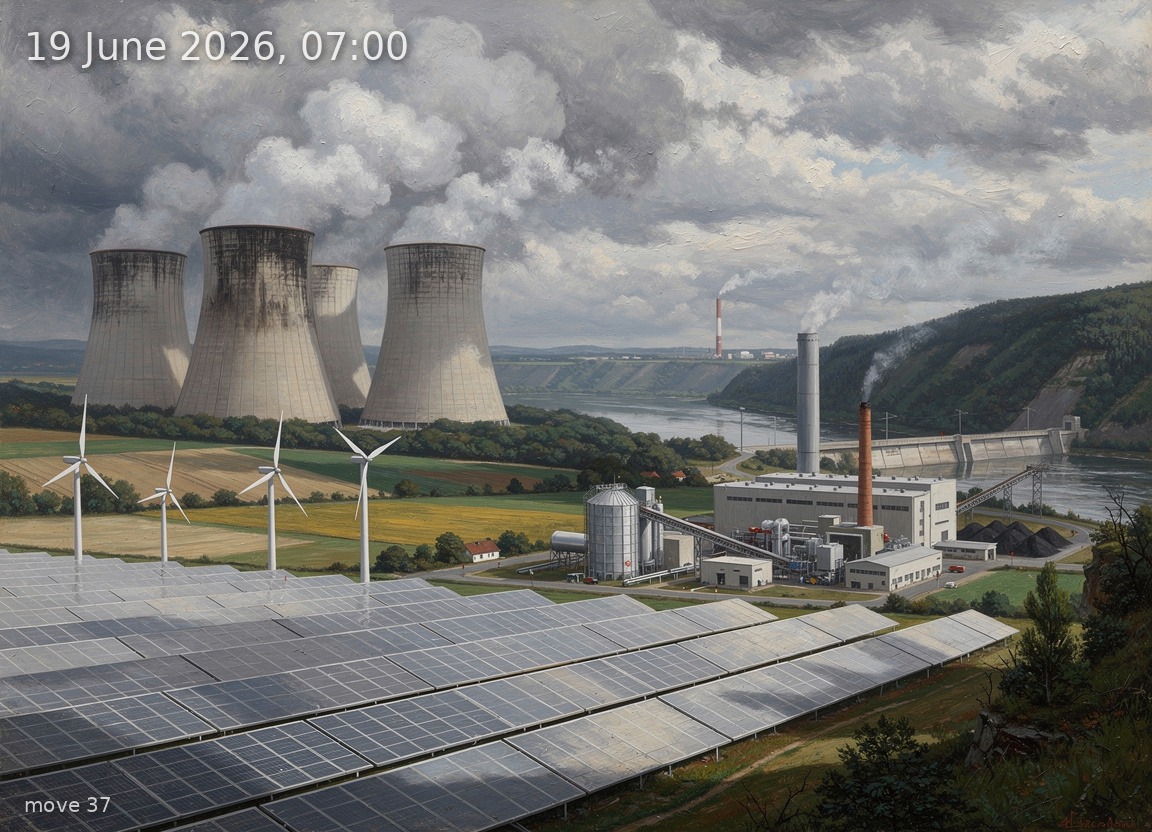
Overcast dawn: solar leads at 12.2 GW but heavy coal and gas fill gaps as Germany imports 14.7 GW.
Back
Generation mix
Wind onshore 14%
Wind offshore 2%
Solar 30%
Biomass 9%
Hydro 4%
Natural gas 15%
Hard coal 7%
Brown coal 18%
60%
Renewable share
6.5 GW
Wind (on + offshore)
12.2 GW
Solar
40.4 GW
Total generation
-14.7 GW
Net import
127.4 €/MWh
Day-ahead price
16.8°C / 3 km/h
Temp / Wind speed
Open-Meteo, Kassel (51.3°N 9.5°E)
92.0% / 16.0 W/m²
Cloud cover / Radiation
272
gCO₂/kWh
Image prompt
Solar 12.2 GW occupies the broad foreground as vast fields of aluminium-framed crystalline silicon PV panels stretching across flat farmland, their surfaces reflecting only a dull pewter gleam under heavy overcast; brown coal 7.2 GW dominates the left background as a cluster of massive hyperbolic cooling towers emitting thick white-grey steam plumes that merge with the low cloud ceiling; natural gas 6.1 GW appears centre-right as a compact CCGT power station with twin cylindrical exhaust stacks trailing thin vapour; wind onshore 5.7 GW is represented by a scattered line of three-blade turbines on gentle hills at centre-left, their rotors barely turning in the still air; biomass 3.8 GW shows as a medium-sized industrial plant with a domed wood-chip silo and a single brick chimney with faint smoke; hard coal 2.8 GW sits behind the solar fields as a conventional coal plant with a single large smokestack and conveyor belt; hydro 1.8 GW appears as a modest concrete dam on a wooded river valley at far right; wind offshore 0.8 GW is faintly visible on the distant flat horizon as tiny turbine silhouettes. The sky is early-dawn light at 07:00 in June—pale blue-grey pre-dawn glow low on the eastern horizon transitioning to heavy dark slate-grey overcast above, no direct sunshine visible, oppressive and heavy atmosphere conveying high electricity prices. The landscape is lush green summer vegetation at 16.8°C, with dewy meadows and deciduous trees in full leaf. Rendered as a highly detailed oil painting in the tradition of 19th-century German Romantic landscape painters—rich, layered colour with visible impasto brushwork, atmospheric depth and aerial perspective, luminous treatment of the cloud mass recalling Caspar David Friedrich's brooding skies—yet every piece of energy infrastructure is depicted with meticulous engineering accuracy: turbine nacelles, lattice towers, cooling tower parabolic profiles, CCGT heat-recovery units. No text, no labels.