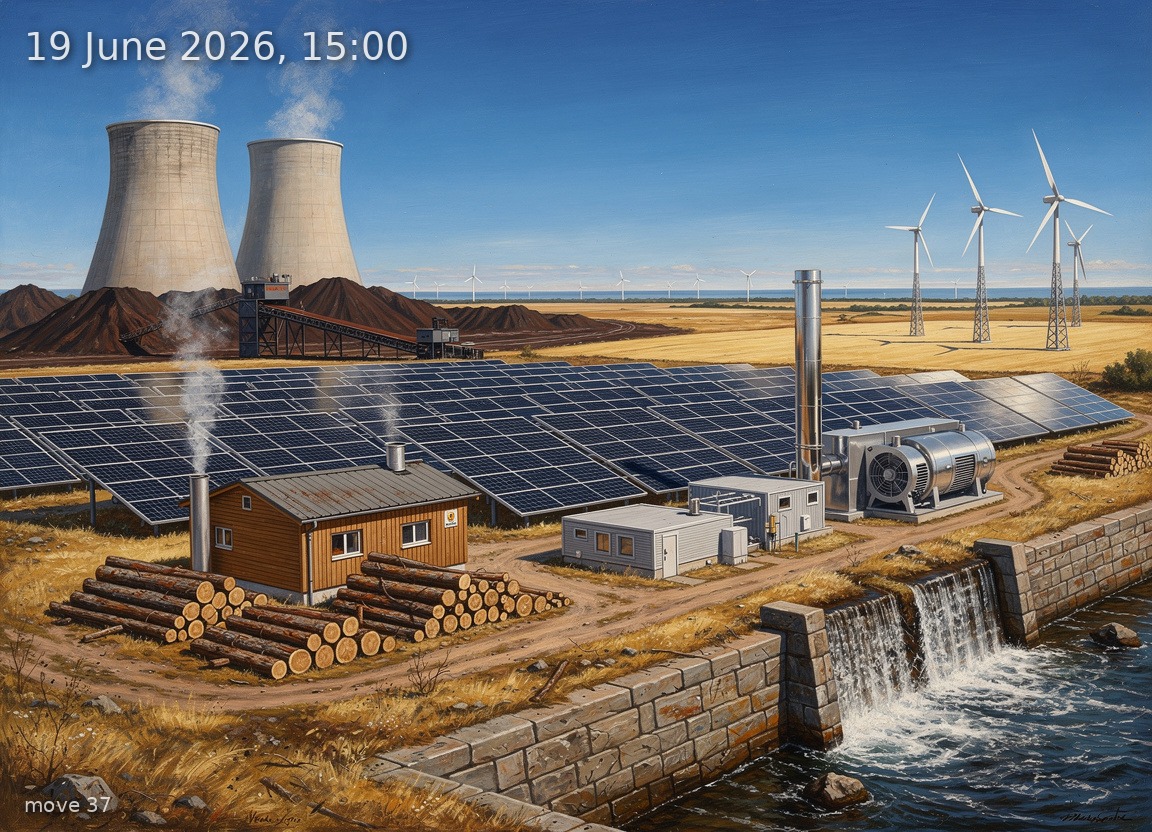
Solar at 43 GW under clear skies drives 75% of generation; minimal wind and summer heat sustain firm demand.
Back
Generation mix
Wind onshore 5%
Wind offshore 1%
Solar 75%
Biomass 6%
Hydro 3%
Natural gas 3%
Hard coal 1%
Brown coal 6%
90%
Renewable share
3.6 GW
Wind (on + offshore)
43.0 GW
Solar
57.5 GW
Total generation
+3.8 GW
Net export
42.9 €/MWh
Day-ahead price
30.8°C / 2 km/h
Temp / Wind speed
Open-Meteo, Kassel (51.3°N 9.5°E)
0.0% / 677.0 W/m²
Cloud cover / Radiation
72
gCO₂/kWh
Image prompt
Solar 43.0 GW dominates the scene as a vast central plain of crystalline silicon photovoltaic panels stretching across roughly three-quarters of the composition, their aluminium frames gleaming intensely under direct overhead sun; brown coal 3.2 GW appears at the far left as a pair of hyperbolic concrete cooling towers with thin wisps of white steam rising in the still air, beside a conveyor belt feeding raw lignite; biomass 3.4 GW sits just left of centre as a modest wood-clad power station with a cylindrical stack emitting faint pale exhaust, surrounded by stacked timber logs; natural gas 1.9 GW occupies a narrow strip as a compact CCGT plant with a single polished exhaust stack and a visible gas turbine housing; wind onshore 2.7 GW appears at the far right as a small cluster of three-blade turbines on lattice towers, their rotors nearly motionless in the dead-calm air; wind offshore 0.9 GW is suggested by distant turbines on the hazy horizon line; hydro 1.6 GW shows as a stone-walled weir and small powerhouse alongside a glinting river in the right foreground; hard coal 0.8 GW is a single industrial chimney with a dark narrow plume at the far left edge. The time is 3 PM on a scorching summer day: the sun is high and blazing in a completely cloudless cobalt-blue sky, shadows are short and sharp, heat shimmer ripples above the dark panels. The landscape is central German: rolling fields of golden-dry wheat and parched green linden trees under extreme summer heat, 30.8 °C, grass tinged yellow-brown. The atmosphere is bright and expansive, with warm golden light but not oppressive — a moderate electricity price rendered as open, luminous air. Highly detailed oil painting in the tradition of 19th-century German Romantic landscape painters — rich saturated colour, visible confident brushwork, atmospheric aerial perspective deepening toward a hazy horizon — yet every technology rendered with meticulous engineering accuracy: turbine nacelles, PV cell grids, cooling tower parabolic curves, CCGT exhaust geometry. No text, no labels.