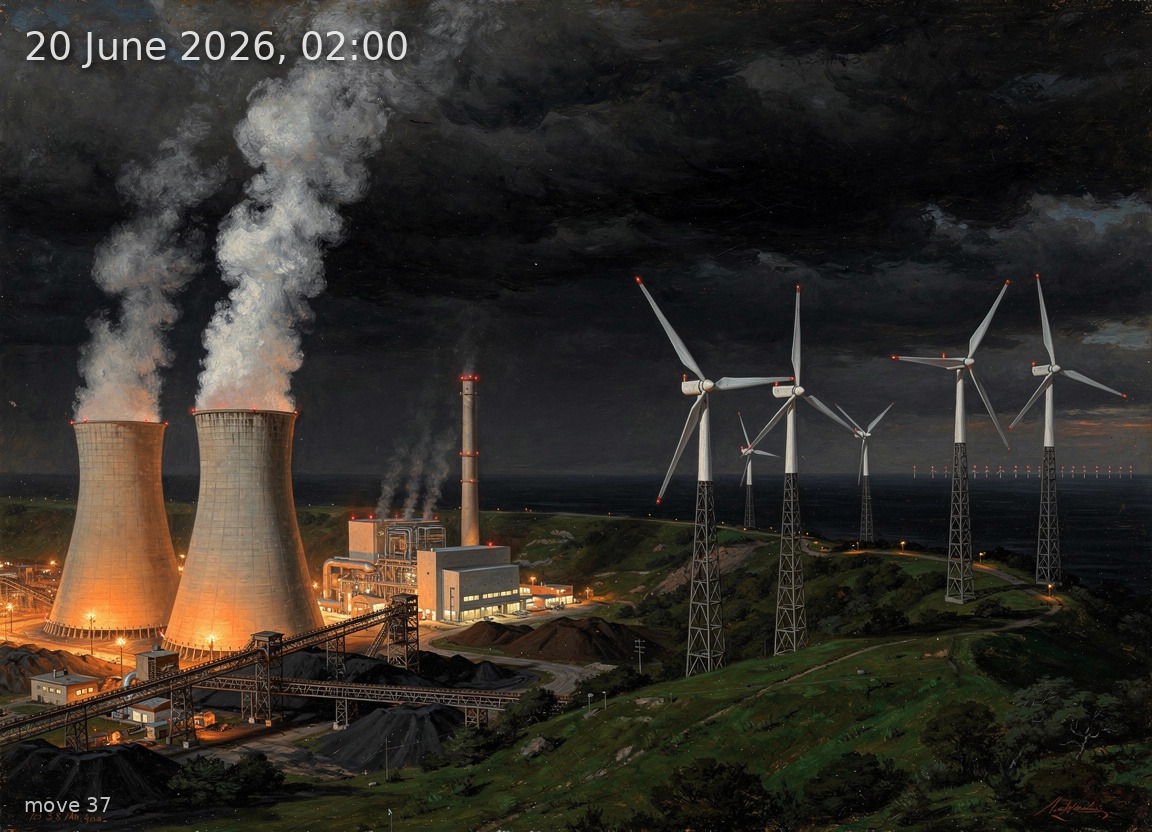
Wind leads at 11.4 GW but 8.9 GW net imports needed as nighttime demand outpaces domestic generation.
Back
Generation mix
Wind onshore 32%
Wind offshore 5%
Biomass 12%
Hydro 6%
Natural gas 18%
Hard coal 9%
Brown coal 19%
54%
Renewable share
11.4 GW
Wind (on + offshore)
0.0 GW
Solar
30.7 GW
Total generation
-8.9 GW
Net import
118.6 €/MWh
Day-ahead price
21.9°C / 16 km/h
Temp / Wind speed
Open-Meteo, Kassel (51.3°N 9.5°E)
100.0% / 0.0 W/m²
Cloud cover / Radiation
309
gCO₂/kWh
Image prompt
Wind onshore 9.8 GW dominates the right half of the scene as dozens of tall three-blade turbines on lattice towers, rotors spinning briskly in moderate wind, spread across rolling green hills; wind offshore 1.6 GW appears as a small cluster of turbines on the far-right horizon over a distant dark sea. Brown coal 5.8 GW occupies the left foreground as three massive hyperbolic cooling towers emitting thick white steam plumes, with conveyor belts and lignite stockpiles visible at their base. Natural gas 5.5 GW fills the left-centre as two compact CCGT power blocks with tall single exhaust stacks releasing thin heat shimmer. Hard coal 2.7 GW appears as a single smaller coal plant with a rectangular boiler house and chimney behind the gas units. Biomass 3.5 GW is rendered as two medium-sized industrial facilities with cylindrical digesters and wood-chip silos in the centre of the composition. Hydro 1.7 GW is shown as a concrete dam with a reservoir in a valley in the centre-left middle distance. The time is 2:00 AM on a warm June night: the sky is completely black with total 100% cloud cover, no stars, no moon, no twilight glow whatsoever — a dense, oppressive overcast ceiling pressing down. All structures are lit only by sodium-orange industrial lighting, glowing control-room windows, and red aviation warning lights atop the turbine nacelles and chimney tips. The landscape is lush summer vegetation — dark green deciduous trees and tall grass barely visible in the artificial light. The warm 22°C air carries a humid haze around the cooling tower plumes. The atmosphere is heavy and oppressive, reflecting the high electricity price — a brooding, weighty industrial darkness. Highly detailed oil painting in the tradition of 19th-century German Romantic landscape painters such as Caspar David Friedrich and Carl Blechen — rich, deep colour palette of blacks, dark greens, warm oranges, and ghostly steam whites, visible impasto brushwork, dramatic chiaroscuro, atmospheric depth receding into murky distance. Each energy technology rendered with meticulous engineering accuracy: three-blade rotor profiles, nacelle housings, hyperbolic concrete cooling tower geometry, CCGT exhaust stack proportions. No text, no labels.